
I’ve written before about marking, but just to summarise: it has always been something I’ve loved doing. There was something in that Boxer-like satisfaction of ploughing through an unending pile of books, leaving lovingly crafted comments in an array of coloured pens and stickers that just looked like it would work so well. How could pupils fail to make progress when I’d spent so many hours on them?
So something I was nervous about when starting at Michaela was their approach to marking; that is, don’t do it. I’d read Joe Kirby’s blog and spoken to him at length, but remained steadfastly concerned that marking worked – if you ensured pupils
acted on feedback. I then moved to the idea that marking worked, but at what cost – a teacher with six or ten classes cannot be expected to give the detailed feedback the lightly-timetabled members of SLT seem to manage on a weekly basis.
In my second week at Michaela, we had a department meeting where Joe brought up the excellent question: it’s great for workload that we don’t mark, but how do we make sure we’re giving feedback to make pupils’ writing better?
One of the main reasons I think I find marking helpful is because it holds me accountable – I am actually reading if I am putting a pen to paper to say something about it. (I annotate the books I read in the same way – it helps me to remain focused.) But while this is an essential strategy when it is 7am on a Saturday, pre-intervention, and you want to clear the last 20 books to enjoy a semblance of a weekend when you return home that afternoon, or 9pm on a Wednesday when you just want to sleep, actually, I had underestimated my ability to focus.
To begin with at Michaela, I couldn’t get out of the habit of marking. I would spend two hours with about 60 books, circling and underlining when I couldn’t resist; writing limitless notes to share with the class, photocopying paragraphs to get pupils to annotate their peers’ examples. Joe’s comments on this kind of feedback were: ‘would you want all teachers to be photocopying twice or three times a week? Is it worth the time getting the pupils to annotate a piece of paper they are then just throwing away? What else could you be doing with that time?’ Moreover, I was reminded of why marking is not always the best method – if I’d put the merest hint of a mark on a child’s book, their hands shot in the air: ‘why is this circled?’ ‘I can’t read your writing on this spelling correction.’ ‘Why is there a question mark here?’ Marking breeds over-reliance on the teacher.
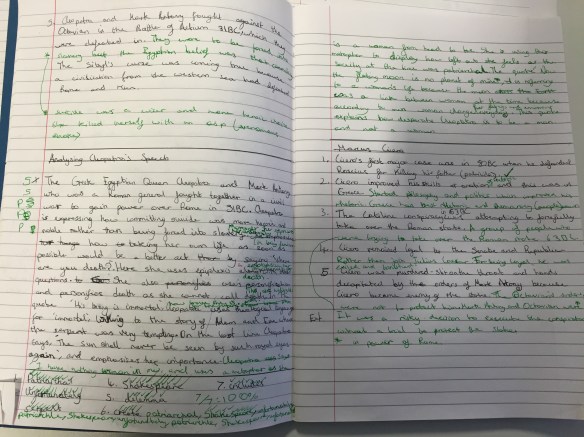
Now, I’m getting into the swing of the Michaela way. I read my pupils’ books once or twice a week. I teach four classes, each with between 28 and 32 pupils, so it is about 120 books in all. I read 60 books in 30 minutes. As I read, I make notes: spellings lots are getting wrong, things they’re all doing well at, and the main issues they need to improve. I note down anyone whose paragraph is amazing to reward with merits or show the class; I note down anyone whose work is messy to give a demerit to. It looks something like this:

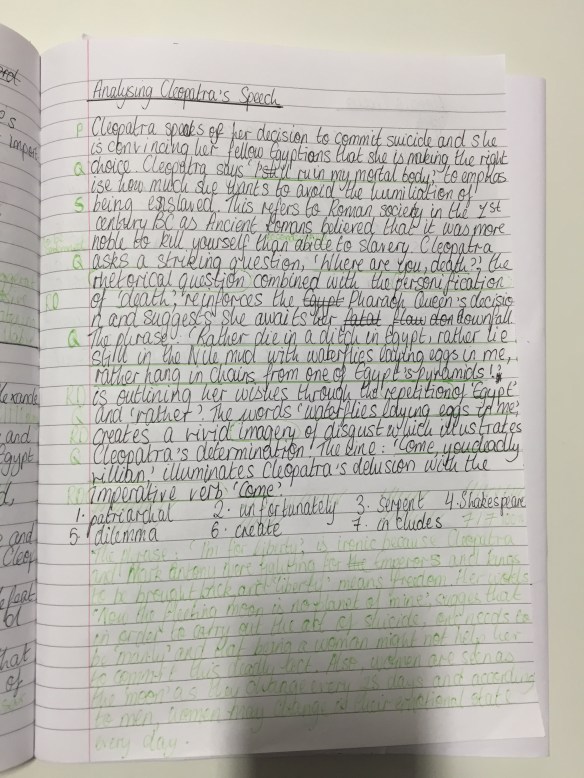
In the following lesson, I teach the spellings from the front, and then test pupils. They will write their corrections out in green pen, interleaving the ones they got wrong, or the ‘toughest three’ if they managed, on this occasion, to score 100%. I’ll test them again the following day. I’ll share the positive things I found and celebrate the star paragraphs, and then explain carefully, perhaps modelling on the board (as Katie Ashford has described brilliantly here or occasionally putting a great paragraph from the class under the visualiser, how they can all improve their own paragraphs. And then they improve them, in green pen. It looks like this:
![FullSizeRender[1]](https://readingallthebooks.com/wp-content/uploads/2016/03/fullsizerender11.jpg?w=584)
The second powerful tool is in-class feedback. With an excellent behaviour system, silent writing for 25 minutes means I can see every child’s paragraph twice while circulating, giving them suggestions and tweaks while they write. On my colleague Lucy Newman’s suggestion, I’ve also started using my visualiser more. This way, we can take a pupil’s book, display it to the class, and show pupils how to edit their mistakes in that very lesson, just by giving oral feedback on the common errors they are making, or the aspects they really need to focus on improving.
The thing is, what makes the difference in their writing is the quality of the feedback and how timely it is. They don’t need feedback on a paragraph they wrote two weeks ago. At Michaela, they can improve the paragraph they wrote yesterday, while it is fresh in their minds. I miss marking, I do. But I’m realising I did it for me, not for the pupils.
 Reading all the Books
Pingback: A guide to this blog | Reading all the Books
Really useful run through of how your principles operate in practice – thanks very much for sharing!
LikeLike
Thank you for sharing. I like the change of focus…to the kids not you. I use my visualiser every day now modelling writing,analysing poems, showing work of students and find because it’s ‘real’ the kids are happier to share theirs to the class too. I only mark their independent work now because what they’ve copied from the board isnt ‘their’ work. I have introduced feedback Friday’s. ..A review of their weekly work completed or changes required to homework with focused questions to guide them followed by 30 minutes reading.
LikeLike
Hi jo
Is this an approach used in all subjects or just English? I am guessing it is school wide but just checking. I am a head of history and the amount of marking is always a challenge under my schools pretty reasonable marking policy so this is intriguing. Thanks.
LikeLike
This is a school-wide policy!
LikeLike
Pingback: Focusing our Teaching and Learning Priorities: A reading list. | headguruteacher
Really want to try something like this in primary. I wonder how young we could take it? Will have to experiment. What to the G, S and Q in the margin mean?
LikeLike
We teach pupils to include different elements in their paragraphs – so here it was SPQR or society, purpose, quotations, rhetoric. They then mark where they think they have included them!
LikeLike
Thanks- that’s helpful.
LikeLike
Hello. Interesting read thanks.
Could I ask if you know how this works in the maths department please?
LikeLike
You’ll have to get in touch with Bodil Isaksen, but as a school we do not mark – in Maths I think they work a lot with mini-whiteboards and again lots of circulation and peer-marking with their answers, but sure Bodil will have a more comprehensive answer!
LikeLike
Thanks. Are you able to give a contact link for them please?
LikeLike
Bodil Isaksen is at Twitter @bodiluk, or blog.bodil.co.uk
LikeLiked by 1 person
How could I apply this to university level where I can have multiple classes of 80 students? Sounds interesting.
LikeLike
Same thing perhaps? I find having something concrete helps – have you included at least 7 short quotations? So set the parameters at University level and have them count up what they have/have not included perhaps? And again, general feedback will be more useful, or photocopying the best essay and explaining what makes it so brilliant, and what that person could also improve. Quality of examples over time is key!
LikeLike
Hi, like @reflectivemaths I’d be very interested to know if/how this works in maths.
LikeLike
This was awesome – thanks for sharing! I’m an American soon-to-be certified high school English teacher and I too use composition books and free-write assignments. At first, I read the books and made no markings at all. I needed students to get comfortable just letting words flow. Now that that’s happening, I was wondering how best to approach giving feedback. I love the use of the green pen! Question: Since you’re not reading books every day anymore, do you stick to a particular day for in-class feedback around spelling and modeling excellent responses? Thanks so much!
LikeLike
I actually don’t – it takes me so little time to read their paragraphs I can do it when I need to. It helps me be really responsive to them as time demands. If I were pushed for time, I would do a sample of 10 random books I think and use that to formulate general feedback.
LikeLike
Pingback: Focusing our Teaching and Learning Priorities: A reading list. | Kesgrave High School
Reblogged this on The Echo Chamber.
LikeLike
Pingback: Let’s fix Marking | mhorley
Pingback: Term 1 at Michaela: what have I learned? | Reading all the Books
Thought this was great. Thanks for sharing, we are already trying it
LikeLike
I like this – I’ve just had a go with a set of 30 y11 poetry paragraphs and it took less than 15 mins. But how do you then know that they have actually improved their work? Do you ever grade/ put comments on their work?
LikeLike
Hi Jo,
Please could you let me know how this is done at your school in MFL lessons. Great idea and would love to see how it can be adapted for us in MFL.
LikeLike
This article has given me food for thought. I wish to buy a visualiser any recommendations?
LikeLike
Pingback: Using exit tickets to assess and plan: ‘The tuning fork of teaching’ | Improving Teaching
Pingback: Whole class marking | MrHistoire.com
Pingback: A Michaela Feedback Lesson | Reading all the Books
Pingback: Feedback with no marking? | Kesgrave High School
Pingback: Disillusionment in Schools – The World Is Maths
Pingback: We Have Overcomplicated Teaching: Research Ed 2016 | Reading all the Books
Pingback: Whole-class marking: KS4 mock exam | NDHS Blog Spot
Pingback: Rethinking marking and feedback. It’s all about the response. | headguruteacher
Pingback: Marking is shit | MrHistoire.com
Pingback: Imitating the Action of the Tiger – Unto the Breach
Pingback: Wading into the debate on ‘that’ UK school | mrslexicon
Pingback: Reducing Workload Part 2: Policy vs. Autonomy | mrbunkeredu
Pingback: The Blogosphere in 2016: Roaring Tigers, Hidden Dragons | Pragmatic Education
Pingback: A beginner’s guide to inset days | Teaching Newbie
Pingback: 20th January – Bluecoat Maths
This is exactly how I mark. Great to see a school make it easier for their teachers. I only write in the books to tick the box of “evidence”. The students get far more this way. I’ve just recently found your blog. I definitely don’t agree about everything but I agree with a lot and I find it all interesting. Thank you for sharing.
LikeLike
Pingback: Teaching English at Michaela | Reading all the Books
Pingback: On valuable feedback that supports teacher wellbeing | the learning profession
I’m all for making more effective use of my time and increasing the impact of my feedback to pupils. Over the past year, I’ve been using an adapted ‘markingcribsheet’ from @MrThorntonTeach which seems to be a similar approach. It works for my Senior MFL classes, not sure how it would work with my Junior classes as we’re a school with a high proportion of pupils with literacy and/or learning needs so I feel I do still need to mark their books. If I’m honest, I do still mark their extended writing. I’m not sure they would pick up all the various types of errors in their work. I do find a whole class sheet is helpful to highlight common +/- points. Good to see and consider different approaches from different schools.
LikeLike
Pingback: Leading the Research Led English Faculty – Reflecting and Refining
Pingback: Ten teaching techniques to practise – deliberately. | teacherhead
My previous infant school, which has over 70% of children in the bottom 2 categories of ACORN data, worked on similar principles. Teachers didn’t make a mark on children’s work. When we had Ofsted the lead inspector was, initially, sceptical. However, when he saw the systems we had in place, such as very structured guided sessions, child created targets, detailed formative assessment booklets and the way teachers guided children’s self assessment he went away with a different perspective. The school was judged Outstanding and the inspector went home to rethink a talk he was giving about marking for trainee teachers.
I am now deputy in a primary school; a very strict and time consuming marking policy, with no differentiation for age or stage, was introduced last year. I find extremely frustrating when teaching the younger children. If a teacher is writing more than the child, and the child can’t read it independently, we have to ask who we are doing it for? When teaching nursery last year I drew the line at introducing and marking writing and maths books and getting the children to correct with a green pen. Consequently, I was moved to KS1 this year and nursery now have books!
LikeLike
Pingback: Assessment in a Knowledge Curriculum | Reading all the Books
Pingback: Getting Better at Feedback – Hannah Tyreman
Pingback: Video feedback: an efficient solution? | An act of communication
Thank you. How do you check that what they then write in green pen is actually an improvement?
LikeLike
Pingback: Giving feedback the ‘Michaela’ way | Reading all the Books | David Parkin
Pingback: Towards an Assessment Paradigm Shift | teacherhead
Pingback: Kesgrave High School
Pingback: On using marking codes for VCE English essays – At the quiet limit of the world
Pingback: Feedback and English mocks | The Wing to Heaven
I like whole class feedback and responding to whole class issues. How does your spelling activity work with the children who can spell though? (Do they have a separate task at that point?)
LikeLike