What we say to our students

I’ve been thinking a lot this week about what we say to our students, and what that says about us.

I’ve spent a good deal of this year encouraging Year 11, as a cohort, in assemblies, classrooms and corridors. But it occurred to me recently that they might not see my words as “encouragement.”

John Tomsett’s excellent blog here made me wonder how year 11 heard me. Did they hear my words as encouraging – “we’re putting on extra revision sessions for you”, “we’re looking at your coursework and we want to help you improve it”, “your speaking and listening exams are over the next couple of months” – or was I actually berating them?

All year, teachers and SLT have reported that the year 11s are feeling “stressed.” For most of the year, I was fairly dismissive of this – after all, it’s year 11. It’s not going to be a cakewalk. They just needed to work harder.

This week, like all weeks, I looked at the data. Instead of being terrified about the 35 or so students who aren’t on track, I decided to look in a “glass half full” manner this term. John Tomsett in the post above wisely says:

“It’s pointless berating Year 11 at this stage, just love them instead. The die is largely cast by now and what they attain in their GCSEs this summer will not be improved by relentlessly getting on their case. Make them feel special and trusted and they might just find a little more enthusiasm for their revision over the next couple of weeks.”

I’ve tried to take this to heart.  Each time I’ve spoken to the year group this term, I have emphasized how positive their position is. On Friday, after a long few weeks of moderation, I told the year group something along these lines: “I’ve looked at all your coursework. It’s brilliant. I’ve looked at your speaking and listening exam results. They’re brilliant. You don’t need to do anything different to achieve amazing grades – just keep doing what you’re doing.” Before, I wanted them to be afraid. I now wonder if this is counter-productive, and has actually made them reject work.

And it’s not just year 11. Students come to school with all kinds of preconceptions; the number this year who have referred me to the received wisdom that “some people are just naturally smart” has made me feel incredibly depressed. I’ve worked hard with my own classes to emphasise effort; one of my happiest moments this year came at an Easter revision session (where targeted students across the year group were invited) when one of my students replied to a student who said the above aphorism by finishing my sentence: “It’s not how smart you are-” “It’s how hard you work!” I’ve had a year 7 say she doesn’t try because she “always gets it wrong”; trying to explain that failing is learning is taking time, but it is valuable to have that conversation every time, I think.

Of course, the caveats placed on “teacher talk” can seem endlessly numerous: never say: “brilliant!” without qualifying your praise; never talk about “work” (it is “learning”); never say a child is a level (they are “working at level…”); say thank you instead of please to encourage compliance with instructions…

I automatically bristle at such rules. They seem to discount the fact that students and teachers are people, who use language to communicate. The over-analysis of tiny words seems like mindless minutiae.

But then there are the students who pick up on our un-thought-out words. In my first year as a teacher, it was not long before I was met with the phrase familiar to all teachers: “you hate me, don’t you?”

Now, I’m one of these method-actor teachers. I’m an open book, and find it impossible to lie or fake an emotion or response. I have to love all students, because if I didn’t, I just couldn’t teach them. I’m also of the firm belief that all children have something lovable in them; something great – if only great potential. So I could face the student in question and quite honestly tell her: “of course I don’t hate you.”

We’re an emotionally oppressed profession, because we can’t tell students we love them, even though we do, and even though we freely tell our friends (every teacher I know has used the L-word about their students).

I know a teacher who bends over backwards for her class; who is in school before 7am and out of school after 6pm; who comes in on Saturdays to work with almost many of her targeted students. And yet one of her students, who I also teach and about whom we have frequent chats of our concerns, believes this teacher hates her. Nothing could be further from the truth. I won’t pretend every teacher loves every single student, but I don’t believe any teacher truly hates any student.

So, above all, I think we have to communicate that love to our students. In short, my resolution for this term, the most difficult term, is to strive to communicate the love I have for my students to my students. Let none say: “Ms Facer hates me.” I don’t. I really, really don’t.


Cambridge, Kings and Changing my Teaching

“I enjoyed the trip very much and it made me sure of wanting to study English at university and that Cambridge would be an amazing place to do this.”

Year 12 student

My year 12 are undeniably a fantastic class. High achieving on entry, they have exceeded expectations this year in terms of the quality of their coursework. I’m certainly not discounting the mountain of work they still need to do to ace their exam in May, but each and every one of them has astonishing potential. And it is becoming more and more apparent that some would like to take English further, for which I am forever grateful. Much of this is down to two incredible universities who have opened their doors to us.

Back in September, in the early heady days of my new post , I contacted what seemed like every London university, explaining I wanted to build links between our sixth formers and a “local” university. Our year 12 are the first in our school to take English Literature A-level, so the time seemed ripe for new beginnings. Many did not respond. Those who did often offered specific days, often entirely unrelated to the course my year 12s are studying, and often at inconvenient times – as a consortium sixth form, it’s almost impossible to take students out of their other lessons (as perhaps it should be, always).

Conversely, two universities have offered numerous opportunities, but have also been open to helping us out in our particular circumstance. They have listened to what our students need and engaged with us on our terms. I am hopeful of a lasting relationship with each.

cambridge river

And the lecturers. Their astonishing knowledge, charisma and humility, as well as humour, was thoughtfully matched to sixth form students’ interests and levels. I was reminded of the very best of what I experienced at University, and found myself in the lovely position of learning alongside my lovely children.

On our trip to Cambridge University on 20th March, we learned how to make a successful application, and what subjects would be useful to do at A-level when applying to do an English degree. Also, we were taught what it would be like to do English at Cambridge. Finally, we were given an English lecture at University level focused on the philosophical question of: “How soon is now?” We looked at several different examples in poems, in the novel “To The Lighthouse” by Virginia Woolf and in the play “That Time” by Samuel Beckett.

Year 12 student

The following Monday, an incredible and generous lecturer from King’s College London relieved me of my duties and came in to teach my year 12 double lesson. I had previously explained to her that the students had been doing coursework, and they were now moving onto the exam. Could she perhaps do a session on Gatsby and narrative?

No powerpoint, no card sorts, no drama; a lengthy handout and some bullet points on a piece of paper had the students entranced. The angle the lecturer took, her questioning and her planning made me feel these short hours had given my 21 students a massive advantage over anyone else taking the exam who was not in that session. Oh, to be such a teacher!

In the frantic movement of everyday life in school, it is hard to find the kind of peace and tranquility necessary to reflect and create. I know that if I slowed down my lessons would be more thoughtful; too often, these days, I cling to success criteria and exam specifications in order to ensure my students know what they “need” to know. This is not enough.

I am going to aim to bring in some University when I plan. To think beyond the rubric. Not just: what do my students need to know? But: what is the most intellectually interesting way we can explore this?

I’ve often maintained that we should all be always learning, but perhaps it is time for me to go back to school with English. It feels like it has been a long time since I have learned anything new about English, and I was reminded last week that the world of the academic moves, at times at least, in a surprisingly sprightly fashion. There are a raft of post-graduate and short course prospectuses piled up by the door, hastily ordered following my recent experiences, and perhaps one of these holds the key to a wiser teacher.

We can always improve, and it is foolish to imagine there could be such a thing as a zenith of teaching practice. These two weeks in particular I have come face to face with greatness, and I’m falling short. I need to know more, so I will read more; I need to do more and plan more and question more and become better at what I do so the children that learn with me can know more, and go further.

But in the meantime, if I can expose my students to these kinds of opportunities, and inspire them to aim for the best they can achieve, I can take some comfort at least.

cambridge logo

Professional distance and politics

In this week’s “Tough Young Teachers”, one of the trainees talks about professional distance, mentioning he’s not a father/brother/uncle, but a teacher. Sure, the lesson of his week seemed to be that letting his guard down a bit led to big gains with a hard-to-reach student; but most teachers will agree with the dictum of professional distance.

It’s not that I’ve ever fiercely guarded my private life, but if it doesn’t come up at a time when learning is not happening (and without a tutor group, it doesn’t tend to) I won’t mention it. This week, one student asked me during break if I was a nun, which interested me, but was possibly more to do with my below-the-knee skirt than anything else.

Also, there is the legalese on political balance to be aware of – you can’t fly a particular political flag in your classroom; you must introduce balance. These are impressionable young minds, after all. 

Over the years, I’ve shied away from politics and political statements more and more. I think this is mostly down to my personal preference to be inoffensive to others, as well as my general ennui with the political game.

Increasingly, I’m starting to wonder if this is an acceptable approach.

A couple of years ago, one of my oldest and dearest friends asked me to go to see a film with wadjdaher that she had free tickets for called “Wadjda.” I agreed, mostly because time with her is golddust (she spins many plates) and I wanted to catch up. It came as a genuine surprise to me that this film was scheduled on Internetional Women’s Day, mostly because I didn’t have an awareness of when that day was. Before the film, we chatted, among other things, about “feminism” and both agreed that 1. We weren’t feminists and 2. We thought feminism was a bit outdated.

After the film, we were both put firmly in our privileged places by the media before us. Luckily for us, we live in the UK, where a woman’s freedom is equal to a man’s; a woman’s legal rights are equal, access to education is equal, and the right to work and generally live unfettered lives of choice are equal. My ignorance of the experience of the rest of the world was poorly showcased as I watched open-mouthed at a little girl who was not allowed to ride a bike in public, in a film set not in the dim and distant past, but today, right now, in a different part of the world.

And then I sort of got on with my life.

Somewhere along the way, I found myself reading Caitlin Moran’s “How to Be a Woman”, which is hilarious and brilliantly written. I nodded along to everything she said, while simultaneously recognising that, actually, I conform to many of the expectations society unfairly has of women (example: I do things men do not, such as wear make-up: Moran tells us we need to ask one central question to see if something is fair or not, and that is “are the men doing it?”).

And then, again, I got on with my life.

But misrepresentations of women are all around us, and accepting this and buying into this is undeniably damaging for the future generation – this future generation, part of whom I happen to teach, working, as I do, in a girls’ school.

Working in my second girls’ school was definitely unplanned. Although I loved my first, I sought to broaden my experience by joining a mixed school. And although I was offered a great job in just such a school, I happened to fall in love with my current one on interview day, and here I am.

I have always maintained, however, that segregation of schooling for any reason (money, faith, gender) is wrong. I’ve maintained this very, very quietly, because I really hate disagreeing with people. I’m also a terrible debater, so I’d rather write my views here and run away. I can’t hold my own in an argument. I start smiling and nodding too soon.

My belief that gender segregation of schooling is unfair stemmed from research I encountered early on in my career that, while girls do just as well in single sex schools as in mixed schools, boys don’t. By this, of course, I mean exam results. So there are a whole lot of boys out there who aren’t getting as good of a deal as the girls I am lucky enough to teach.

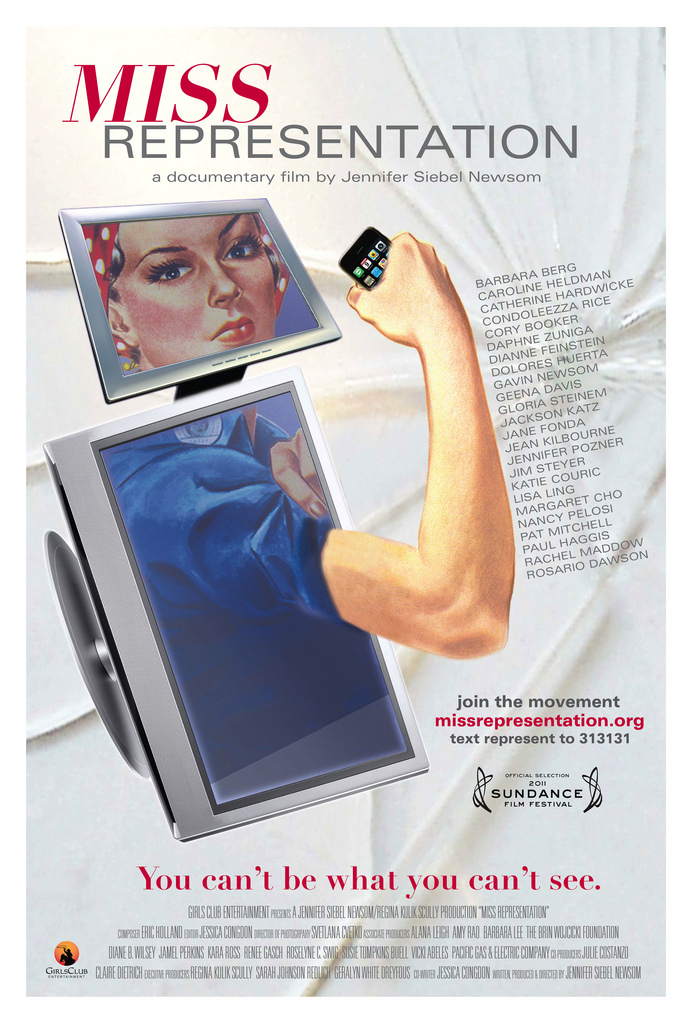
Miss_Representation_(2011)The film “Miss Representation” has put me firmly in my place on that. Because actually education is not just about exam results. So the boys don’t do as well in their GCSEs? They go on to dominate the media and society as a whole in every conceivable way.

I visited a school in my first year of teaching with a heavy boy bias, due to being flanked by several girls’ schools in the surrounding area. While there, a colleague informed me that the girls had a big problem with “self respect”: they would let boys talk to them inappropriately, and even touch them inappropriately, many of them falling in line with the expectations of women the media had of them. I sat in on a wonderful assembly, where the girls were gathered and shown this Dove ad. They were spoken to about their potential, and the role they should be looking to play in society.

In “Miss Representation”, the media’s bias is laid bare, with advertising, tabloid journalism, music videos, news broadcasting and politics all explored to mine the cultural implications for women. Watching this, I found myself thinking about the students I teach, and the amount who can become very passionate and articulate about why they should be allowed to wear make-up to school, but don’t seem to have an awareness of why they, as females, are expected to wear this make-up while men are not.

I’m wary that banging a feminist drum will alienate people, but perhaps I need to be a better role model for the students I teach. It’s really hard to get some students to buy into education, but what if they knew the world they would enter into would be one where their voices would be always judged in accordance with their looks? Might they better see the link to be made between an education and redressing the balance?

These are impressionable young minds. I’m in a privileged position to be leading them. I think it needs to get political.

Dr Byrne and what makes great English teachers

Last July I came to the end of my time in my first school, working as a full-time English teacher. The school was, in a word, amazing; my contribution to that amazing-ness was undeniably minimal. Yet I was blown away by the beautiful cards my kids and colleagues wrote. This highly emotional transition made me think about teaching English, and why we do it, and who we remember, and I wrote this post in the immediate aftermath of that high emotion.

In my own education, I had a few great English teachers. I was blessed to work in a school with exceptionally minimal staff turnover, meaning I had three English teachers in my time.

First, Mr. Hopper. He was my form tutor as well as teaching me History and English for two years. I had never had a teacher as brilliant: he seemed to know everything, and commanded his class with the discipline of a seasoned professional. I remember in my first week going home to my Mum and telling her: “I want to be an English and History teacher.” To this day I remember individual lessons he taught – he defied expectations of the “experienced teacher” by being incredibly energetic and having fantastically engaging and student-led lessons. He definitely made learning fun, but also set incredibly high standards: I moved to that school from a less “high expectations” environment and remember Mr. Hopper killing me with my first graded piece of work – a C. He made me work harder than I had believed possible.

When I moved on to upper school, I had Mrs. Grinham. The main things we loved about Mrs. Grinham, in no particular order, were: her amazing dress sense, her perfectly cut bob, her stories about her children and grandchildren, her stories about knitting, her stories about baking, her stories about the Jane Austen society, her stories about university. Myself and my female peer group all aspired to be Mrs. Grinham. She sat behind her desk and talked to us about great literature, like the authors and characters were her friends. She also seemed to know everything about everything, and I’m delighted that she taught me at A-level as well as in year 9.

In year 10 to year 13, I was taught by a master teacher. His name, as pretty much all of my current students (and friends) could tell you, is Dr. Byrne. Dr. Byrne, not only seemed to know everything about everything, but actually did. His vocabulary was astonishing. He conducted all his lessons socratically, and never had I been challenged to think and work as hard as I did in those lessons. His questioning was simply incredible. I returned to my old school about five years ago, when I first thought about being a full-time teacher, and when I “observed” Dr. Byrne again I forgot to write any notes about classroom management or pedagogy – I simply took notes on Chaucer, which is what he happened to be teaching at that time.

Dr. Byrne not only taught me in lessons, he also opened up the wide world of literature for me. I am embarrassed to say that I wasn’t a big reader before he taught me. Dr. Byrne told me to keep a log of every book I read, perhaps sensing my competitive edge; I wanted badly for that log-book to be full quickly. (I still keep that list to this day, now fully digitised via googledocs.) That was only the beginning, however. Dr. Byrne used to physically give books to me – the best way of engaging a reluctant reader. I simply hadn’t heard of these authors before, and became transformed into a “reader” almost immediately. When it came to me applying to University, Dr. Byrne gave up a lunch break every week (maybe even more) to tutor me one-to-one in literature, pushing me when looking at poetry to come to conclusions and interpretations under pressure.

I know I’m not the only one deeply affected by Dr. Byrne. All of my school friends still talk about him and what he taught them.

I remember one of my fellow students, however, mentioning that: “for set one, we didn’t get very many A*s”, which was interesting – I hadn’t really explored beyond my own GCSE grade at the time. Perhaps she was right. But even if she was…

This conversation prompted me to think about what teaching English really means. Are we desperately looking for data? School league tables and Ofsted are certainly pushing departments in that direction. One of my colleagues summarized this data-drive nicely: “if they can’t measure it, they don’t see it.” This rings depressingly true.

What Dr. Byrne taught me was definitively not how to achieve an A* in English. Nor did Mrs. Grinham, nor did Mr. Hopper. I was taught how to think, how to analyse, how to interpret, how to challenge, and most of all how to read and love reading. English was always the high-point of my day, and I am grateful now that all I do all day is English, just on the other side.

When I spend lesson time talking to students about books I am reading, or they are reading, that are not on the syllabus, should I feel guilty? Have I wasted a precious moment of their time when they could have perfected their sentence boundaries? I will admit, I frequently bang on about grades with my students – I do talk to them about As and A*s (though I try to not talk about C grades, even with lower sets, as experience has taught me they are almost always capable of more). I sort of wish I did that less. What I am aiming for is for my students to love English, not to love success.

In my last ever lesson in July with my beloved year 9 set 5, I indulged in some non-teaching. We chatted a lot. Some students didn’t choose to chat, but I adored that they took out their personal reading books and read. I love that they enjoyed reading for the sake of reading. I really hope that in the future the bright stars I have left will remember me for more than just getting them high levels, or convincing them they could achieve high grades.

So where is this rambling post going? I’m thinking about the teachers who have formed me, both past and present. My mentor of three years, Ms Moran, now an insanely amazing director of English in a new school too, has definitely made me the teacher I am today. Dr. Byrne has probably done more than anyone to make me the person I am today.

One of those (many) amazing leaving moments came when one of my year 12s told me “you know you always talk about Dr. Byrne? You’re our Dr. Byrne.” I know I’m a long way from that, but it killed me (in a Salinger-positive way) to be told that. Dr. Byrne, I am still inspired by you and I hope one day I can make the above statement a more profound truth.

What do I do with the scary smart ones?

A member of SLT I greatly admire told me recently “I don’t like labels.” I think I had forgotten you were allowed to say that in a school. We have so very many labels for our sausages (another member of SLT described the kiddies thus – another thing I had forgotten we were allowed to say): SEN, EAL, FSM… At what level are there just “kids in my classroom who are all a bit different”?

In our age of advanced data awareness, we are encouraged to not only differentiate, but to do so for the target groups du jour, and in many schools G&T, AG&T, or GTP (gifted and talented, able gifted and talented, gifted and talented pupils – love a good acronym, do teachers) are a box to tick. I know of one school where these students are given gold badges to wear, undeniably a source of pride for them (and a key visual clue for their teachers).

Yet I’m not convinced this helps us. I worked in one school where G&T students were a massive deal; there were countless G&T coordinators, and the provision for these chosen ones was immense. Other students, not knowing the label, would frequently complain that this cohort got to go on all the trips, for example, and that they felt excluded. I’ve used the term “chosen ones” as that is exactly what they were: teachers would identify about 10% of their class, the official guideline for the proportion of a school’s G&T population, and put them on the list, as early as year 7.

Ever after, that student was on the list. You could be added to the list, but you couldn’t be taken off the list. This kind of assumes that G&T is purely an achievement thing: if a kid is achieving at a higher level, we need to sustain that progress.

Though there are arguments that being gifted is much more than being a high achiever. I put students forward for the list who were gifted creative writers; who wrote stories in their own time which were, frankly, works of brilliance. Clearly a gift. But often their achievement in term of APP box-ticking was not of the highest order.

That brings up another problem, of course; kids change. As a child, I was obsessed with dogs. Imagine, if you will, a school which taught “animals” as a subject. I’d be identified in year 5 as gifted. But by year 9, I actively hated animals. If teachers had been intervening, trying to get me to take up once more my love of furry creatures, I would not have been happy.

Of course, we don’t teach animals; we do identify kids as gifted in academic subjects that we hope they will flourish with throughout their school days. But it is worth considering that a child’s interest may well move, just as some children “struggle” in their primary school and go on to flourish in another school, and can in time be taken off the SEN register.

Once upon a time, I like to imagine (though it is probably untrue), teachers were lone rangers, seeing a smart and motivated student, and giving them a little bit extra to do or think about. In English, that meant extra books to read. I wonder if we don’t already do this without the label.

Word of mouth reaches me faster than the data is made available. Last year, I knew who I had to “look out for”: students who were very, very able indeed. I taught one of them in year 12, but she basically taught me. In the most incredibly polite way, I would make a statement, she would frown a tiny bit, put her hand up and say “but miss…” and destroy my argument. It was an incredible blessing to have such a child in my classroom, but how do you teach such a child?

Luckily, I remembered that I had an English degree. I went back to the days of the Friday 9am “Critical and Cultural Theory” lecture of first year, and found the anthology of critical theory I had done battle with for my four year English degree. I lent it to the student, and she devoured it, quoting essays from it in her coursework. I felt cruel asking for it back when I left.

I have written before on making book lists for students, and in a mixed ability classroom I do think it is worth spending time, perhaps on a cohort-level, talking to high-achieving, highly motivated students about reading particular books. I have made separate reading lists for these students, because I want to make sure they are being challenged when they read, and engaged and interested. (I’ve pasted these below, and before anyone tells me I have duplicated books across year groups, I will say I have duplicated books – I’ve included the whole list for each year group lest anyone be about to reinvent the wheel and find the below useful.) I also think you can never underestimate the importance of “having a chat” in schools, whatever the group of students you choose to focus on.

Sure, some of these students will go on to choose Maths, or become doctors. But while they are interested, we can give them something to chew on. And that is something you can do with the scary smart ones.

Year 7 Extension Reading List

  • John Green: The Fault in Our Stars
  • A girl suffering from cancer meets a boy… Very romantic.
  • Helen Grant: The Vanishing of Katharina Linden
  • An adventure story and one of friendship – it will intrigue you.
  • Anne Cassidy: Looking for JJ
  • An interesting look at psychology and forgiveness.
  • Marcus Sedgewick: Revolver
  • Step into a different world and time for a book about a revolver.
  • Jostein Gaarder: Sophie’s World
  • Kids are smarter than adults – this is the way this book opens! Like to think deeply? This is the book for you!
  • Charles Dickens: Oliver Twist
  • Dickens’ orphan story is epic and full of twists and turns.
  • George Eliot: Silas Marner
  • Explore a small village and a man who loves his pot of gold.
  • Dodie Smith: I Capture the Castle
  • Romantic; a book which is also about sisters.
  • Mark Haddon: The Curious Incident of the Dog in the Nighttime
  • Told by an autistic boy, extremely funny too!
  • Marcus Zusak: The Book Thief
  • An imaginative and moving account exploring life in World War 2.
  • Dave Eggers: What is the What
  • One man’s struggle to escape the civil war in Sudan.
  • Harper Lee: To Kill a Mockingbird
  • Racism, civil rights and a very likeable narrator.
  • Philip Pullman: Northern Lights
  • Fantasy; Pullman creates a completely new world.
  • Frederik Douglass: Narrative of the life of Frederick Douglass, an American Slave
  • Douglass escaped slavery, taught himself to read and write and told the world about what happened.
  • Lewis Carroll: Alice’s Adventures in Wonderland
  • A girl falls down a rabbit hole and discovers a whole new world.
  • Louisa May Alcott: Little Women
  • One family and many sisters.
  • John Steinbeck: The Pearl
  • Boy dives for pearl… But this book is about so much more.

Year 8 Extension Reading List

  • Jostein Gaarder: Sophie’s World
  • Kids are smarter than adults – this is the way this book opens! Like to think deeply? This is the book for you!
  • Charles Dickens: Oliver Twist
  • Dickens’ orphan story is epic and full of twists and turns.
  • George Eliot: Silas Marner
  • Explore a small village and a man who loves his pot of gold.
  • Dodie Smith: I Capture the Castle
  • Romantic; a book which is also about sisters.
  • Mark Haddon: The Curious Incident of the Dog in the Nighttime
  • Told by an autistic boy, extremely funny too!
  • Marcus Zusak: The Book Thief
  • An imaginative and moving account exploring life in World War 2.
  • Dave Eggers: What is the What
  • One man’s struggle to escape the civil war in Sudan.
  • Harper Lee: To Kill a Mockingbird
  • Racism, civil rights and a very likeable narrator.
  • Philip Pullman: Northern Lights
  • Fantasy; Pullman creates a completely new world.
  • Frederik Douglass: Narrative of the life of Frederick Douglass, an American Slave
  • Douglass escaped slavery, taught himself to read and write and told the world about what happened.
  • Lewis Carroll: Alice’s Adventures in Wonderland
  • A girl falls down a rabbit hole and discovers a whole new world.
  • Louisa May Alcott: Little Women
  • One family and many sisters.
  • John Steinbeck: The Pearl
  • Boy dives for pearl… But this book is about so much more.
  • Angela Carter: The Magic Toyshop
  • First love, and a toyshop that is magical.
  • Kathryn Stockett: The Help
  • Detailed exploration of American “help” in a time of intense racism and segregation.
  • Bram Stoker: Dracula
  • The original vampire book.

Year 9 Extension Reading List

  • Aldous Huxley: Brave New World
  • There are no families and your life is governed by state-given drugs.
  • Jane Austen: Emma
  • Emma has the best of intentions, but her plans often go horribly awry…
  • Carson McCullers: The Heart is a Lonely Hunter
  • The inner struggles of four central characters.
  • Henri Alain-Fournier: Le Grand Meulnes
  • The seeking of a lost world and the gap between childhood and being an adult.
  • Henry James: Daisy Miller
  • Love or hate her, Daisy is a complex character who knows her own mind.
  • D.H. Lawrence: Sons and Lovers
  • Northern mining town; strange family relationships.
  • Thomas Hardy: Jude the Obscure
  • Heartbreaking story of a man trying against the odds to rise in the world.
  • Thomas Hardy: Tess of the D’Urbervilles
  • A tragedy of a beautiful woman defied by fate.
  • Jostein Gaarder: Sophie’s World
  • Kids are smarter than adults – this is the way this book opens! Like to think deeply? This is the book for you!
  • Charles Dickens: Oliver Twist
  • Dickens’ orphan story is epic and full of twists and turns.
  • George Eliot: Silas Marner
  • Explore a small village and a man who loves his pot of gold.
  • Dodie Smith: I Capture the Castle
  • Romantic; a book which is also about sisters.
  • Mark Haddon: The Curious Incident of the Dog in the Nighttime
  • Told by an autistic boy, extremely funny too!
  • Marcus Zusak: The Book Thief
  • An imaginative and moving account exploring life in World War 2.
  • Harper Lee: To Kill a Mockingbird
  • Racism, civil rights and a very likeable narrator.
  • Frederik Douglass: Narrative of the life of Frederick Douglass, an American Slave
  • Douglass escaped slavery, taught himself to read and write and told the world about what happened.
  • Lewis Carroll: Alice’s Adventures in Wonderland
  • A girl falls down a rabbit hole and discovers a whole new world.
  • Louisa May Alcott: Little Women
  • One family and many sisters.
  • John Steinbeck: The Pearl
  • Boy dives for pearl… But this book is about so much more.
  • Angela Carter: The Magic Toyshop
  • First love, and a toyshop that is magical.
  • Kathryn Stockett: The Help
  • Detailed exploration of American “help” in a time of intense racism and segregation.
  • Bram Stoker: Dracula
  • The original vampire book.

Year 10 and 11 Extension Reading List

  • Aldous Huxley: Brave New World
  • There are no families and your life is governed by state-given drugs.
  • Jane Austen: Emma
  • Emma has the best of intentions, but her plans often go horribly awry…
  • Carson McCullers: The Heart is a Lonely Hunter
  • The inner struggles of four central characters.
  • Henri Alain-Fournier: Le Grand Meulnes
  • The seeking of a lost world and the gap between childhood and being an adult.
  • Henry James: Daisy Miller
  • Love or hate her, Daisy is a complex character who knows her own mind.
  • D.H. Lawrence: Sons and Lovers
  • Northern mining town; strange family relationships.
  • Thomas Hardy: Jude the Obscure
  • Heartbreaking story of a man trying against the odds to rise in the world.
  • Thomas Hardy: Tess of the D’Urbervilles
  • A tragedy of a beautiful woman defied by fate.
  • Jostein Gaarder: Sophie’s World
  • Kids are smarter than adults – this is the way this book opens! Like to think deeply? This is the book for you!
  • Charles Dickens: Oliver Twist
  • Dickens’ orphan story is epic and full of twists and turns.
  • George Eliot: Silas Marner
  • Explore a small village and a man who loves his pot of gold.
  • Harper Lee: To Kill a Mockingbird
  • Racism, civil rights and a very likeable narrator.
  • Frederik Douglass: Narrative of the life of Frederick Douglass, an American Slave
  • Douglass escaped slavery, taught himself to read and write and told the world about what happened.
  • John Steinbeck: Grapes of Wrath
  • Like Of Mice and Men, but epic and enormous. Very helpful to read for your Literature GCSE.
  • Angela Carter: The Magic Toyshop
  • First love, and a toyshop that is magical.
  • Bram Stoker: Dracula
  • The original vampire book.
  • Ken Kesey: One Flew Over the Cuckoo’s Nest
  • A man trying to escape a jail sentence pleads insanity and winds up in an insane asylum   
  • E.M. Forster: A Room With a View
  • A young girl’s heart is awakened on a holiday in Florence
  • Sylvia Plath:  The Bell Jar
  •  Plath explores depression using the story of a young, intelligent girl
  • Fyodor Dostoyevsky: Crime and Punishment
  • A man brutally commits murder and comes to terms with it       
  • Nathaniel Hawthorne: The Scarlet Letter
  • A young woman is ostracised for having a child out of wedlock
  • F. Scott Fitzgerald: The Great Gatsby
  • A man pines after his lost love and accrues great riches in an attempt to attract her back
  • George Eliot: Middlemarch
  • An in-depth exploration of a small society which focuses on different characters, their flaws and redeeming qualities
  • Jack Kerouac: On the Road
  • Tells the story of life on the road, where the only aim is to enjoy life
  • William Faulkner: As I Lay Dying
  • A ground-breaking novel which takes place around a mother’s coffin
  • Virginia Woolf: Orlando
  • A man becomes a woman and grows older through the centuries   
  • Mary Shelley: Frankenstein
  • A scientist creates a monster – or is it less simple?
  • Charlotte Bronte: Jane Eyre
  • Life story of a young Victorian lady. Some romance, some tragedy
  • Leo Tolstoy: War and Peace
  • A novel containing everything that is in life and more
  • Truman Capote: Breakfast At Tiffany’s
  • A woman searches for an emotional home   
  • J.D.    Salinger: The Catcher in the Rye
  • A young man battles for realism in a “phoney” world
  • Oscar Wilde: The Picture of Dorian Gray
  • A vain young man has a sinister portrait painted which has surprising consequences
  • Emily Bronte: Wuthering Heights
  • An examination of the pain that comes with great love
  • Chinua Achebe: Things Fall Apart
  • A gripping study of European colonialism in Africa
  • Samuel Beckett: Waiting for Godot
  • The most philosophical comedy you will ever read
  • Arthur Miller: Death of a Salesman
  • A tragic examination of a man
  • William Shakespeare:  Othello
  • A tragedy concerning a marriage and a deceitful friend   
  • John Milton: Paradise Lost
  • Satan betrays God and is cast out of heaven
  • Walt Whitman: Song of Myself
  • What does it mean to be American? Human? Walt Whitman?

Behaviour

I was in a workshop during my teacher training where we were role playing behaviour management with our peers. (Doesn’t that sound horrific? Since my first year of university when I unexpectedly contracted “the fear” and walked out of a read-through I’ve had a problem with anything acting-related. This workshop was therefore more nightmarish that you can even imagine.) Yet having observed a thousand teachers and read a million books, you would think I could handle this. Hardly. I clammed up; I was speechless. I had no comeback at all for my partner.

I remember that evening, in despair, calling my “leadership development officer” (basically our mum for 6 weeks), in tears, telling her I didn’t think I could do it. Amy was amazing. After giving me the phone equivalent of a massive hug, she told me something along the lines of “you will. When there is a child in front of you, you just will.” “What if I cry?” I asked. “You just won’t.”

I was, and still am, a crier, so I’m not sure I believed her, but I stuck with Teach First. And she was right. I have never ever cried from managing a tricky child, or a tricky class. Not even nearly. More than this triumph, I never clammed up. I always had something to say.

Obviously, it wasn’t always the right thing to say, but you live and learn.

Now, no book on behaviour management will fully prepare you to teach. Even after several years of teaching students will do and say things you can’t even imagine. Some of my personal favourites are so inappropriate I simply can’t write them here. I think reading these books during your first placement, or first term of teaching, is actually more helpful than reading them pre-term time.

So, onto some of my favourite books on behaviour management.

Classroom Behaviour by Bill Rogers

This was definitely the most useful book for me prior to teaching. It is replete with phrases you can practise saying, and above all in the early days you need some stock phrases to fall back on. Rogers espouses a gently gently approach, always aiming to avoid confrontation and focus on the positive. There are some real gems here; rather than “take off that fluorescent orange balaclava” saying “what’s the school rule about scarves?”; adding a “thanks” to the end of an instruction rather than a “please” (I have never done this, because I am a stubbornly traditional user of English sentence structure, but I hear it works well) and advice on when, who and how to tactically ignore.

Assertive Discipline by Lee Canter

This is an example of a book I read and all but dismissed during training and only came to appreciate when I entered the classroom.

“Assertive Discipline” is an ideal solution for the problem of praise: feel like a bit of an idiot praising the one person with their book and pen out? Canter instead advocates “behaviour narration” rather than judgement. Rather than a “well done for doing the absolute minimum I expect of you” you narrate it: “Chanelle has her pen out and is ready to start learning”. This then draws attention to the positive behaviour and nudges others towards following it. To non-teachers this might sound crazy, but it works supremely well, at least in my experience. (There are other tips, but this one is my favourite.)

Why are you shouting at us? by Phil Beadle and John Murray

I began teaching in the halcyon days of Teachers’ TV, and was a bit of a fan girl for Phil Beadle, one of their vanguards. His charisma and creativity was everything I wasn’t, and I loved reading his book “How to Teach” (though his insistence on the efficacy of marking as a sure-fire way to change achievement even when your classroom is a bit chaotic led to me neglecting planning in favour of an unimaginable amount of written feedback, with disastrous consequences. By my second year I marked less and planned more and found it worked. This is almost certainly my error of interpretation, not his writing.)

I know not all teachers are Beadle fans, but I think he is great. Driven by a strong moral purpose and with all the skills you would expect of an AST, this co-written book is a superb round up of effective behaviour management. At 130 small pages the text is lighthearted enough to be read speedily and joyously. It is also fairly honest about what kids can do and how you can combat it.

Less useful are the charisma based methods – I’m not sure I have ever managed to calm a truly angry child with a joke, though I wholly endorse the anti-shouting pages (quiet seething is far better for your health, if less immediately effective).

Reluctant Disciplinarian by Gary Rubinstein

Rubinstein was trained by Teach for America, and this book is the better for the honesty with which he reveals his classroom mistakes; an honesty which comes partly from his subsequent successes in the classroom. I related to this book as Rubinstein, like me, is a self-confessed “softy”.

Acknowledging that behaviour management can never be adequately taught (not least, I would argue, through role play), this book takes you to the possible pitfalls of your initial months in the classroom and shows you the light at the end of that tunnel.

There are some traditional methods explored here in a clear way, for example meaning what you say – something I found surprisingly hard in my initial term of teaching. This is possibly because I wasn’t sure what I wanted, or if what I was doing was right; therefore I really didn’t mean what I said all that often. I will always remember a fellow teacher telling me that it was during her bout of laryngitis that she had become a better teacher; she had so little voice that she needed to mean everything she said.
Of course, the best “behaviour management” comes from familiarity: you with the kids, and the kids with you. It can’t happen straight away or overnight; merely sticking it out, turning up and following through with every consequence you say (at first even if you immediately regret it; only later with a conversation and apology if you were wrong) will work. It will work. It will.

Eventually.

There are no shortcuts

Teaching is really, really hard. Anyone who is a teacher already knows this, but I need to preface this post with that key piece of information lest any non-teachers be reading. Yes, it is the greatest job in the world, but it is also, at times, unremittingly tough.

I wanted to write about Rafe Esquith, because I am coming to the end of my third year, and teaching is still really hard. Esquith was one of my first-year crutches: when I wanted to give up, or thought “actually, I’m making no difference at all, and I don’t really know how to”, I would pick up one of his books and I would find the tenacity to carry on.

Thank you, Rafe Esquith, because those hard times became fewer and further between, and I stuck it out. But there are still times where you wonder “is it worth it?” – those are the times you need this book. Maybe leaving school after an arduous parents evening which has made your in-school working day 13 hours long, and that’s before you mark year 9 at home. Maybe in those long winter months, when you leave home and it is pitch black and you return home and it is pitch black. Maybe after marking 28 essays and 28 books and organizing revision clubs and breakfast boosters and lunch boosters and a student still says: “I don’t understand. I need more help”; or more time, which you don’t have, because the exam is this Monday, and you have 27 other students, and this child has only just started to care about their exam, and if they had cared two years ago they might not be saying this now.

Whatever the scenario, when in doubt, read “There are No Shortcuts.”

Rafe Esquith works in a system that sounds tougher than anything I have ever heard of in the UK. Early on in the book, Esquith writes to new teachers: “outstanding teaching will require you not only to do everything in your power to reach your students but to battle the forces that are supposed to be on your side.” His is an administration doggedly opposed to any kind of innovation or creativity in the classroom, portraying low expectations of children at every turn. One example of this is that he can’t teach a full text; he needs to teach snippets of great literature to drill kids in multiple choice exams which say nothing about their aptitude for essay writing. As an English teacher, my heart hurt when I realized that an act of rebellion was teaching a full text, something I took utterly for granted. Indeed, Esquith advises to “read your favourite books with your students”, something I can already do, thanks to an incredibly trusting Head of English.

Esquith teaches fifth grade in a primary school in an extremely deprived part of Los Angeles. The rallying cry of this book is in the title: there is no magic way to help students catch up who are far behind their peers. You just need to work at it; and Esquith does: terrifying commitment is shown in every utterance. At times, you do wonder whether he is not actually an exception, and whether all folk could find this level of hard work sustainable.

What is great about this particular book is that you realize that Esquith did not always get it right. He made mistakes, and yet persevered, and altered countless lives. This is comforting to any teacher beginning to doubt their “calling.”

So, if ever you need your fire for teaching re-lit (and “Lighting their Fires” is another Esquith I would recommend), turn to dear Rafe, marvel at his efforts, and remember he is a human just like you, and what you do is amazing.