Term 1 at Michaela: what have I learned?

Teaching

For the first two weeks at least, the feedback in my (very frequent) observations was ‘you are going much too slowly. You need to speed up!’ Having worked for over five years in other schools, I’d become adept in the ‘explain it slowly three times and check everyone understands before doing anything,’ and at Michaela that is completely unnecessary – with the expectation for 100% sitting up straight and looking at the teacher, they get it first time, every time.

I was also spending far too much time eliciting information the pupils didn’t know – at Michaela, instead we tell them and then check they have learned it. So, if there is a word they haven’t learned I used to say ‘who knows what this word means?’ And if someone got close, try to elicit them to the right answer. Now, I say ‘woe means “intense sadness.” Annotate it on your booklet.’ And then, at the end of the lesson, I ask the class: ‘what does “woe” mean?’, along with the other new words we have encountered.

I’ve written at length about how we give feedback to help pupils improve their writing, but for me this was a totally new way of approaching looking at kids’ work. I’ve learned lots about the best way to explain how to improve, and when it is important to show exemplars to clarify trickier concepts.

I’ve worked on my ‘warm-strict’ balance. In a school with such strict discipline, it is especially important to explain why you are issuing a demerit or a detention – because you love them, because you want them to learn and succeed, and that issuing such a sanction doesn’t diminish your love for them as a human. I can’t emphasise enough how important it is at Michaela to show your love.

I’ve never taught from the front so much in my life, so I’ve had to improve my explanations. Luckily, I work with wonderful colleagues, and our weekly huddle where we annotate the lessons for the week has really helped me become clear on exactly what I will be explicitly teaching the pupils and how. This has been especially important for me with grammar, as I’ve never taught a single grammar lesson in my life. I am eternally indebted to Katie Ashford for spending countless hours going through the resources with me, and in particular for her eternal patience in always quickly answering my occasional panicked text message, which invariably reads: ‘is this an adverb or a preposition?’

Ego

Previously, I’ve been a bit of a praise junkie. I like to be told I’m great. There is no room for ego at Michaela – I’m bringing my A-game to every single day, and still have a such a long way to go to match up to the brilliant people I am surrounded by. It can be hard to see daily the distance between where you are and where you need to be, but being hung up on yourself just makes it harder. I’ve also had moments of panic, where I’ve thought: ‘I need to progress up the career ladder! Why did I quit an Assistant Head position? I need to have an impressive title and feel important NOW!’

Luckily, I’m able to find peace in the realisation that it isn’t about me – it’s about the school. The point isn’t me being brilliant and important, the point is all of us working together in the best way to serve our children. The ego gets in the way – kill it dead.

Purpose

I’ve written before about the intensity of the Michaela school day: no doubt, working at Michaela is hard! The difference is purpose: I’m not doing last-minute marking or planning, I’m not having stressful altercations with recalcitrant children or chasing up a thousand missed detentions: I’m preparing our year 9 units and improving our year 7 and 8 ones.

Reading my year 8s essays on Macbeth, who I’d only taught for a month at that point, was an emotional experience. Every single one contained more genuine engagement, impressive analysis, and originality of thought than any other essay on Macbeth I had ever read – including my previous year 13 class. I can’t take a single shred of credit for that, having only just arrived, but again it affirms my purpose: the sky is the limit for what these children can do, and it makes me want to do everything I can to see what is truly possible.
IMG_0372

Giving feedback the ‘Michaela’ way

I’ve written before about marking, but just to summarise: it has always been something I’ve loved doing. There was something in that Boxer-like satisfaction of ploughing through an unending pile of books, leaving lovingly crafted comments in an array of coloured pens and stickers that just looked like it would work so well. How could pupils fail to make progress when I’d spent so many hours on them?

So something I was nervous about when starting at Michaela was their approach to marking; that is, don’t do it. I’d read Joe Kirby’s blog and spoken to him at length, but remained steadfastly concerned that marking worked – if you ensured pupils

acted on feedback. I then moved to the idea that marking worked, but at what cost – a teacher with six or ten classes cannot be expected to give the detailed feedback the lightly-timetabled members of SLT seem to manage on a weekly basis.

In my second week at Michaela, we had a department meeting where Joe brought up the excellent question: it’s great for workload that we don’t mark, but how do we make sure we’re giving feedback to make pupils’ writing better?

One of the main reasons I think I find marking helpful is because it holds me accountable – I am actually reading if I am putting a pen to paper to say something about it. (I annotate the books I read in the same way – it helps me to remain focused.) But while this is an essential strategy when it is 7am on a Saturday, pre-intervention, and you want to clear the last 20 books to enjoy a semblance of a weekend when you return home that afternoon, or 9pm on a Wednesday when you just want to sleep, actually, I had underestimated my ability to focus.

To begin with at Michaela, I couldn’t get out of the habit of marking. I would spend two hours with about 60 books, circling and underlining when I couldn’t resist; writing limitless notes to share with the class, photocopying paragraphs to get pupils to annotate their peers’ examples. Joe’s comments on this kind of feedback were: ‘would you want all teachers to be photocopying twice or three times a week? Is it worth the time getting the pupils to annotate a piece of paper they are then just throwing away? What else could you be doing with that time?’ Moreover, I was reminded of why marking is not always the best method – if I’d put the merest hint of a mark on a child’s book, their hands shot in the air: ‘why is this circled?’ ‘I can’t read your writing on this spelling correction.’ ‘Why is there a question mark here?’ Marking breeds over-reliance on the teacher.

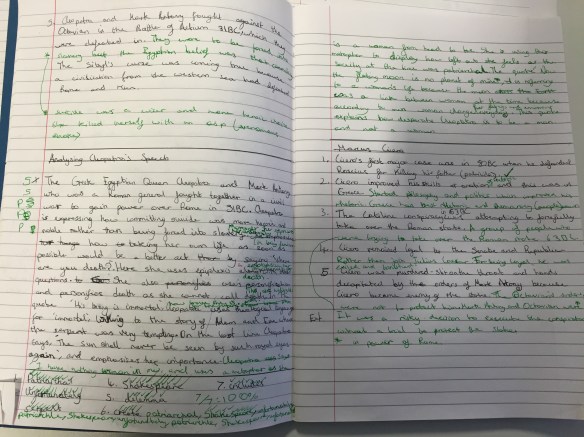
Now, I’m getting into the swing of the Michaela way. I read my pupils’ books once or twice a week. I teach four classes, each with between 28 and 32 pupils, so it is about 120 books in all. I read 60 books in 30 minutes. As I read, I make notes: spellings lots are getting wrong, things they’re all doing well at, and the main issues they need to improve. I note down anyone whose paragraph is amazing to reward with merits or show the class; I note down anyone whose work is messy to give a demerit to. It looks something like this:

FullSizeRender

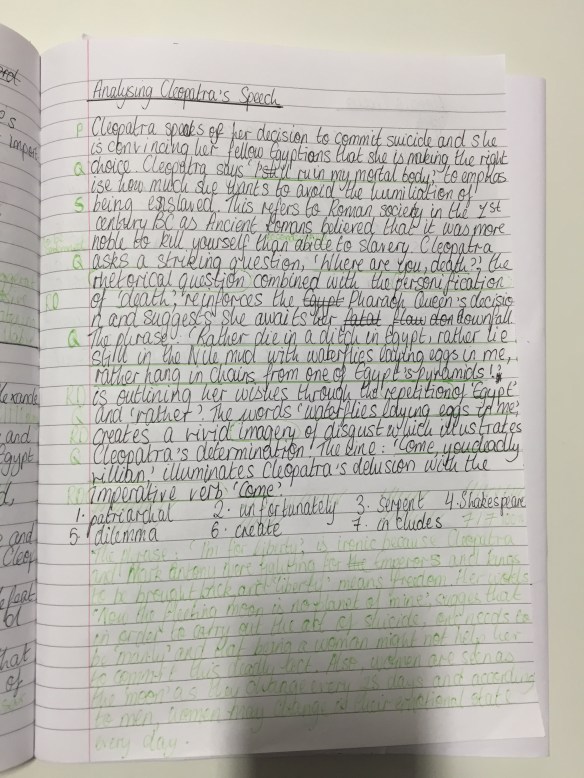
In the following lesson, I teach the spellings from the front, and then test pupils. They will write their corrections out in green pen, interleaving the ones they got wrong, or the ‘toughest three’ if they managed, on this occasion, to score 100%. I’ll test them again the following day. I’ll share the positive things I found and celebrate the star paragraphs, and then explain carefully, perhaps modelling on the board (as Katie Ashford has described brilliantly here or occasionally putting a great paragraph from the class under the visualiser, how they can all improve their own paragraphs. And then they improve them, in green pen. It looks like this:

FullSizeRender

FullSizeRender[1]

IMG_6305

The second powerful tool is in-class feedback. With an excellent behaviour system, silent writing for 25 minutes means I can see every child’s paragraph twice while circulating, giving them suggestions and tweaks while they write. On my colleague Lucy Newman’s suggestion, I’ve also started using my visualiser more. This way, we can take a pupil’s book, display it to the class, and show pupils how to edit their mistakes in that very lesson, just by giving oral feedback on the common errors they are making, or the aspects they really need to focus on improving. 

The thing is, what makes the difference in their writing is the quality of the feedback and how timely it is. They don’t need feedback on a paragraph they wrote two weeks ago. At Michaela, they can improve the paragraph they wrote yesterday, while it is fresh in their minds. I miss marking, I do. But I’m realising I did it for me, not for the pupils.

Starting at Michaela

Starting at Michaela is unlike any other school I have started at. In the three other schools I have started at, in my first lesson I have introduced myself, told them a bit about myself (especially if I have a position of any clout) and where I’ve worked before (showing them I’m not a newbie and won’t be walked over), stamped my authority on the class as kindly as I could (in particular, showing them I know the behaviour system) and then just done what I do. I’ve taught as I’ve always taught, improving incrementally each year (I hope).

In a first week at Michaela, there must be three hundred new things to learn every day. Some examples: all teachers say ‘3-2-1 and slant.’ No child does anything until you say: ‘go.’ Each lesson begins with children handing out books; this takes ten seconds and you count it down. Every second of every lesson is used; routines are meticulous to ensure this happens and everyone uses the routines. This, for me, has been the hardest part: on top of learning 240 names (the expectation is that every teacher knows every child’s name), you’re always thinking about the systems that others have long since automated. It is hard.

But necessary. Because what you don’t need to do when starting at Michaela, even mid-year, is stamp your authority on children. Children will happily file in absolutely silently, wait for all your cues, and do exactly as you say. Within 30 seconds on Monday, I was teaching my first Michaela lesson. Contrast this with the first lesson I ever taught: asking a colleague what I should do, she replied: ‘well, you have to give them their books. So you won’t have much time after that.’

Behaviour is so good I am having to fine tune my radar. Demerits are given for infringements than at any of my past schools would have gone unnoticed: turning around slightly, leaning over instead of sitting straight or not ‘tracking’ the page or me. Demerits are given publically and quickly: ‘Hayder, that’s a demerit for not tracking. We listen so we can learn.’ And the pupils’ response? So far, for each demerit I have given, pupils have responded by desperately trying to get back into my good books: sitting up straighter, putting their hand up more, writing faster, trying harder. They don’t sulk; they don’t argue back. They want to do the right thing; the demerit is the reminder to meet the sky-high standards.

Teaching, something that takes up 59 minutes of every Michaela hour, is a joy. With 100% focus, we get a lot done. I am constantly being given feedback to ‘speed up’ my teaching. Previously, I’ve been told: ‘slow down – they don’t get it.’ I’m starting to think that pupils didn’t ‘get it’ because they weren’t listening. Their behaviour and habits were such that I had to go over and over key concepts to ensure they understood. Every moment is used, and the pupils expect this. On packing up my last reading group of the week at 4:29pm, saying how much I enjoyed reading with them, I noticed no-one had closed their books. One pupil raised their hand and, eyes shining, said: ‘we still have one minute! Can we keep reading?’ A dozen nodding heads agreed. We read on.

I’ve been observed a lot – at least once a day, sometimes twice. Sometimes it is someone wandering in the back for five minutes; sometimes they stay for the full hour, usually bringing their own work to get on with at the same time. I’m given written feedback immediately, meaning I can put it into practice in the next hour. There are no grades. There are two, maybe three, small action points (‘narrate when you give a merit.’ ‘When you parse the sentence, start with the nouns and verbs, not the first word.’ ‘Don’t ask them an open question they can’t answer.’ ‘Don’t say “we shouldn’t be.” Say “We don’t.” Should suggests people are going to defy that expectation.’) The feedback has felt incredibly supportive.

What has also felt incredibly supportive is the response of the pupils. On my first day, children were thanking me for my lesson with beaming grins as they exited. Then came family lunch, where I sat with pupils whose names I could not remember, as they told me how much they were enjoying poetry. By the end of the week, pupils I taught were telling me: ‘my friend thinks you’re a great form tutor.’ I have never had such positive feedback in my life, and it makes me love each lesson all the more. At one moment on Wednesday, I looked at the clock: 12:20pm, ten minutes to lunch, and I actually felt sad. I felt a deep sadness that my lesson was nearly over. I desperately wanted to keep going. Similarly, on Thursday evening, I asked my other half if it was ‘Thursday or Friday tomorrow?’ He looked bemused: ‘Friday!’ It didn’t feel like the end of the week. Even this first week, which has to be the toughest, I could have kept going.

Teachers work hard at Michaela. We teach intensely, making every moment count. We have lots of duties, maximising the time we are with pupils. We are reminded to engage the pupils at break time and lunch time: they are our top priority. We have lunch together every day, talking and chatting with them. And yet teachers do not work late: the work is intense, but manageable; with pre-planned resources, my own ‘planning’ can be done on half a post-it note, and most of that is reminding me to give the books out.

IMG_5963

What has surprised me most? The noise. It can be loud. If more than half the class have their hands up to give you a one-word answer (‘what poetic technique is this?’), you get a choral response: ‘one two three:’ ‘ALLITERATION!’ Thirty-two children shouting an answer is loud. This happens several times in everyone’s lessons. Lining up ready for lunch, children are chanting poems they have learned by heart, speeches, times tables or subject chants, in unison. It is loud. They love it. The looks on their faces are joyful to behold.

These are normal kids. But they are exceptional. And at Michaela, a normal teacher like me can begin to feel exceptional too.

IMG_5966

New Year, New School (Part 2)

I can honestly say I did not foresee 2015. For me, 2015 was a year of dramatic changes, both personal and professional. In 2015, I saw things differently, and it was really, really hard.

Could it be a product of turning 30? Could my willingness to move away from what I had always taken to be a given have been signaled by my growing awareness of the brevity of life? Have I, in plain terms, had a mid-life crisis?

It is possible. I’m going to talk about one of the big, controversial choices I made in 2015 and why I made it.

In September, I took on a post as Assistant Principal for Curriculum Design at a large academy. I couldn’t believe it: my dream job in my dream school. It was everything I had wanted: a big promotion, whole-school responsibility, and an opportunity to change the minds and practices of every teacher in a big academy. When I started in September, it was even better than I had hoped. People listened, engaged, argued, and, swiftly, started to get on board. Change was, in many ways, rapid. I realised straight away I was working with some phenomenal people: an understanding line manager who ‘got it’ on every level; a Head of English and Head of Communications who were not only smart but massively fun to hang out with in the office we all shared, and a core group of individuals I ‘clicked’ with. Then there were the children: they were something else. Despite coming in massively far behind, despite every conceivable deprivation and difficulty, they were joyous. Within days, children I didn’t teach were greeting me politely; classes at first a little wild soon accustomed themselves to my preference for silence and made ridiculously good progress, and I was even beginning to enjoy the challenge of teaching, for the first time, out of my specialism. I could see myself building my career here.

So why on earth would I leave such a job?

I met Joe Kirby, Katie Ashford and Bodil Isaksen for the first time in January 2013. Between the three of them, they changed the way I thought about everything in education. They presented a radical departure from the norm to me, and although I held firm for a long time, eventually truth and research won me over. I could argue no more: there was a better way of doing what I did. I had to kill my darlings: group work, student-led activities, student research, and skills-led lessons. In the summer of 2013, when Joe, Katie and Bodil were about to found what would become Michaela Community School, I thought briefly about trying to join them. I dismissed the idea almost immediately. Why would I join something so untested? How did they know these ideas would work in practice? Then there was my own career trajectory – I was about to become Head of English; my next career move would be Assistant Head, not Head of Department again.

Then I visited. I saw what they had created, and I was awestruck. Here the ideas were, in their purest form. The children were amazing; so engaged; their progress more rapid than I could even have imagined. The curriculum was inspirational – the very best texts, the most important ideas, carefully organised for maximum student learning. And I met, for the first time, Katharine Birbalsingh, who in 20 minutes of discussion taught me more than I’d ever learned in such a short time about leadership, and what it meant to be a brave and bold leader.

But I was on the cusp of my next job, the job I’d always wanted; the trajectory I had so desired. Why would I leave that? Again, the job advert had come at the wrong time. Taking a step ‘back’ to be Head of Department again is hard on the ego. It is hard when you think about perceptions, and what others will think. ‘Oh, she couldn’t hack it at a tough school.’ ‘She wasn’t ready to be a senior leader.’ ‘It was too hard for her.’

Let them think that. I could have impact in my school in my context as Assistant Head. But as part of the Michaela team, we have the potential to change the whole education paradigm. If the ideas work, and it is a big if, predicated on massive amounts of work and effort, when the school is to scale, it could be the exemplar that moves leaders in education around the country to change what and how children are taught, and to avoid teacher burnout on a massive scale. I don’t want to stand by and watch as my closest friends change the world. I want to be part of that team.

So I have, after a short term, left my dream job. I have defied my own expectations for what a career progression should look like. I have let down colleagues and children at a school I promised to be a part of for long-term change. All of this is true.

And yet, I am hopeful. I am hopeful that, at Michaela, I can build an English curriculum that will endure for twenty years or more. I am hopeful that, at Michaela, I can learn from some of the best professionals in the country. I am hopeful that, at Michaela, we can destroy all the remaining doubts that ‘children like these’ can achieve at the highest levels in the hardest subjects. I am hopeful that, at Michaela, I can be a part of a school that will change the way children are taught and the way our profession is run.

IMG_0490