I have written and spoken at length about simplification. In short, I have come to believe that a knowledge curriculum simplifies everything we do as teachers. Rather than considering engagement, entertainment, or pupil interest, a knowledge curriculum relentlessly and ruthlessly prioritises kids learning stuff in the most effective way: that is, reading it, writing about it, and being quizzed on it.
In my past life, here are some ways I assessed pupil learning:
Painstakingly marked their books with lengthy written targets for improvement that pupils responded to
As above, but for essays and assessments
Used spurious National Curriculum levels to denote the level the child appeared to be writing at
Developed an assessment ladder based on vague descriptors provided by GCSE exam boards to denote how far a child was from the GCSE expectations
Had pupils complete multiple choice exams which, having sweated over making, I would then have to mark
Had pupils swap books with one another to write insightful comments such as: ‘good work. Next time, write more’
Asked pupils to tell their partner what they know about a topic
Asked pupils to write a mind-map of what they know about a topic
Asked pupils to make a presentation of what they know about a topic
Not only are the above techniques unnecessarily complicated, they almost never gave me any useful information about what my kids could do.
At Michaela, we ask the kids questions constantly. Every lesson begins with two to five practice drills. In English, this would consist of two or more of the following:
A spelling test
A vocabulary test
A grammar drill
A gap-fill on a poem the pupils are memorizing
Knowledge questions on a previous unit
Knowledge questions on the current unit
We then read some material, and ask the pupils questions to ensure they have understood. The pupils then answer some questions about the material. We then go over the questions as a whole class, and pupils edit their responses using the whole-class feedback. For a lengthier piece of writing, I would use a half-page of feedback as outlined in my post ‘Giving Feedback the Michaela Way.’
For our bi-annual exams, pupils write an essay or, in subjects like Science or Maths, complete an exam paper that tests their ability to apply their knowledge. They also complete two to five ‘knowledge exams,’ which are simply open answer questions about everything they have learned that year. (Example questions from English could be: ‘What is a simile? When did Queen Elizabeth die? When was Macbeth first performed and where?’) We don’t painstakingly mark every paper – instead we sort them swiftly into three piles: A, B and C. A quick glance can tell us how a pupil has done – lots of gaps is a C, a sample glance at a number of correct answers and all questions attempted with a well-worked extension an A; everything in the middle a B.
The reason we can assess so simply is that in a knowledge curriculum there is a correct answer. There are, though we love to deny it, right and wrong things to say about literature. At Michaela, we are explicit about this. When I asked for pupil inferences about Curley’s wife in Of Mice and Men in my previous school, I remember asking them what the colour red could symbolise. Their answer, ‘jam,’ was simply wrong. What we do at Michaela is to codify the knowledge we want the pupils to learn, teach that knowledge, and then relentlessly test that knowledge.
One of the things I hear a lot from my colleagues at Michaela is that working at the school has made them better people. Why is it that so many of us feel we have improved as humans through our collective endeavour to teach children?
Stoicism
‘I’d never heard of stoicism before I worked here. Now I’m reading Epictetus with eleven year olds. It’s mad!’ (Michaela teacher)
We explicitly teach stoicism to the kids from day one of Bootcamp in Year 7. We teach them that adversity is there to test them, and the true test of character is how they choose to respond. They will, like everyone, experience difficulties in their lives: stoicism gives them tools to rise to those challenges.
By continually reminding pupils to ‘stay stoical’ – when they get a detention, when they cut their finger, when they have a cold, when they’re finding a topic or idea difficult, when they have six hours of exams a day in exam week – we are also internalising that message ourselves. It is really quite extraordinary how high staff attendance is at Michaela.
Stoicism is a life-changing philosophy. I’ve recently started reading The Daily Stoic, which is like a Bible for perseverance and perspective. When difficult things used to happen in my life, I would go to pieces. I would cry, or feel anger, or feel that it just wasn’t fair. But now, I remember what we teach our kids: Nelson Mandela spent 27 years wrongfully imprisoned; Victor Frankl endured the miseries of a concentration camp. Nothing that can happen in my life will come close to the suffering they endured, but through our own endurance we can set examples for others.
In August, for example, I slipped a disc in my neck. I was in absolute agony for months, and felt very sorry for myself continually. But when I was tempted to indulge in considering how ‘unfair’ my lot was, I had only to look at the shining example of my step-mother, whose M.S. may make her daily life incredibly difficult, but will not take the smile and positivity from her. She is a force of nature, and a wonderful human to be around. She is an example for me to live up to: if I feel pain, it is nothing compared to what she feels every day; if she can endure it, I can follow her example.
Humility
Before I worked at Michaela, I loved being told I was great, and hated being told how to improve. I was, in short, pretty arrogant. But through our culture of candour, and through a culture of continual improvement and continual feedback, through working at Michaela you become more humble. We are all always improving, and come to actually look forward to our candid conversations as we know they will genuinely help us improve.
It is great to work somewhere free of blame. In about my first month of working at Michaela, Katharine asked me to present something at a staff meeting. I came up with a handout I know would have worked well at any of my previous schools and talked people through it. It didn’t seem to go as well as I had anticipated, and I wasn’t sure why.
The next day, Katharine asked me to see her. ‘It didn’t work,’ she said. ‘You’re telling people “why,” but they know why – they need to know “how.”’ Does that sound harsh? It wasn’t harsh in the delivery – it was delivered without blame, without recrimination, in the spirit of sharing information: this didn’t work, so next time do this.
Being humble means you learn more: you don’t write off the first year teacher’s advice because you are more experienced, you don’t discount the ideas of others in the school because of any misguided notion of ‘rank.’ You listen to everyone, and you learn more than you could have ever expected.
Space
I do wonder if all schools could be like Michaela in terms of the ethos and atmosphere for staff. Certainly, our workload is very intense – days are packed from 7:30am to 4pm – but we also have evenings and weekends and holidays free to see friends, to see family; to read, to write, to think. I’ve never had so many colleagues go to the theatre mid-week, or go away for the entirety of a half term or long holiday without the slightest qualms.
And every day is zen: silent corridors, quiet classrooms, children behaving beautifully is all conducive to feeling happy to take on difficult advice, and finding it easier to deal with emotional or physical problems. In times of crisis, Michaela is a really lovely place to be.
In my previous jobs, I absolutely loved what I was doing, but I was often exhausted: I would cancel plans at the last minute because I could not bear to leave the sofa at the weekend, I wouldn’t see close friends for months on end, I wouldn’t book long holidays because I knew I would find the workload unmanageable when I returned.
Now, I still love what I’m doing, but it’s not all of my life – it’s part of my life. But that part of my life impacts on everything else, and I find my friendships deepen, and my relationships with my family soften, because I see them more often, and I am more present with them.
Before training as a teacher, I’m genuinely not even sure I was aware of the existence of PowerPoint. I’d certainly never used it, nor was it installed on my computer. I’d never encountered it as a pupil in school or a student in university (although I do recall images being used in lectures, which could easily have been delivered through a PowerPoint format).
It was in my second week of teacher training, in what is called a ‘Second School Experience,’ I first was made aware of the program. Preparing to teach a lesson for the first time, I met with the class’s usual teacher whose opening words were, ‘here’s my log-in so you can make a PowerPoint. Obviously you’ll want to make a PowerPoint.’ It didn’t seem too obvious to me then. I spent an hour or so painfully working out how to use the program, painstakingly copying and pasting images I found at random using clipart (I hadn’t yet understood how to get images from the internet onto a slide), and changing the fonts at random. During the lesson, which was obviously a disaster for far wider ranging reasons than the existence of PowerPoint, I remember finding the slides a hindrance rather than a help, as I awkwardly pointed to a slide from time to time, only really to justify the time that had been poured into making it.
Looking back on my first term of teaching, my early PowerPoints were four slide affairs. They had a title, a learning objective (it was 2010), and then a series of questions for kids to answer, split into different slides which vaguely corresponded to different parts of the text we were learning (normally, the heading was a page number, the bullet points questions).
But I learned fast. My PowerPoints soon exploded into twenty, even thirty slide affairs for a single 50 minute lesson, packed with animations, images and coloured backgrounds as standard. At peak-PowerPoint, I could knock one of these out in under ten minutes.
But I’ve since reneged, and I’ve come to believe the use of PowerPoint is misguided. Why?
Life in a dark room
The first time I visited a school, after 6 interim years of work and study, my first thought was how dark it was. It was the end of the year, and so bright and beautiful outside, but in classroom after classroom it was beyond winter. It was hellishly dark, and with the blinds drawn the classrooms were sweltering. I wondered how the kids could even see what they were reading or writing. Much like modern family life, everyone seemed orientated towards the bright screen at the front. It’s depressing.
Split focus
PowerPoint splits kids’ focus. You want them to focus on you, and your instruction – but instead, they are focused on the screen that bears the remnants of that instruction. You want them to focus on the text and what they are learning, but instead they have to keep looking up to find out what the question is before they write again.
It stops teachers teaching
Even ten minutes to bosh out a PowerPoint is a waste of time. But more than that, it actively impedes my preparation. I’m thinking about slides instead of thinking about content. I might put twenty questions on a PowerPoint, but actually I need to be thinking about a hundred questions to ask pupils. At Michaela, we ask each of the 32 pupils in our classes at least three, and often more, questions in a single lesson. I need to spend my time planning those micro-questions as well, not just the few ‘big questions’ they might answer at length in discussion or writing.
Technology fails you
If I haven’t persuaded you with the preceding arguments, perhaps I will have more luck here! Hands up who has ever had technology fail them in the classroom? That’ll be every teacher ever.
And it’s awful. You stand there at the front. You have nothing. You could write your questions on the tiny actual whiteboard that is awkwardly positioned so not all kids can even read it, but then you’d have your back to the children and we all know how that pans out. Plus, what if half your questions are about the gorgeous images you’ve meticulously selected? You’ve got nothing. You do a little dance. You pray you can contain them.
We teach a poem in year 7 by William Carlos Williams called ‘Landscape with the Fall of Icarus.’ It’s a poem about a painting by Pieter Brueghel, so obviously I felt I needed to show the kids the image in order for them to understand the significance of the poem. It was in my early days at Michaela, and I was already nervous as a visitor I knew vaguely from the world outside Michaela would be in my classroom. (I think we’re all desensitised to visitors now, as we have about five a day wander in.) I cued the image up ready. And then it transpired that my board was not connected to my computer. I absolutely panicked.
Back-up could not arrive in time, so I taught that lesson without my picture. I just explained the picture, and why it was important. The kids got it, wrote about the poem; happy days. It was fine. But by the afternoon my board was fixed. So, the second time I taught the lesson to the other year 7 class I taught, I had the image ready to go.
And it was a much weaker lesson. Because we had split attention. We had a request to pull the blinds down so they could ‘see it properly.’ They were confused by other aspects of the picture I didn’t want them to focus on. It was, all in all, a massive distraction.
Work less, achieve more
Why have a resource and a PowerPoint? It’s the same argument I used to make against lesson plans – why do I need one when my PowerPoint shows my planning? Well now – why do I need a PowerPoint when my resource – poem, novel, play – shows my planning and thoughts about how I will teach these children?
At Michaela, all children have the same resource, and so does the teacher. The teacher’s is annotated with questions and key aspects to bring out in instruction. What more do we need?
A caveat
Ok – I actually do use PowerPoint. One slide, one lesson a week, for ten minutes. It is for our weekly quiz. We put the questions on a single PowerPoint slide, and the kids write their answers on paper. We then sort the papers using comparative judgement.
We’ve tried to come up with ways to avoid this, but so far everything considered has meant considerably more work for teachers than just sticking the questions up. We’re still brainstorming how to eradicate this last remaining slide. One PowerPoint slide one lesson a week. I look on that slide as a necessary evil.
When I joined Michaela, I was excruciatingly ambitious, and not a little arrogant. Within a week, I felt that if I remained an English teacher at Michaela until the end of my working days, I would be content.
For someone who loves books, loves reading, and loves kids, it is the perfect job. Our classrooms are peaceful places, where children read loads and where discussions are enthusiastic, and often insightful. Even teaching year 7 and 8 last year, I would frequently be made to pause, sit back, and say: ‘hm. I hadn’t thought of it like that!’
It is, in short, the dream.
Of course, not everyone feels like this. The list of what we don’t do at Michaela is significantly longer than the list of what we do. We don’t do card sorts, group work, pair discussion, drawing, mind maps, or any tasks asking children to guess. Our knowledge-based curriculum is 100% fully resourced for teachers, so teachers never have to photocopy a single worksheet or create a single PowerPoint slide. They never have to decide what to teach, or in what order. They never have to guess what prior knowledge their kids might have – they simply look at the fully resourced curriculum for the lower year groups.
That said, not everyone wants this.
Many teachers love to create their own resources, and plan their own lessons. But we at Michaela would rather our English teachers focused onhow to teach instead of what to teach. All teachers plan their lessons, in the sense that they read and annotate their booklets prior to teaching, ensuring that they know the best way to deliver new concepts to pupils. We meet together as a department once a week to add to these annotations, and to improve our alignment. It’s not good having one teacher decide to teach the term ‘hypophora’; far better if we all agree to teach the term and agree the best way to teach it. If one teacher’s class are struggling to use apostrophes accurately, we all work together to decide on the best way to ensure the children really understand it.
At Michaela, we think that team beats individual. Our English department works together to ensure that every single pupil in our school gets the very best education possible – not just the kids happening to benefit from what one individual teacher happens to know and think to share with them.
The results? Happy kids, learning loads. Their writing is beyond joyous – it is certainly unlike anything I have ever encountered in any of my three previous schools. In my first term, my year 8s essays on Macbeth far outshone those of the year 13 pupils I had taught the text to last.
If this sounds great, then you’ll be excited to hear that we’re hiring, and we’d love to hear from you!
A number of people have expressed an interest in how tutor time works at Michaela, and given that we have nearly an hour of tutor time every day, it is probably worth explaining our system.
We have tutor time in the mornings for twenty minutes, which is often stretched to twenty-five minutes, as we love to get the kids into the nice warm building, especially in the winter months. Two mornings a week, the children have assembly. Then, we have tutor time every afternoon for thirty minutes.
The tutor at Michaela is absolutely central: they have the strongest relationship with their tutor group, and we work the timetable to ensure tutors also teach their tutor groups. Although our tutor groups are large, the amount of time spent together, combined with excellent behaviour, means that tutors can really get to know each of their tutees.
On an assembly day, the tutors are responsible for lining their group up and leading them into the assembly hall. Occasionally, one tutor will decide to become competitive about which tutor group boasts the neatest, strongest line, and we’ll make this into a silly competition. (In my experience, tutors are generally just slightly more competitive than the kids on this one!)
Once in the assembly hall, tutors stay with their groups, reciting poetry together, rolling numbers together and singing together before assembly begins, and giving merits to members of their form who are doing a great job. Again, we will occasionally make this into a little inter-form competition. Tutors stay for assembly, making sure their tutees are behaving, and also absorbing the key messages of the assembly we want to be reiterating with the children in form time. Our assemblies are built around our school motto: ‘Work Hard, Be Kind,’ and will normally fall into one of those two categories.
On mornings with no assembly, the kids file into their form rooms, and take out their reading books. The tutor completes the register, before doing a quick equipment check. We have a standard expectation of the equipment every child must have, and the tutor ensures that every pupil has this equipment at the start of the day. This is to ensure no time in lessons is wasted with children not having a pen, or a ruler, or any other vital piece of stationery that could stop them learning. Some tutors check this during silent reading time, and others get the kids to hold up their equipment, issuing merits for the swiftest rows with the most professional attitude.
Our pupils are set online Maths homework every day, and morning tutor time is a good opportunity to show the kids who has done the most questions, or who has spent the most time on the Maths programme. Tutors can celebrate this with their tutees, and remind those who aren’t putting in the effort to do so in future. These pep talks are invaluable, as we find now that we often have our weakest pupils making the top ten for Maths prep, and so making huge progress from their starting points.
Before the tutees leave, the tutor gives a swift pep talk for the day, reminding their form of any key expectations they feel they are forgetting (my form last year were in the habit of slouching, so I would take a minute to explain why sitting up straight would help them to focus in lessons), before sending them off for the day.
At break time, tutors are timetabled to be with their form groups for at least ten minutes of that time, so they are able to circulate and speak with individuals, or so that individuals can find their form tutor and speak to them. The same happens at lunch break, when tutors often play table-tennis or basketball with their tutees, and chat and laugh together. Tutors also eat lunch with members of their form each day at family lunch. All of this provides an opportunity for any pupils having a tough time, or seeking reassurance, or struggling academically to find their tutor and express their concerns. It also allows the tutor to seek out pupils who are doing well to congratulate and encourage them, or, if they have a new pupil in their tutor group, to answer their questions and allay their concerns. All of this ‘down time’ together means tutors can really get to know their tutees as individuals, not just as learners.
At the end of the school day, following the final period, the tutor group comes back to their tutor room. After the register, they read their class reader together. Any English teacher knows the joy of sharing a story with a class; at Michaela, all tutors have this same joy. The tutor displays the merits and demerits for the day, week, term or year, congratulating those at the top, having conversations with those who are struggling, and asking those at the top of the chart to explain what they are doing to achieve their merits, to inspire their peers to emulate them.
The afternoon is also our time for one-to-one conversations, where co-tutors take out individuals who are struggling academically or with their behaviour. Wander down any Michaela corridor at the end of the day, and it is a hum of urgent, whispered chats between co-tutor and pupil, with our toughest kids having the most support. Co-tutors like Ms Cheng use a little book to set goals for the day – how many merits they wanted to have achieved, homework that needs to be completed, extra revision that is needed – and follow up on these goals.
Finally, the afternoon is a perfect time for notices and announcements. Tutors also read out the detention list, and can reiterate the teacher’s message of what has gone wrong, and what needs to happen in the future.
Some extra things tutors do:
Once or twice a term, give their tutees postcards to express their gratitude to members of teaching staff or support staff.
Discuss attendance weekly with tutees, congratulating those on 100% and having discussions with those who have missed a day or two of school.
Displaying the number of books each tutee has read weekly and encouraging them to read more.
Giving postcards to their tutees: anyone who has been especially kind, worked especially hard is awarded a postcard. This happens at least once a week. Some tutors do a ‘Michaela drum roll’ (like a regular drum roll on the table, but they SLANT as soon as they are asked) to introduce this and build anticipation.
Like everything we do, we are constantly evolving how we do tutor time. We’d love to hear of what other schools find successful, as we are constantly learning from others around the country to improve what we do. In addition, tutors are constantly innovating and trying new things with their tutees. Things individual tutors do are videoed and emailed out to all staff, so that we can learn from each other and do our best by our wonderful children.
Michaela had always been open to anyone who wanted to visit, and we would actively encourage all kinds of people to visit us. We were so proud of what we did, and we naively thought that if only those who disagreed with us could see it in action – see how happy the children were, and see how much they were learning – they would have to concede that what we were doing was right for them.
Unfortunately, our trust in teachers to do the right thing regardless of their preconceptions and biases was broken. Our guides began to report some guests being rude towards them and the school. Some guests were asking inappropriate questions of our guides, who were feeling increasingly anxious about dealing with these kinds of teachers. In December, we had to close our doors to visitors following a serious safeguarding concern. It has taken us some time to look into this concern, and to alter our policy on visitors to ensure our pupils are kept safe.
Since publishing that blog, we have been inundated with emails, Tweets, and direct messages from those who expressed sympathy that we had to take such action; supporters of what we are doing who had really wanted to visit our school. We knew we had to put something in place to ensure that those people would have a chance to come in.
Our pupil guides are incredible, but they are also children. Their confidence and articulate explanations can make even their teachers forget that sometimes, but they are still only children. When you visit our school, we are placing a huge amount of trust in you: to treat our children with kindness and respect, and to never forget that they are only kids – age 11, 12, 13 or 14.
We are also placing a huge amount of trust in our guests to abide by our rules. I wrote before about some inappropriate behaviour of guests. Some people visit our school to soak up every piece of information they can, to find out more, to see what they can take back and implement at their own school. Some people visit with different motivations – to steal resources, or because someone has made them come when they would rather be taking ‘important’ phone calls while their pupil guides wait patiently for them.
It takes a huge amount of time to organise the visits, to complete the logistics, and to train and support the pupil guides. We are happy to take this time if it is to benefit those who are visiting with the right motivation. So, what we need to do is to work out how to tell whether someone is visiting our school because they want to learn something, or whether they are visiting our school because they want to undermine what we are doing.
When people visit our school with a motivation to undermine, not only do they write inaccurate and, frankly, untrue, things about what we do online (my favourite so far has been that teachers do not eat lunch with children – something every single teacher at Michaela does every single day) that damage other people’s perception of our school, but, far, far more importantly, that they put our children at risk. When people come, desperate to prove that what we do doesn’t work, in the face of the evidence in front of their eyes, they put our children at risk. We were hugely naïve to not recognise this sooner.
All staff at Michaela, including our Headteacher Katharine Birbalsingh, visit all kinds of schools all around the country. Our visits have massively impacted on what we do. We often cite King Solomon Academy, Mossbourne, and Dixons Trinity as influencing some of our central ideas and policies, but we have learned something from every school we have visited – even School 21, which many consider our polar opposite, has taught us lots. Because we go to these schools with the mindset to learn.
So we have now established an application process for visiting Michaela. If you email info@mcsbrent.co.uk, we will ask you to fill out a short form, which will be reviewed by Katharine Birbalsingh or a member of the Senior Team to decide whether the motivation is right. Those who have been kind to us or about us, those who are interested and want to learn from what we do, are welcome to come in. Those who have been rude to us or about us, those who are motivated by the wrong things, are no longer welcome to visit. Any visitor acting in a way deemed inappropriate will immediately be asked to leave. Some schools charge up to £50 per person per visit. We are happy for visitors to come in for free, as long as those visitors are supportive and will not put our children at risk.
Our children are our top priority. Some of our guides are lower ability, and they have been genuinely upset by people visiting who do not like the school, who tell them that the school is bad, and that they are wrong to be happy at Michaela. We hope, desperately hope, that this new policy will be enough to allow those who wish to learn to come in, and to keep our most precious priority, our children, safe and happy.
If you are interested in learning from what we do, please email info@mcsbrent.co.uk for an application to visit Michaela.
When I first visited Michaela, it was in July of 2015. What I saw on that day changed my view of education forever. I left the school in a daze, both dazzled by what was possible. Many of our recent recruits tell a similar story. Some applied for a post on a whim, not really sure what our school was about. The visit changed everything. Reading about our school is great. Seeing it in action is something else.
My visit proved the catalyst for my involvement with the Michaela project. Today, I still feel a little starstruck when I walk into Katharine’s office, or watch Olivia Dyer teaching, or hear Katie Ashford speaking. I feel so lucky and so proud to work at Michaela.
At our event in November to launch our book, people had come to us from so far away. Their joy was palpable, as they came up to various Michaela teachers. ‘We’ve been up since 5am! We’ve read so much! We’re so excited to be here!’ was something I heard so often, I had to pinch myself. I am so lucky to work at Michaela.
On Twitter we have said to people: ‘don’t believe us? Come and visit!’
And they do. We’ve had to organise new systems to deal with the massive influx of visitors. And we didn’t mind that, because so many people came, saw, and took back ideas and methods to use in their own schools. Countless visitors sent us glowing letters of thanks, praising our lovely school and, in particular, our lovely children. We framed the letters, and read them out in assemblies. The children glowed with pride: they felt so lucky, and so proud, of our school. And we were happy to spend the time to spread the ‘good word.’ Our pupils were so proud to show guests around, and explain everything they knew about their school.
Now, not all visitors were respectful. We’ve had visitors cancel at the last minute – the day before, or on the day, causing untold difficulties with the administration at our end. We’ve had visitors turn up with seven of their colleagues unannounced, expecting it wouldn’t matter how many of them there were. We’ve had visitors make dietary requests at lunch, as if we were a restaurant and not a school. We’ve had visitors become annoyed because their specified date or time was not available. We’ve had visitors email on Sundays, following up their Saturday email, asking why no one has got back to them yet, as if we were a business, and an eternally open one at that. We’ve had visitors demand to speak to various Heads of Department or Deputy Heads, as if those people didn’t have a school to run.
None of these demands are quite as disrespectful as what some visitors to our school have done. We have had visitors take away lesson materials, even out of pupils’ books. We have had visitors rifle around a teacher’s desk; even her drawers. Visitors have frequently interrupted a teacher while they are teaching, sometimes only to ask where the toilets are. We have had visitors filming our lessons without permission, or taking photographs of our children. We have had guests asking children what set they are in, even after being explicitly told to not mention setting to our pupils as we do not share this information with them. We have had visitors talk loudly to pupils who are desperately trying to concentrate on their silent practice, or their teacher’s instruction. We have had visitors hide in the toilets, making long phone calls, while their guides stood waiting for them, unsure of what to do when the guest asked for an extension on their thirty minute tour afterwards. We have had visitors talk to each other, loudly, in the back of the classroom, disturbing the learning of our children.
So we have had to chase visitors down to delete images or wrestle our materials from them, and start reminding people before they visit of the etiquette of a school, and begin emailing out our prospective visitors with guidelines of how to behave, and what to do and what not to do.
And then there was worse. Much worse.
More recently, we have had hostile visitors. People who have come to our lovely school, only to look for what is wrong with it. Some have written blogs and Tweets, deliberately misrepresenting our school, and containing factual inaccuracies of things they have not understood, but have not bothered to ask for more information about. Visitors who have come with an agenda to destroy, not caring about who they are hurting in the process: the children.
We have had guests aggressively questioning the children taking them around – year 7, year 8, year 9 pupils. People, teachers, who have bombarded our children with leading questions, perplexing them and upsetting them: ‘aren’t the lessons boring? Do you hate this school? Do you think your teachers are too controlling? Do you feel oppressed? Isn’t this school much too strict?’ One visitor told a pupil over lunch: ‘your teachers aren’t teaching you Science properly. There is a much better way to do it,’ and proceeded to explain he could teach him science using football.
This week, over lunch, one of our pupils in our lowest attaining group, who is also a guide for visitors, sat with our Headmistress. Deeply shaken, she said: ‘Miss. They say our school is bad. I don’t know what to say to them. I love our school.’ She did not want to be rude to the guests, but she did not know what to say. Katharine, who had before wanted to open our school to those who wished to learn, began to question the wisdom of our approach.
Our concerns reached their apex this week, when one visitor, a non-teacher, raised a safeguarding concern with our Headmistress about the aggression the pupil guides were enduring from another visitor, a teacher, who was on the same tour. And of course, we take safeguarding concerns very seriously.
So it is with great sadness that we are closing our doors to guests for the moment. Although parents of pupils attending our school are always welcome at any time, we need to protect our children. We need to focus on educating them, and keeping them safe. We opened our doors to guests so we could share the love and the joy of what is happening here. Instead, our children have been compromised by the political blindness of some of our guests, who haven’t come to have their minds opened, but have instead come seeking confirmation of their prejudices, and have put vulnerable children at risk in order to do this.
We will still share through blogs, through Twitter, through images and videos we take, what we are doing at Michaela. And in the meantime, we will try to find a way that we can have visitors in without putting our children at risk. We do want to keep our doors open to teachers who are genuinely interested in what we are doing. The difficulty is distinguishing between those guests, and those who are putting our children at risk. We hope to have found a solution to this in early 2017.
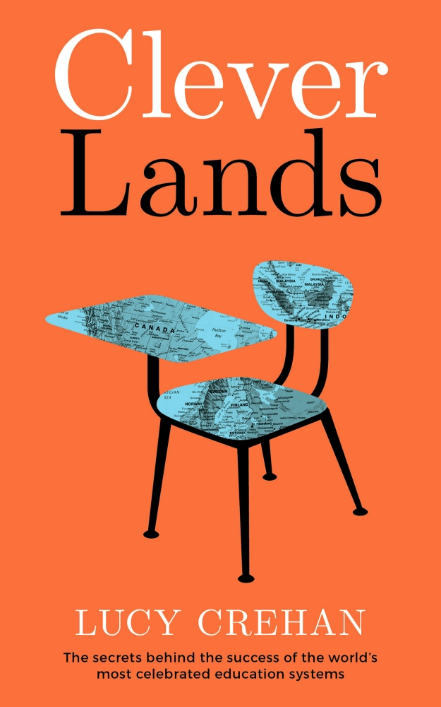
I have been excited about Lucy Crehan’s book for what seems like eons, and it does not disappoint. Unlike Amanda Ripley’s (also excellent) The Smartest Kids in the World, Crehan’s book has real direction and pulls together helpful strands, always with a focus on what we in the UK (or in the USA, as she makes frequent allusions to both countries) might learn from these successful systems. Crehan’s style also fuses strong, robust research with anecdote, all told in a witty and engaging style evoking a sense of a travelogue.
Early on Crehan refers to her research as a ‘geeky gap year.’ Many teachers would surely envy her travels, but she does not shy away from evoking some of the tougher aspects of travelling from place to place, spending around a month in each country, teaching, observing, helping and discussing education.
There is much to be learned from almost all of the countries explored by Crehan, and I was pleasantly surprised by which I learned the most from in reading Cleverlands.
As a former ‘progressive’ teacher, I used to hold up Finland as an example of all that progressive education could accomplish: comprehensive, child-centred, homework-less. But as its PISA results have flagged, and my own pedagogical values have shifted, I have increasingly turned my back on this previous analysis, listening instead to those who claim Finland’s previous results were down to its earlier, more traditional methods.
And yet I learned much from Crehan’s chapters on Finland; perhaps more so than any of the other chapters. She points out that in 2012, Finland was still the highest scoring non-Asian country. Her analysis ranges over the late school start – age 7 – and the counter-intuitive ‘learn through playing’ ideology that pervades these early years. But the focus in those years is on making children school ready, and Crehan cites extensive research showing that it makes no difference if children begin school early or late.
In fact, trying to teach very young children difficult skills may even prove counter productive: ‘like scattering seeds on a path, trying to teach children to read aged one or two will be unproductive, as they don’t have the skills, the language abilities or the cognitive capacity to be able to do it yet.’ Moreover, such a focus could ‘detract from the time they could be using to develop the knowledge and skills that are needed’ to be ready to learn to read.
Crehan considers the success of Finland’s comprehensive system to be due to its slow lead-in time, extensive training, and oversight and inspection of teachers and schools until its full establishment. And Finland is fully comprehensive, down to mixed ability classes, which make a number of appearances in the book. The focus for the Finnish teachers is on the weakest kids: one teacher opines ‘the brightest kids, they’ll learn anyway, whatever you do with them.’ This equity is also reflected in school structures; only the Headteacher is different in the hierarchy. There are no department heads, or senior teachers. There is no performance related pay.
Teachers are continuously developing their own practice independently, genuinely engaging with research and education and cultural writing, and there is a palpable culture of believing this makes them better at their jobs. Crehan warns, though, that this is only possible with a highly motivated workforce.
Of the often celebrated ‘teacher autonomy’ of Finland, Crehan has much to challenge, beginning with a 1996 report on Finnish schools which found: ‘whole classes following line by line what is written in the textbook, at a pace determined by the teacher… you could have swapped the teachers over and the children would never have noticed the difference.’ From Crehan’s observations, she notes a ‘consistently traditional approach’ in classrooms, with lessons ‘led by the teacher, but with substantial whole-class interaction.’ High quality textbooks are ubiquitous. Teachers are not forced to use these, but she points out it would be foolish not to. As Finland has no official exams until age 18, these textbooks are not focused on drilling to a test, but instead on promoting ‘engagement and deep understanding’ of the topics.
Where Finland’s values are reflected in each of its schools, Japan’s system seemed the least coherent. Whereas middle schools invoke military discipline to toughen kids up for high school (Crehan includes one of many brilliant details in outlining the lightweight uniform being entirely useless in winter, but due to layers and coats being forbidden the children ‘buy self-heating pads, which they put in their socks and stick to their backs on the really cold days’), the primary schools are almost completely devoid of any behaviour system, with teachers relying on the children to discipline each other using peer pressure. Teachers are graded A to E, but never know their grade, and they are moved from school to school as their district sees fit. The families in Japan demonstrate strong support for education, with mothers expected to ‘retire’ when pregnant and devote their lives to raising kids, and the school constantly admonishing parents for not supervising children’s homework if it is not done.
More positive aspects include the curriculum: in Japan it is, according to Crehan, narrow but deep. Teachers share planning, and all teach the same lessons. They support struggling pupils outside lesson time.
A large proportion of Crehan’s discussion on Singapore schools pertains to selection, which occurs throughout the system, with streaming beginning early, and schools sorted into more and less academic. Personal responsibility is strong in the chapters on Singapore, and Crehan cites former Prime Minister Lee Kuan Yew saying: ‘nobody owes you a living.’ The schools are extremely competitive, and private tuition is big business: kids are often being tutored until 10pm or even later, as the exams increase in difficulty every year. The ‘disparity between what is taught at school and what is in the exams puts further pressure on parents to fund private tuition,’ which Crehan dubs a ‘shadow education system.’
The results of this highly competitive system are indisputably impressive: even the poorest pupils in Singapore are far ahead of their Western counterparts. Yet here, Crehan challenges her reader to think more carefully about what equality looks like. Because although the poorest echelons and weakest performers in Singapore are far ahead of other countries, ‘it doesn’t mean they have better academic opportunities, as their advantaged peers in their own country are still ahead of them, filling the places in the junior colleges and forcing them onto less academic courses.’
In Shanghai, the overriding message was that a Chinese value is that everyone is capable of learning. Success was not considered to result from innate ability, but effort. All work is given to all children, meaning the work is pitched to the top: weak pupils are ‘given challenges rather than concessions, and were expected and supported to rise to them.’
Interestingly, the parents in China ‘tend to play down their children’s successes, because they see it as their role to promote effort in their children… when parents from Eastern cultures point out a child’s failings or mistakes, its whole purpose is to allow the child to grow and improve.’ This puts the writings of Amy Chua into perspective, and helps to explain to a Western mindset why, though the Chinese mother might seem ‘cruel’, it is, in fact, working from a different paradigm in raising children’s expectations of themselves. Like Japan, schools constantly communicate with parents and hold them to high standards. In lessons, pupils are taught didactically, but there is little time for extended practice – this is done as homework.
Of all the countries covered, Canada to me sounded more nightmarish. Crehan outlines a national curriculum full of discovery learning and group work. Yet Crehan herself in fact favours Canada, praising its balance between ‘the teaching of academic content and broader cognitive, social and moral skills and traits.’
There is much to learn from this extraordinary work, but one aspect I found compelling was the teaching in nearlyall the above examples in mixed ability classes. Since moving to Michaela, I have really enjoyed teaching streams – lessons move at a pace the very vast majority of the class is comfortable with, and I can give whole-class feedback that is relevant to all pupils. Teaching to the top in a mixed ability class is not impossible, but it does rely on the weakest children working the hardest: doing more homework, and coming to teachers for individual support. This is possible in a culture where hard work and personal struggle to achieve are normalised. The practical reality, in my experience, is that the weakest kids are also the least invested: the least likely to do homework, and the least likely to attend additional clubs (non-teachers wouldn’t believe how hard it is to get kids who have fallen behind to attend catch-up clubs put on specifically for their benefit). But what we can take from the mixed ability argument is a need to pitch our curriculum to the top, so we teach all children the same stuff. This could be done by changing the allocation of lessons, so weaker children do the same high-quality work, but just have more time to spend on that tough material.
This book is fascinating for its research, but it is also a crucial one for all educators in that it reminds us that education is about values. More than once, Crehan asks: ‘would you want this in your country?’ This is why education will always be a knotty issue, because we do not have a consensus on values. We know what works to improve pupils’ behaviour, learning and habits, but what we don’t know is whether we all want pupils to behave in a certain way and know certain things. This book is crucial to prompt reflection from all educators.
‘If you want to go fast, go alone. If you want to go far, go together.’
Western society prioritises individual achievement. Many of us spend our lives in this paradigm, and Western society applauds us for doing so. We are focused on ourselves: what grades can I achieve in my exams? What kind of degree can I get? How impressive can my first job after University be?
And teachers are not immune to this. We are surrounded by people climbing the ladder, reaching for the stars; young headteachers are showcased by the media and applauded. We are programmed to aspire and to achieve.
I’ve written before about why I chose to join Michaela. Doing so meant stepping out of the ‘ladder’ mentality: I was an assistant headteacher in two schools prior to becoming a Head of Department here.
But it also meant stepping out of the ‘individual achievement’ paradigm. Before I began, I thought: ‘let’s see how fast I can be promoted.’ But when I started, I realised that I was in utterly the wrong paradigm. It wasn’t about me anymore. In fact, it had never been about me to begin with.
When weighing up the decision to join Michaela, Katharine gave me some honest options: ‘if you want to be a headteacher quickly, stay where you are. You’re not going to be a head fast if you come with us. In fact, it will slow you down.’ How badly did I want to be a headteacher? Really badly. But why? I wanted to change the lives of thousands, not hundreds, of children. But was that all? Or did I also want the ‘glory’? The responsibility, the excitement of being in charge?
I forced myself to face reality. Would I be ready to be a headteacher in five years? Or maybe even less? What kind of mistakes was I liable to make if I was promoted too quickly? How many people – adults, children – would suffer because of my ambition?
At Michaela, it’s not about me – it’s about the team. And that is, of course, how it is in other schools, for people who have left behind their ego, as I have learned to. I may not go fast, but it’s not about that. We, as a team, will go far. Together, we can accomplish what I could never do on my own. How could I make an extraordinary science curriculum, as Olivia Dyer has done? What do I know about Geography, History and Religion? Nothing compared to Jonny Porter. I took A-level French, but I don’t have a hope of teaching people to teach languages like Barry Smith and Jess Lund. And Maths? I can barely add up without using my fingers to count. Dani Quinn has a degree from Oxford. I don’t even know the first thing about how to teach grammar, and I’m an English teacher with a degree in English! I need Katie Ashford.
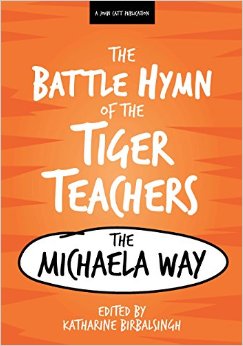
At Michaela, I’ve stopped focusing on what I can get, and started thinking about what I can give. When I have extra capacity, I ask Katharine what other parts of school life I can contribute to. That’s why I have had the opportunity to help to shape our CPD sequence, which I write about in our forthcoming book Battle Hymn of the Tiger Teachers. I’ve been able to do so much more in a school where everyone works as a team, and the impact on the kids is beyond belief. With all of us ‘rowing together,’ the boat gets a lot further.
Our book is a great example of this. Individually, the teachers at Michaela write a whole heap of brilliant blogs. But this book is more than one person’s perspective. Instead, it is the perspective of twenty people, who all contribute to make our wonderful school the happy, productive place it is. We are a team, and team beats individual every time.
I was overjoyed to be asked to present at Research Ed’s national conference last Saturday.
We have massively overcomplicated teaching. In my talk, I explored how we have overcomplicated it, why, why we need to go simple and how that would work, using examples from Michaela Community School.
I began the session with a series of questions, which readers may wish to revisit:
How many activities do you need in a lesson?
How often do the activities change in a lesson?
How many different ‘starters’ do you create?
How many different ‘plenaries’ do you have?
How many variations on tasks do you have?
How many slides do you have on a powerpoint?
How many resources do you print for each lesson?
How many ways are you expected to differentiate for children?
How many pages does your scheme of work fill?
How often have you changed schemes of work?
How often have you taught the same curriculum two or more years in a row?
How many intervention sessions have you run after school? Weekends?
How much feedback do you give children?
How much data do you gather? Input? Use?
How many CPD sessions have explored new ways of teaching children?
How many targets do you have to meet for your performance appraisal?
How many trips do you take?
How many forms do you have to fill out to take a trip?
How many forms do you have to fill out to log a behaviour report?
How many external agencies are working with your young people?
How often do children miss your lessons for interventions?
How do you get children to turn up to detentions, and what happens when they don’t?
How many action plans have you written?
I spent four years teaching thirty slide powerpoint lessons. Life in a dark room, filled by clicks and mumbles, was uninspiring for both the children and me. The failures of the past, not purely powerpoint-related it must be conceded, have led to what I called ‘intervention hell’ in the present, something that will be kicking in soon for many teachers, if it hasn’t already. We are drowning in data we don’t use. External agencies are taking children out of the one thing that will change their life: lessons where they are learning.
Schools are no longer seen as places of learning – in the expectation that we will educate the whole child, prevent radicalisation, encourage healthy eating, and teach financial literacy (among other initiatives), we are missing the crucial thing: kids learning stuff, passing exams, having successful lives. In 2015, only 53% of kids in the country achieved the old benchmark of 5 A*-C including English and Maths. 47% of kids didn’t even get five Cs including English and Maths. Schools are categorically failing to teach all kids effectively. Our role has been massively overcomplicated.
But the over-complication is not only the state’s fault. We too must accept responsibility. In the ‘missionary teacher’ or ‘martyr teacher’ paradigm, too many of us have decided to ‘sacrifice our lives on the altar of pupil progress’, to borrow a phrase from Joe Kirby’s Michaela debate speech. Working fourteen hour days, working weekends, working holidays (as it seemed nearly the whole room was doing or had done at some point) is categorically not sustainable. Who can do that for thirty, forty years? Our martyrdom has spawned an arms race, where ambitious teachers strive to outcompete each other. Add to this soup flawed accountability measures, spurious research (learning styles, anyone?) and the ‘teacher as entertainer’ model pedalled by teacher training organisations and SLTs up and down the country, and you have a recipe for disastrous burnout, as evidenced by the 50,000 or so teachers leaving the classroom every year.
Why is simplicity better? Three reasons spring to mind: sustainability, consistency, retention. Sustainability for teachers: simpler teaching means we can have lives and carry on doing the job we love for the long-term. A career is a marathon, not a sprint. Consistency for children: teachers who stay massively impact on the children. Having the same teachers year in, year out, is undervalued at the moment. (In a later conversation, I mused about school improvement. I think a lot of mediocre schools who achieve great results do so by being strong on two fronts: behaviour, and teachers staying. Behaviour is obvious – better a calm than a chaotic school. But teachers staying, as long as they are middling to excellent and not diabolically harmful to children, has a massive impact on consistency within the school and consistency for children.) And retention: teachers who want to stay in the profession is of obvious benefit to schools who spent enormous sums of money and time on recruitment each year.
How do we simplify teaching? I explored three strands: curriculum, pedagogy and systems.
With the curriculum, I focused on within subject choices, rather than whole-school curriculum. When planning the curriculum, instead of fourteen page schemes of work that no child will ever see (or arguably benefit from), make unit packs. All ‘worksheets’ can be in the pack. No need for a powerpoint – everything is happier when your curtains are open in the classroom, and technology is an added stress teachers simply don’t need in their lives. At Michaela, we use packs to cut workload, but also to benefit kids: the text is central. Kids are reading a vast amount across subjects, not just in English. We add recap questions to strengthen pupil memory, resource comprehension and discussion questions to prevent teachers thinking these up on the spot or the night before, and prepare model exemplars to guide pupils to where we want them to end up.
With pedagogy, I foregrounded the three arms of practice at Michaela: direct instruction, questioning, and extended practice. There is a huge gap between our pupils and their wealthier counterparts, and the gap is partly knowledge and partly practice. To close the knowledge gap, we teach with urgency. We never ask pupils to guess, but instruct upfront by reading text and explaining. We then question to check understanding, and recap to aid memorisation. To close the practice gap, we make sure when we’re not questioning and teaching, the kids are reading and writing. Kids are generally great speakers, great debaters and especially great at arguing; that’s not where the gap is. Our kids need more reading and more writing, so we make sure they do lots of that. We need to teach with urgency all the way through school – from reception to year 10, we teach like every second is vital (because it is). Hopefully that way we can prevent the intervention hell that is year 11.
I showed some clips of what direct instruction looks like, as it can sound massively off-putting:
Notice how interactive these lessons are. It’s certainly not a case of teachers lecturing at bored children. We can’t just talk at children – that much is true. We have to constantly question and check they have understood and remembered what we have taught.
Finally, I explored three systems to simplify teaching: behaviour, homework and feedback. Currently, I would imagine the majority of schools ‘allow’ teachers to set their own detentions. This is great for building teacher-pupil relationships, but I would argue the drawbacks outweigh this benefit. Teachers set detentions of any length they choose, so children can judge different teachers to be stricter or ‘easier.’ If a pupil doesn’t turn up, individual teachers have to hunt the child down. Too often, teachers end up chasing detentions that are multiplying, constantly trying to remember who has and has not turned up, and liaising with form tutors and parents to cajole the children into serving their time. Long-term, many teachers give up. I don’t blame them. The administration involved in setting, sitting, chasing detentions is too much. So teachers stop bothering.
Similarly with homework – and homework isn’t just challenging in terms of sanctioning non-completion. Teachers are desperately trying to think up new and different homework tasks, setting it, and then marking it. Again, all this administration is overburdening and discourages pupil completion (‘son, what’s your science homework?’ ‘No idea. Something about research? It might be due next Tuesday? Dunno.’) At Michaela, all teachers set the same homework on a rigid timetable. All kids are revising their subjects for the same length of time in the same way. Absolutely no confusion over what they need to do or when; no excuses. (We use knowledge organisers to set this revision.)
Finally feedback – I’ve written at length on this before, so I would encourage you to revisit my lengthier piece if you’re interested. The long and the short of it: don’t do it.
I ended with some advice for leaders. When you have a shining star working 14 hour days, it is tempting to let them get on with it. But that sets unrealistic expectations for others, and could set up unfair comparisons between them and other teachers. They are also too often using their time pointlessly: extra marking, making transient displays, or forty five slide PowerPoints with the requisite resources. Instead, have the conversation with them: could every teacher do what you are doing? Do you want a family one day? Will you be able to do this when you do? When you lead a department, would you want every teacher doing this? Thousands of teachers leave the profession every year – how do we make this a school where people want to stay? What is the impact of your excessive workload on others in the department?
Leaders need to lead by example, teaching rigorous content, actually teaching, limiting their activities, resources and feedback (I suggested teachers carry a red pen around with you when kids are writing, and use icons to set targets instead of laborious written comments). Leaders need to mitigate the impact of school systems on teachers: if you lead a department, you set a centralised detention for that department if your school will not (show the SLT it works).
There were a number of questions and comments following the talk. One common thread in these questions was: where is the room for teacher creativity with such a rigid system? I guess we don’t really value creativity as highly as consistency and workload at Michaela. Although there is plenty of space for creativity in delivery (see: Jonny Porter jousting, above), we don’t let teachers make whizzy jazzy PowerPoints or decide to teach their own thing in their own way. Michaela is not for everyone.
But I would challenge questioners: sometimes what we enjoy doing most is not the best thing for the kids. And sometimes what we enjoy doing in our own classroom, going above and beyond for our kids, has an adverse impact on the others around us, not to mention our own workload. And finally, great content is exciting in and of itself! I wouldn’t choose to teach Julius Caesar – it’s not my favourite Shakespeare play. But I absolutely loved teaching it, because it’s Shakespeare! Same with Coleridge’s ‘Kubla Khan’ – not my favourite poem, but again, it is a great one, and so great to teach.
I was heartened by the people I met afterwards: it was especially lovely to hear teachers say to me: ‘I’ve done this for years and always been told I was wrong!’ What I’ve said is not revolutionary: many, many teachers have always known this. I hope Michaela can shine a light on what works for kids and teachers and allow these brilliant professionals to just teach, and then have a life. Some of what I said was not appreciated by some members of the audience; I had reports of some eye-rolling and tutting as I was speaking. I’d like to say: thank you. Thank you for coming to hear me speak, thank you for not walking out, thank you for taking the time to be challenged. Next time: ask a question, get in touch, tell me what you don’t like. It is wonderful to debate these ideas. I really think that in sacrificing some individuality and creativity we can deliver amazing results for pupils, and amazing work-life balance for teachers.

 Reading all the Books