Teacher Instruction

While moving my blog from Squarespace to WordPress, I witnessed some worrying things. I was horrified to see the extent to which I had relied upon group work, philosophy circles and multimedia to engage pupils. I considered, briefly, expunging these articles from my blog. But I decided, ultimately, that it was more honest to leave them. I have, you see, been on a journey.

When I first met Joe Kirby, Katie Ashford, Bodil Isaksen and Kris Boulton in 2013 to write an e-book for Teach First starters, I was their polar opposite. While they talked about knowledge and instruction, I raved about student-led lessons and pupils’ personal interpretations. We had common ground only on curriculum choice: the one thing that united us was the idea that kids should be taught great literature. We were desperately divided on how to teach it.

By September 2014, Michaela Community School had opened, and I was still nay-saying in the corner. It wasn’t until Katie Ashford shared her pupils’ essays with me that I had the profound realisation: their way worked. My way did not work. With my way, some children thrived, and others were left hopelessly far behind. With their approach, Katie’s set 4 (of 4) year 7s were outperforming my set 3 (of five) year 10s.

Teacher instruction sounded terrifying. For one thing, I’d never done it or been trained to do it. What would I say? How on earth could I fill 60 minutes of learning time with… Me? In my head, teacher instruction was like a lecture, and in my experience lecturers would speak once a week, and have a whole week to prepare it. How could you possibly lecture six times a day?

But that isn’t at all what it is. When I first visited Michaela, I accepted the theory, but had no idea what to do in practice. Seeing it, I saw there was a lot more common ground than I had thought. In fact, even in the dark days of 2013, I might even have done a bit of teacher instruction myself.

Teacher instruction is highly active, not passive. We explain, read, expand, yes; we also probe, question and test. We spend time writing out explanations and printing them up for pupil and teacher to read together. We spend time in department meetings discussing what we will teach and the key learning points we will be drawing out as we teach. The result is powerful: a highly engaging and dynamic classroom, full of pupils learning, answering questions, and recapping their prior knowledge. Visit Michaela and you see one thing very clearly: pupils love learning. They aren’t sitting in lessons bored, waiting for the next video clip or poster activity to engage them. They are answering questions, positing ideas, listening and annotating or taking notes, reading, reading reading; writing, writing, writing.

For a flavour of what teacher instruction looks like, watch year 8 annotating as Joe Kirby talks. Notice how he recaps on their prior knowledge throughout instruction – picking up on vocabulary they have learned, along with their prior knowledge:

https://www.youtube.com/watch?v=lsZ28UTUvp4&feature=em-upload_owner

Watch Olivia Dyer questioning year 8 in science. This is the start of a lesson, where she is recapping their prior knowledge. Look how many pupils have their hands up wanting to contribute! I always love visiting Olivia’s classroom – her manner is extraordinary: she is patient, quiet, calm and encouraging.

https://www.youtube.com/watch?v=o3aqkCE6450&feature=em-upload_owner

I love Naveen Rizvi’s excitement about the Maths as she carefully models for year 7, and engages the pupils every step of the way:

https://www.youtube.com/watch?v=7G2tboFz-DI&feature=em-upload_owner

And finally, Jonny Porter’s expert use of a pupil demonstration to explain jousting to year 8, again recapping on their prior knowledge all the way:

https://www.youtube.com/watch?v=G6TTZbDC3Kc&feature=em-upload_owner


Term 1 at Michaela: what have I learned?

Teaching

For the first two weeks at least, the feedback in my (very frequent) observations was ‘you are going much too slowly. You need to speed up!’ Having worked for over five years in other schools, I’d become adept in the ‘explain it slowly three times and check everyone understands before doing anything,’ and at Michaela that is completely unnecessary – with the expectation for 100% sitting up straight and looking at the teacher, they get it first time, every time.

I was also spending far too much time eliciting information the pupils didn’t know – at Michaela, instead we tell them and then check they have learned it. So, if there is a word they haven’t learned I used to say ‘who knows what this word means?’ And if someone got close, try to elicit them to the right answer. Now, I say ‘woe means “intense sadness.” Annotate it on your booklet.’ And then, at the end of the lesson, I ask the class: ‘what does “woe” mean?’, along with the other new words we have encountered.

I’ve written at length about how we give feedback to help pupils improve their writing, but for me this was a totally new way of approaching looking at kids’ work. I’ve learned lots about the best way to explain how to improve, and when it is important to show exemplars to clarify trickier concepts.

I’ve worked on my ‘warm-strict’ balance. In a school with such strict discipline, it is especially important to explain why you are issuing a demerit or a detention – because you love them, because you want them to learn and succeed, and that issuing such a sanction doesn’t diminish your love for them as a human. I can’t emphasise enough how important it is at Michaela to show your love.

I’ve never taught from the front so much in my life, so I’ve had to improve my explanations. Luckily, I work with wonderful colleagues, and our weekly huddle where we annotate the lessons for the week has really helped me become clear on exactly what I will be explicitly teaching the pupils and how. This has been especially important for me with grammar, as I’ve never taught a single grammar lesson in my life. I am eternally indebted to Katie Ashford for spending countless hours going through the resources with me, and in particular for her eternal patience in always quickly answering my occasional panicked text message, which invariably reads: ‘is this an adverb or a preposition?’

Ego

Previously, I’ve been a bit of a praise junkie. I like to be told I’m great. There is no room for ego at Michaela – I’m bringing my A-game to every single day, and still have a such a long way to go to match up to the brilliant people I am surrounded by. It can be hard to see daily the distance between where you are and where you need to be, but being hung up on yourself just makes it harder. I’ve also had moments of panic, where I’ve thought: ‘I need to progress up the career ladder! Why did I quit an Assistant Head position? I need to have an impressive title and feel important NOW!’

Luckily, I’m able to find peace in the realisation that it isn’t about me – it’s about the school. The point isn’t me being brilliant and important, the point is all of us working together in the best way to serve our children. The ego gets in the way – kill it dead.

Purpose

I’ve written before about the intensity of the Michaela school day: no doubt, working at Michaela is hard! The difference is purpose: I’m not doing last-minute marking or planning, I’m not having stressful altercations with recalcitrant children or chasing up a thousand missed detentions: I’m preparing our year 9 units and improving our year 7 and 8 ones.

Reading my year 8s essays on Macbeth, who I’d only taught for a month at that point, was an emotional experience. Every single one contained more genuine engagement, impressive analysis, and originality of thought than any other essay on Macbeth I had ever read – including my previous year 13 class. I can’t take a single shred of credit for that, having only just arrived, but again it affirms my purpose: the sky is the limit for what these children can do, and it makes me want to do everything I can to see what is truly possible.

IMG_0372

Giving feedback the ‘Michaela’ way

I’ve written before about marking, but just to summarise: it has always been something I’ve loved doing. There was something in that Boxer-like satisfaction of ploughing through an unending pile of books, leaving lovingly crafted comments in an array of coloured pens and stickers that just looked like it would work so well. How could pupils fail to make progress when I’d spent so many hours on them?

So something I was nervous about when starting at Michaela was their approach to marking; that is, don’t do it. I’d read Joe Kirby’s blog and spoken to him at length, but remained steadfastly concerned that marking worked – if you ensured pupils

acted on feedback. I then moved to the idea that marking worked, but at what cost – a teacher with six or ten classes cannot be expected to give the detailed feedback the lightly-timetabled members of SLT seem to manage on a weekly basis.

In my second week at Michaela, we had a department meeting where Joe brought up the excellent question: it’s great for workload that we don’t mark, but how do we make sure we’re giving feedback to make pupils’ writing better?

One of the main reasons I think I find marking helpful is because it holds me accountable – I am actually reading if I am putting a pen to paper to say something about it. (I annotate the books I read in the same way – it helps me to remain focused.) But while this is an essential strategy when it is 7am on a Saturday, pre-intervention, and you want to clear the last 20 books to enjoy a semblance of a weekend when you return home that afternoon, or 9pm on a Wednesday when you just want to sleep, actually, I had underestimated my ability to focus.

To begin with at Michaela, I couldn’t get out of the habit of marking. I would spend two hours with about 60 books, circling and underlining when I couldn’t resist; writing limitless notes to share with the class, photocopying paragraphs to get pupils to annotate their peers’ examples. Joe’s comments on this kind of feedback were: ‘would you want all teachers to be photocopying twice or three times a week? Is it worth the time getting the pupils to annotate a piece of paper they are then just throwing away? What else could you be doing with that time?’ Moreover, I was reminded of why marking is not always the best method – if I’d put the merest hint of a mark on a child’s book, their hands shot in the air: ‘why is this circled?’ ‘I can’t read your writing on this spelling correction.’ ‘Why is there a question mark here?’ Marking breeds over-reliance on the teacher.

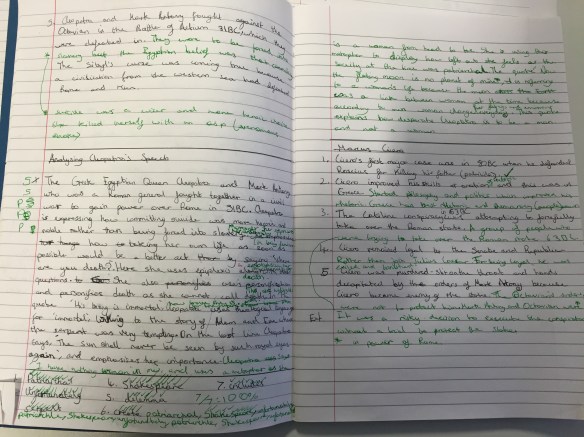
Now, I’m getting into the swing of the Michaela way. I read my pupils’ books once or twice a week. I teach four classes, each with between 28 and 32 pupils, so it is about 120 books in all. I read 60 books in 30 minutes. As I read, I make notes: spellings lots are getting wrong, things they’re all doing well at, and the main issues they need to improve. I note down anyone whose paragraph is amazing to reward with merits or show the class; I note down anyone whose work is messy to give a demerit to. It looks something like this:

FullSizeRender

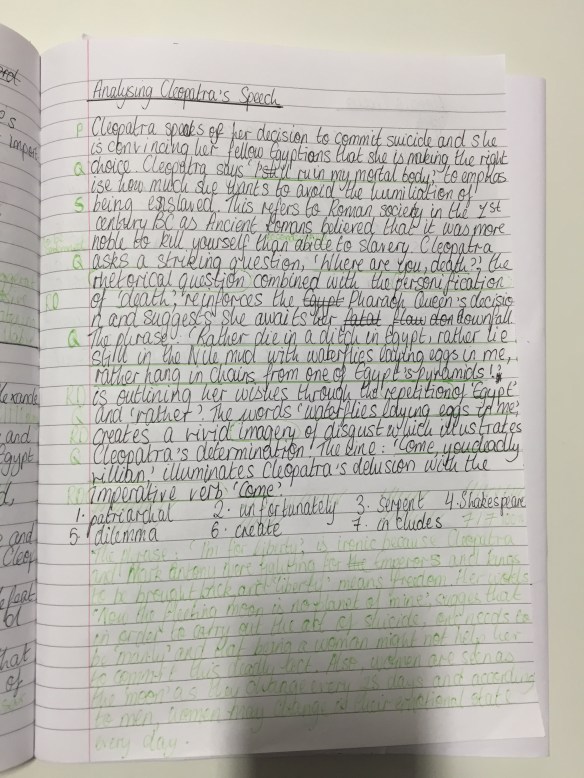
In the following lesson, I teach the spellings from the front, and then test pupils. They will write their corrections out in green pen, interleaving the ones they got wrong, or the ‘toughest three’ if they managed, on this occasion, to score 100%. I’ll test them again the following day. I’ll share the positive things I found and celebrate the star paragraphs, and then explain carefully, perhaps modelling on the board (as Katie Ashford has described brilliantly here or occasionally putting a great paragraph from the class under the visualiser, how they can all improve their own paragraphs. And then they improve them, in green pen. It looks like this:

FullSizeRender

FullSizeRender[1]

IMG_6305

The second powerful tool is in-class feedback. With an excellent behaviour system, silent writing for 25 minutes means I can see every child’s paragraph twice while circulating, giving them suggestions and tweaks while they write. On my colleague Lucy Newman’s suggestion, I’ve also started using my visualiser more. This way, we can take a pupil’s book, display it to the class, and show pupils how to edit their mistakes in that very lesson, just by giving oral feedback on the common errors they are making, or the aspects they really need to focus on improving. 

The thing is, what makes the difference in their writing is the quality of the feedback and how timely it is. They don’t need feedback on a paragraph they wrote two weeks ago. At Michaela, they can improve the paragraph they wrote yesterday, while it is fresh in their minds. I miss marking, I do. But I’m realising I did it for me, not for the pupils.

At what cost?

I know that what I do works.

I know, albeit from just over five short years of experience, that the way I teach children English works. Students enjoy coming to English. They do what I tell them to do. They interact with ideas. They put up their hands, give responses when prompted, discuss when directed, and smile lots. They make good progress, sometimes excellent, progress.

Before, when I was challenged about my practice, I would probably have said something similar to the above.

Now, I am not so sure this is a valid response. Because there is a second, unsaid and often unconsidered half to this sentence.

I know what I do works… But at what cost?

Marking

I mark every student’s book every week, unless they are ill when I take them in. In addition to this, I mark any essays or assessments students have done, whether for a pre-decided mock exam or assessment point, or simply exam practice. When I made the change from fortnightly marking to weekly marking, I saw a dramatic improvement in my students’ progress.

But at what cost?

I have marked, for the last five years, constantly. I have marked in free periods, before and after school, at home, during the weekend and even on flights. Some might say this is the inescapable fate of the English teacher. Yet now I am on a very light timetable, with very small classes, and my marking load appears undiminished. Although what I do works, would I want it to be replicated by every teacher in my team on a full timetable? Absolutely not. If I were to continue in this way, would I remain in the profession? Absolutely not.

If the cost of student progress is teacher burnout, it cannot be worth it.

Intervention

Last year, as Head of English, I checked student data weekly for exam classes. That is because it was constantly changing, what with redrafted coursework, completed Speaking and Listening exams and constant teacher-assessed mock essays and exams. Using this data, I picked out students and created personalised intervention plans. I would confidently estimate that there is practically no year 11 student who was not in some way “intervened” with.

I have given up before school time, after school time, lunchtime, Saturdays, half-terms and Easters over the years. I have altered entire holidays to fit in with a schedule of revision, to the point of cancelling and re-booking flights.

Our students achieved phenomenal results; only King Solomon Academy achieved better in English the year before last for schools in London with comparable amounts of students receiving free school meals.

But at what cost? If I knew I would have to run intervention in this way until retirement, would I stay in this profession? Absolutely not. Do I want to stop running intervention and instead delegate it to my team, asking them to similarly give up weekends and holidays? Absolutely not.

And what of the students? Tired, stressed, but well-prepared; what happens to these students at sixth form? At university? Learning there will always be “extra” put on for them can’t incentivise them to make the most of lesson time.

If the cost of student progress is complacent students and teacher exhaustion, it cannot be worth it.

All the activities

I used to spend hours lesson planning. I would research existing plans and resources, cross-referencing with other teachers’ and TES resources, and trying to make every lesson an individual snowflake, never repeating the same series of activities. I would ensure there was something for everyone, and plenty of opportunities for students to talk together, research independently, collaborate and postulate together. I would review their “learning” and value the “ideas” they came up with, however ill-founded; however misunderstood.

I have had students carouselling, moving, making, standing, dancing, clapping, acting, advocating, laughing, enjoying and even learning while they did this.

And those students did achieve good results.

But at what cost? How many Cs could have been Bs, Bs As, if I had stopped cramming in activities for the sake of engagement and fun, and started simply telling students what they needed to know, and then testing to make sure they had learned it?

Would I have still been addressing classic misconceptions after 3 years of teaching the same class – no, Shakespeare was not a Victorian; no, that’s not where you put a comma…

With my year 10 intervention class last year I tried something different. Shocked by their lack of knowledge and understanding, their lack of retention, I relentlessly talked to them, got them to write independently and then quizzed them. It was a massive uphill struggle, but that struggle was as much against pre-conceived expectations of what their lessons should look like and the expectations I should have of what they were able to access as it was about changing what they remember. And while I struggled on, students knew more, could explain articulately, and could remember and apply challenging concepts. It was far from perfect, but I haven’t seen better progress previous to employing these methods.

If the cost of student engagement is student learning, it cannot be worth it.


We have a responsibility to students, and a responsibility to ourselves. We must be open to new ideas, to new approaches. The proof is in the results: certain methods lead to increased student achievement, happier teachers and a more workable system of education. Whether what I do works is irrelevant – it must work, be sustainable, and lead to the best possible student results.

So the next time someone dismisses your ideas by telling you “I know that what I do works”, you can bite your tongue and keep doing what you do, reaping the benefits for yourself and your own students, or you can ask: at what cost?

Memory: an inset session

On 1st September, I wasn’t as nervous about starting a new school as I was about standing in front of the teaching staff of the secondary school at 10am to make my pitch about knowledge and the curriculum. I advised myself that it is always easier to speak to people you don’t know, yet this did little to assuage my fears: whatever I told myself, first impressions count.

Happily, I have lucked into my second wonderful line-manager in a row, and together we worked on a session that would hopefully engage the teaching staff at the right level.

To begin, teachers had a multiple-choice quiz about memory, knowledge maps and multiple-choice questions. The idea was to put into practice what we would preach about pre-quizzing and how to construct MCQs.

We split the session into two parts: theory and practice. To begin, I took two key questions: how does memory work, and how can we teach to build memory? I used Hirsch’s example of ‘Jones sacrificed and knocked in a run’ to highlight that we don’t always know how important knowledge is unless we don’t have it and suddenly can’t access what looks like a fairly straightforward sentence (stealing from Daisy Christodoulou the sentiment that ‘knowledge is like oxygen: it is vitally important, but we only notice it when it is not there.’ I went on to explore other examples of sentences students required explicit content knowledge to be able to access ideas. Then, using Joe Kirby’s excellent ideas on knowledge and memory, asked what we mean by knowledge – after all, if many of us took a GCSE paper now we would fail it, having completely forgotten what we once crammed in. We need to move from a cramming culture to one of real mastery.

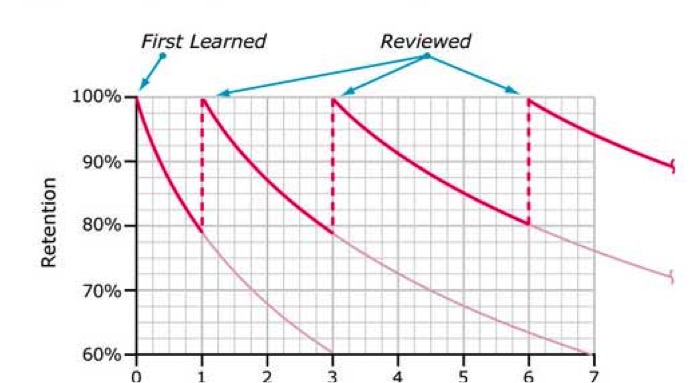
I then shared the forgetting curve, exploring the idea of revisiting to secure concepts in long-term memory, along with Willingham’s advice that ‘memory is the residue of thought’: we remember what we think hard about.

forgetting curve

The two practical implements we focused on were knowledge maps and multiple choice questions. Knowledge maps are hugely useful for three main reasons.

Firstly, they nudge subject leads to make decisions on what to teach. You obviously can’t teach everything about Frankenstein, for example; you must be selective and deeply consider the most vital information you want students to retain for a very long time.

Secondly, they provide clarity to teachers. The first question any new teacher has is ‘what am I going to teach them?’, and a knowledge map answers that in a single slide. They provide further clarity for subject leads in knowing that everyone in their department is on the same page, and are helpful for senior leaders to have more detailed knowledge of what exactly is being taught.

Finally, they are brilliant for revision. Not intended to be only for teachers, students too can be literally on the same page as their teachers. A knowledge map is a powerful tool for revision, helping students to know exactly what it is they need to revise, both as they are taught the unit, and in the months to come.

I then shared three organising principles for knowledge maps. Firstly, they are selective; you should only select what can fit onto a single page. Secondly, their terms are defined – a list of complex vocabulary without definitions is useless as a revision tool. Thirdly, they are organised into manageable sections, allowing teachers and students to focus on the discrete aspects of the unit.

To assuage the fears that MCQs could not test skills, I shared some examples. The first tests pure recall, which is of course important. The second two test application of that knowledge, looking at how well students can infer and analyse. I explained how each of these latter questions still relied on a huge breadth of student knowledge – you need to know the meanings of the poetic terms in order to decide whether they are being used in the example.

  • When did Coleridge write ‘The Rime of the Ancient Mariner’?
  • a) 1665
  • b) 1793
  • c) 1797
  • d) 1815
  • e) 1816
  • ‘I, the true murderer, felt the never-dying worm alive in my bosom, which allowed of no hope or consolation.’ Which language techniques are combined here, and what is the writer trying to suggest?
  • a) In this quotation, onomatopoeia and religious imagery are used to emphasise how disgusting Frankenstein is.
  • b) In this quotation, a simile and religious imagery are used to emphasise that the death of Justine will never be forgotten.
  • c) In this quotation, pathetic fallacy and natural imagery are used to emphasise how destructive what has happened is.
  • d) In this quotation, prolepsis and a metaphor are used to suggest that the creature will wreak his revenge.
  • e) In this quotation, a metaphor and graveyard imagery are used to emphasise how destructive the guilt Frankenstein feels is.

Drawing heavily from people much smarter than I on MCQs, I explained three reasons for using them. Firstly, workload: although requiring a much greater effort upfront, MCQs are quick to mark and can be used year after year, compared with the uphill struggle of the essay, which is quick to set, but must then be marked 30 times, at length, year after year after year. Secondly, MCQs allow for a much clearer diagnosis of what students do and do not know – in an essay, where a student misplaces a comma, we might not be sure if they do in fact know how to use a comma, but were distracted by exploring Macbeth; or if they can use a comma for lists but not to separate clauses, or if they can’t use a comma at all. With MCQs, you can test each of these aspects separately, and have a much clearer diagnosis of what students know and do not know. Thirdly, MCQs enable teachers to test the breadth of their subjects, not just the depth; with MCQs, we can find out what students know about every single theme and language technique, compared with an essay which might focus on one theme, and include examples containing three or four techniques.

After sharing some key principles for creating MCQs – five options to avoid guessing, plausible distractors to make it challenging, unambiguous distractors to avoid contention over multiple responses, building misconceptions into the distractors, and including more than one correct option, subject teams had 15 minutes to make five using a subject-specific text they had brought along.

Finally, teachers re-did the do-now test as a plenary. Looking through teacher responses really helped me to see where my explanation had been clear, and where I need to clarify at a later inset. In particular, almost no-one managed to get the multiple correct options right; often they would get two of the three, for example. This made me consider that multiple correct options might be too tricky for students at the start of using MCQs, or that we should flag up how many correct options there are in the question.

I was excited to find for the rest of the inset days a number of presenters used MCQs, and my colleagues referring to ‘distractors’ as they noted some ‘ambiguous’ or ‘implausible’ ones where they occurred. More than that, though, I was overwhelmed by the excitement and energy expressed by so many teachers on these ideas.

Memory Inset

Handout

What makes great teaching?

Before the summer, I asked on Twitter for advice on making a department handbook. The overwhelming response? Don’t. No-one will read it, it’s oppressive and not useful, it’s a bureaucratic tick-box exercise.

Much as I sympathised with such views, having new teachers join the department, and tending to spend much of my time (literally) running around the corridors of the school, I felt these teachers needed something to refer to when I (or a seasoned teacher) could not be found.

Brimming with hubris, I decided to open the handbook with “Teaching and Learning”, and proceeded to randomly write down ideas I had for what I think makes great teaching. It’s by no means an exhaustive, or even logical, list, but I’d be interested in the thoughts of others. I have pasted below exactly from the handbook, word for word.

Relationships

  • Like your students and tell them
  • Value what they say in class – ensure everyone is listening and taking note when anyone is speaking
  • Call home positively for as many students as you can. Do this early on and save yourself many negative calls later
  • Be there for your students emotionally, but remember you’re their teacher – refer on any pastoral issues promptly
  • Ask students to reflect on their learning and be honest with you about what they need more of. Be responsive to their needs

Mindset

  • Believe in the unlimited potential of all your students to succeed. Share this belief with them
  • Challenge your students to do better, even when they have “achieved” their “target” grade
  • Remind students who aren’t there that they aren’t there yet – further effort will not be in vain

Goals

  • Set clear goals for each lesson, each week, each term and unit of work. Share these goals with students

Feedback

  • Ensure written feedback is timely
  • Allow students time to ask you questions about your feedback
  • Give students time to respond and correct errors

Questioning

  • Challenge student answers – get them to develop their ideas further
  • Never accept “I don’t know” – always ask another student to help out so they can repeat the answer
  • At the same time, ensure all your students know “I don’t know” is fine to admit, as long as they show themselves ready to learn after saying this
  • Bounce questions to other students to answer
  • Practice hands down questioning regularly so all students are listening and ready
  • Aim to speak to each student at least once in each class

Pratice

  • Independent practice using key skills should be built into every lesson
  • Students should be supported by teachers during independent practice (e.g. circulating and making verbal corrections/suggestions for improvement as students write)
  • Bear in mind you might need to explicitly teach skills you take for granted – e.g. taking notes, the right place for a comma, what a verb is

Behaviour management

  • Expect 100% compliance with 100% of your instructions 100% of the time
  • Phrase instructions positively
  •  Talk about choices
  • Never allow students to “earn off” a sanction
  • Have a no excuses culture – one high standard for all
  • Have high expectations of behaviour – silence means silence; group discussion of the task means no off-task chat
  • Have clear and unchanging policies for all misdemeanours, no matter how minor, that you apply equally to all students (remember that it is not the severity of the sanction that is important but the certainty of the sanction)
  • Give specific praise – verbally and written
  • Narrate positive behaviour you wish to see in all your students
  • Avoid singling out students for chastising publicly, at least the first time you note off-task behaviour

Share and celebrate success

  • In class, verbally and frequently
  • Copy great work and share with the class
  •  Ensure students buy into learning as a desirable success to aim for
  •  Share success stories (students who have made incredible progress through hard work)

Knowledge

  • Have deep knowledge of the material you are teaching which goes beyond what students “need to know”
  • Use material throughout the curriculum to challenge students and empower them to find their place in any walk of life they choose

Discussion

  • Engage students in debate/discussion – allow them to reason through answers and ideas themselves. Challenge them to uphold their thinking. Ensure it is ok to change your mind with new evidence
  • Encourage structured and purposeful student talk

Differentiation

  • Know where your students are, using recent data, marking and assessment for learning in lessons
  • Plan the next step your students need
  • Teach to the top, support at the bottom
  • Tell your Teaching Assistant (if you have one) what they can do to most help your students

CPD

  • Be aware of your strengths and areas for development as a teacher
  • Share good practice (e.g. during department meetings)
  •  Go and see teachers who do something you’d like to do
  •  Raise development needs with your line manager so the department CPD can be appropriate

Assessment

  • Mark student books regularly (at least every 2 weeks)
  • Level or grade student work once a half term. Remember that levels/grades are not as important as developmental feedback, but these levels/grades will help you to complete Assessment Point 1, 2 and 3
  •  After assessments, spend time exploring what students need to do next time to improve

Homework

  • Set students homework which builds on their learning in class
  • Homework should be reasonable
  • Be aware that computer access is an issue for some students
  • Be aware that some students will thrive on “homework extensions”
  • Build in spelling and grammar to your homework routine
  • Set homework on the same day/s every week
  • Ensure students write homework in their planners 

Communication with parents

  •  This can form the key to excellent student progress
  • Try to ensure your first contact with parents is positive
  •  Don’t be afraid to call a meeting with a parent; ask your line manager to attend as well if there are pressing issues you need to discuss in person prior to parents’ evening

Reading exercise books

Marking as an English teacher means you spend most of your week reading. If I am honest, most of what I read is what I mark. A set of exercise books can become a novel; more than a novel depending on the class size. A novel, of course, full of repetition and analysis. Perhaps, then, more a book of critical essays.

A recent conversation prompted me to realise that while anyone I have worked with knows that marking is 1. My absolute favourite part of teaching and 2. The way I spend almost every evening, weekend and holiday, I have somehow neglected to say very much on the subject here. Below is my attempt to shoe-horn my ideas about marking into a blog about reading.

Teaching lessons: in my first year in the classroom, I found I wasn’t terribly good at it. I read Phil Beadle’s How to Teach, wherein he writes: “make no mistake: this is the most important thing you do as a teacher… mark their books with dedication and rigour and your class will fly.” Essentially, Beadle contends, you can be the greatest educator ever, but if you don’t mark, your students won’t progress; conversely, you can be a bit of a rubbish teacher, but if you mark well, great things could happen. In my first-year-teacher despair, I clung to marking.

While my mentor and line manager watched me hunched over yet another pile of books (“you’re marking again Jo?”) and begged me to instead spend more time planning semi-decent lessons, I ploughed on regardless, writing buckets of WWWs and EBIs on every page a child’s pen had reached. I handed books back, and rushed to deliver my next rubbish lesson.

Happily, what I learned from this was to balance my time more effectively. I went on to spend less time marking, to mark less frequently and say less, and taught better lessons where children went on to make some progress, as well as making my life less of a nightmare.

Indeed, as the years have gone on, it seems that the thinking around marking, at least in my sphere of existence, has become ever-more progressive and manageable. If the mantra of my mentors early on was “mark less!”, it is now “write less!”

I’ve read so many excellent blogs on time-saving marking, notably from Joe Kirby; and Alex Quigley has signalled my earth-changing, life-altering view of marking, and made me realize that “marking” as a term is horribly outdated. What we need to talk about, instead, is feedback. (Indeed, Quigley’s department has a feedback policy as opposed to a marking policy, a semantic shift I adore.)

When we mark a student’s book, they need to spend about as much time doing something with that marking as I spent giving feedback. This means that rather than writing “nice notes” as I had been advised early on (“put something on every page, so Ofsted don’t think you’ve ticked and flicked”), I do tick and flick their notes (if they are there and in good order; if they are not I tend to write “WHERE ARE YOUR NOTES?!”). I mark their extended writing closely, but not too closely if it’s riddled with errors – most of their ideas are good, and the human brain can process only so much red/pink/green ink.

At the end, I write an encouraging comment (unless they have been truly lazy) and a target. I used to check students had met their target the next time I marked their books, but I now recognize this is not the most effective way of target setting. I now phrase their target in such a way as to encourage editing there and then. And, crucially, I give students time to go back and improve their writing.

The first ten to twenty minutes of the following lesson can then be spent improving a decent paragraph and making it marvelous. The efficacy of this exercise very much depends on what you have written as a teacher; your comments need to be specific, detailed and open-ended, allowing students to add to their responses without needing you to stand beside and cajole each letter from their biro.

Interestingly, in our department’s mock-Ofsted last year, the English specialist pulled out a couple of books that he believed showed outstanding marking. These books had a relatively small amount of ink spilled, but it was done in a miraculously effective way. Teachers had written short, pointed questions at key moments, and students had responded and improved their work. Easy as that: marking not to build confidence, not to check every error, not to show Ofsted we have marked – marking, instead, that allowed students to progress, and allowed teachers to mark without wanting to kill themselves. What a relief!

I haven’t written about the state students keep their exercise books in, because it’s not something I’m especially concerned about. Perhaps another year I will endeavour to inspire students to keep their books pristine, but I’m not a very visual person, and I can’t help but overlook dog-eared covers for the glorious writing inside.

All of this sounds so painfully straightforward, I wonder if anyone is still reading. There will always be new ideas, and new approaches. Yet the core of marking is beguilingly simple: mark often, mark strategically, mark specifically, and make the students do some work too.

Being the teacher Year 10 deserve

I have what has been termed as an “intervention” group in year 10. Last year, when making the set lists, I decided to make a top set and then mix the rest of the year; it was then decided that certain students would take one less GCSE and have three extra lessons a week: one in English, two in Maths. So the two intervention groups came about, and I took one.

Why do these students need extra English? It’s not because they’re stupid – but then, I’m not sure I’ve ever met a stupid child. It’s not because they’re illiterate, although I do wish they would read more. They seem to be behind their peers, in terms of their raw data, and for that I can think of many reasons, which I would imagine are the same reasons any “intervention” child is behind. What it boils down to is time and effort. At some point, for some reason, these students have lost time in English. They have missed lessons, or they have been in lessons in body only. Many of them aren’t the well behaved angel children I am accustomed to dealing with (joking – though my year 11 class does seem fairly rammed with angels).

The bottom line is that these children deserve the best teacher. They have to cover more ground in less time; they have less than two full years, and time is ticking.

But I’m filled with doubt. Am I the teacher they deserve? Can I dedicate enough time, energy and effort myself? With all my other classes exam classes, with running a department, and with the additional responsibilities of being a member of the SLT, can I be that teacher?

These children need to be inspired. They need to feel awe and wonder in their English lessons. They need to be thirsty for knowledge, keen to read and learn and close the gap. Can I muster the energy to inspire them six times a week?

These children need to be nurtured. They need to be comforted when things go wrong, they need to feel safe in my classroom, they need to know that they have the space to get things wrong because that is what learning is. They need to be cared for, and their parents need to be told when they are wonderful, every time they are wonderful. Can I care for each and every child individually?

These children need to be in the room. They might behave in ways which eventually lead to being sent out, but when they do that in every lesson every week, it is clear that they are desperate to avoid the learning. They need to be sanctioned in multiple ways, outside classroom time, and those sanctions need to be both horrible and long. Can I improve my planning and pedagogy to the extent that I can ensure no-one needs to be sent out of my classroom? Can I follow up every sanction relentlessly?

These children need to receive excellent feedback. They need to fill their books with work they are proud of, with paragraphs that improve every week, where they understand the next steps towards achieving in English. Can I mark every book every week, let alone every lesson, with comprehensible guidance to lead them in the right direction?

I don’t think there is a teacher in the world who hasn’t had a class like my year 10. In fact, there probably isn’t a teacher anywhere in the world who doesn’t have this class right now: the class where every moment is vital, every interaction make or break, every comment taken to heart. This week, I have invited teachers into my lessons and taken their feedback, tracked down students in between lessons to smooth over issues, phoned parents and re-read parts of my go-to teacher manual Teach Like a Champion before and after every class. Next week there will be more visitors to the class, and more phone calls, more emails, more marking, more reading, more encouraging, more consoling, more understanding.

Things are improving, but I’m not the teacher they deserve.

Yet.

New teachers

Teaching is absolutely the best job in the world, but it doesn’t always feel like that. The first year of teaching was, for me, the hardest. Yet in a way it is almost the best: in no other time of your career will you go so far so fast. By the end of the year, you will seem to be decades ahead of where you began. Here are some of my tips for new teachers.

Fake it til you make it

No-one needs to know you’re a new teacher, and it can be helpful to forget this fact yourself. Cling to all your past experience, whether that be in your placement school for your PGCE, or your Summer Institute teaching practice with Teach First, or your TEFL experience, or even tutoring your sisters/brothers. It all counts in the big performance of not carrying your new teacher baggage with you. Pretend, pretend, pretend.

Learn their names and use them

With every new class, I have a clipboard with the seating plan. Within a week, the clipboard can go away. Consult it for every question asked, for every hand up, for every cold call. Use the students’ names as often as you can – it means a lot to a child that you have learned their name, and you will be surprised at how offended they will be if you mispronounce it, even by a syllable.

Call home to say nice things

My mentor used to make three positive calls on a Friday before going home – no matter how bad your week, this will make you feel better and pave the way for a more positive Monday. On my darkest days even now I will call home to five or six students to say “well done.” It is great for the student, but also reminds you: you have done a good job. Indeed, parents will often be magnanimous in assigning you as the cause of their child’s wonders – on a tough day, take the credit.

Praise three before sanctioning one

Your students come into the room, and inevitably the first thing you will notice is the one (two, five, seven) doing something wrong. The temptation is to immediately call out these students. In the early days, however, a wall of misbehaviour can feel overwhelming: if you call out one/two/five/seven and not the other one/two/five/seven (“it wasn’t only me!”) you can redouble your problems. Try praising three before calling out any. Lee Canter talks about “behaviour narration”: “I can see X is standing behind her chair”, “has taken his coat off,” “is ready to learn,” “is doing the right thing,” for three students will usually ensure you have far fewer to sanction as more and more fall into line, wanting you to say their name positively. Most students just want some attention. If they know you will give it for positive things first, they may well switch their behaviour.

Don’t back down

That said, you will need to sanction students. In the heat of the moment, I know I often ran to the wrong sanction; usually one too harsh for the crime committed. No matter – stick to your guns. You threatened a one-hour detention? They sit a one-hour detention. You know you were wrong and you probably won’t do it again, but if you back down or negotiate with students who have done something wrong they will not learn to respect you. That said, do use that hour to reassure the student that you know they can succeed. And remember: it’s not the severity of the sanction but the certainty. Three minutes of their lunch hour will hurt just as much (and you can get on with your life).

Mark books

At the start of the year, look at your free periods and when you see your classes and set out a marking schedule for yourself. If possible, give yourself at least a day – don’t try to turn around a set of books from Wednesday to Thursday, for example. Think about how big (or how demanding) your classes are and make a rota; so all things being equal I would mark year 7, 9 and 10 one week and then year 8 and 11, as year 11 will want your most brilliant marking prowess. (This is, of course, assuming you are an English teacher with a normal amount of classes.) When you take in books, ask students to turn to the page you last marked: this way, you can have the last target you set in the back of your mind, as well as saving valuable seconds (they really do add up) by not having to find the right page to start on.

Be yourself

When attempting to “fake it til you make it,” it can be tempting to emulate your mentor, or your own favourite teacher from school, or the scary teacher you wish you were (I have tried and failed at all of these). Students see through it. You have to be yourself. I find it really hard to not smile and have a laugh with students; in the early days I suppressed this and found myself called out as a classroom ogre. It didn’t feel right. You will find your own classroom personality, and it might not fit any of the preconceived ideas you have about what being a teacher is. No matter. No-one will be you.

Good luck!

Too much fun

Perhaps it is the people whose work I encounter, but I feel recently as if, in general, the advice out there for teachers right now is: don’t have too much fun. It’s all about rigorous learning. And to a certain extent, I agree: children are in school to learn; we are educators, not entertainers, and if you plan a lesson to be “fun”, chances are students will leave having not learned much. I also know that each teacher is different, and has a different style, and that variety is part of the patternless pattern of all aspects of life.

But I also know I am guilty, deeply guilty, for having far too much fun. Clearing out my phone, I found a note written on 11th August 2013 called “new school year resolutions”. Many of these were regarding having an actual life beyond school, but the last reads: “improve rigour of learning – set the tone.”

Anyone who has met me will be aware that 1. I have zero capability of poker face and 2. I smile too much. Neither of these aspects bode well for a teacher. Somewhere along the line, I have learned to do an impression of an angry face, which is moderately effective. (Though quite a few of my students find this face hilarious, so I’m not sure it ever quite has the desired effect.)

You see, selfishly and stupidly, I still can’t quite get over my luck. Every single day I get to turn up to a place filled with wonderful colleagues, a desired level of challenge, a sense of academics, books, and children who really, really want to learn almost all the time. When I see students lining up for a lesson, even if I’ve had a terrible morning or a horrible meeting, I can’t help but grin. They’re so full of energy and hope, they give me energy and hope.

This might sound lovely to any non-teachers reading this, but too often this happiness bubbles over into fun. I’m not saying I plan lessons to entertain, I just get a little over-excited when teaching. I make only a few silly jokes and do a great impression of a teacher most of the time, but the tone of most of my lessons is a bit like a very controlled reading party.

Don’t get me wrong, I teach from the front for some time every lesson, and I make them write on their own for a quarter of the lesson. But in between that, my students can be trusted to discuss and try out and push limits and (crucially) stay on task. I still believe discussion is a necessary precursor to writing analytically. This discussion can be framed and guided; the activities around the texts can be varied and can occasionally involve a creative twist. These activities must be linked to the learning objective and the final desired outcome, but equally they must be engaging, or no-one will do them, and no-one will learn anything, and no good will come.

I have bad days and sad days, and days when it’s just not working, when I find myself giving too many warnings and even sending students out. I know I am the difference in the room, and with my usual approach that student would be sitting down doing the work. I know that extra effort on my part can make the difference, but it’s not easy to consistently manage behaviour in a completely positive way in 10 out of 10 lessons (though very many teachers do it), especially at the end of a term when you are tired and they are tired. After all, the stuff of learning is hard, and teachers and students alike both have bad, sad days.

So, where is this going? I’m not sure how much I agree with my August self. I have found that when I “set the tone” in this rigorous way, it tends to translate into overly didactic, overly controlled and overly sombre experience. I’m being someone else, and I’m not a good enough actor for my students to trust that person. I’ve always found that students respond to reality: they need to know the person you present to them is who you really are (not the same thing as knowing anything about your private, non-teacher life). And what I hesitate to add for fear of hubris is that my students do really well; often far beyond what is expected of them. If what I did wasn’t working, I would change it, immediately, despite my personal reservations and predilection for having a fun time.

Perhaps in the past too much emphasis has been placed on fun. But a lesson devoid of joy doesn’t work for me; it doesn’t make teaching a career I want to be in and it doesn’t make my students learn.