Shapiro at the Sam Wanamaker: 2nd October 2015

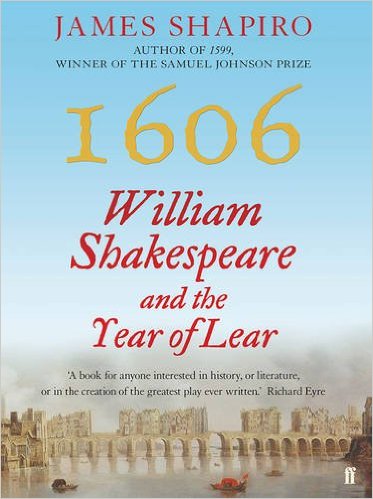
I wrote last year about the first Shapiro lecture I attended at the Sam Wanamaker theatre, when I was terribly excited to hear his next book would be on 1606, Jacobean London. Shapiro’s latest talk accompanied the launch of said book, and to open his talk he humorously positioned the book on the stage behind him ‘in case I forget anything.’

As before, Shapiro did not have a pre-prepared speech; he simply took questions from the audience. The first: why 1606? Shapiro said that academics tended to ‘divide up Shakespeare’ within their department to ‘before Hamlet and after Hamlet. Because no one wants to give up Hamlet.’ Having taught ‘before Hamlet’ for many years, he humbly protested: ‘I needed to know more about that time.’

Asked about a Freudian interpretation of King Lear, he replied: ‘I live back then;’ he expanded this to say that a contemporary audience member didn’t see Lear in this way, and though Freud and others provided interesting interpretations, that wasn’t where his interest was. He pointed out that the 1600 version (‘Leir’) ended happily, and so for Shakespeare to change the ending so dramatically was akin to a theatre-goer now turning up to Pride and Prejudice and seeing Darcy and Elizabeth hit by a truck during their final embrace.

On Shakespeare the man, Shapiro argued we can never know, because far too much is lost. Any scholars who do begin to assume what he was like, he noted, were merely giving their own autobiography, and their versions of Shakespeare tell us far more about themselves than about him.

The most interesting utterance to me as a teacher was to hear that Shapiro ‘hated Shakespeare’ at school. The reason for this? ‘I didn’t get it. I didn’t get Romeo and Juliet. I didn’t even get the dirty bits.’ Although Shapiro does focus on context in his work, and in placing the plays and the playwright in their time, the other focus he drew out in his talk was understanding: if we can understand the words, and take our students to brilliant productions where they understand the words, that will hook them into Shakespeare. Shapiro works with a prison theatre group on Rikers island in Chicago, and they put on Shakespeare productions in original language. He mentioned talking briefly to the audience of inmates before each production and being asked the same two questions – ‘how many plays did Shakespeare write?’ and ‘is he still alive?’ This latter question contextualises the literary awareness of the inmates, and yet he notes that they engage with the plays vibrantly, citing a moment when Hero in Much Ado faints and an inmate yelling out: ‘she’s down!’

Such an anecdote is inspiring and comforting. We don’t need to ‘dumb down’ Shakespeare for our classes – we just need to understand every word ourselves (no easy feat) so we can lead our students through it and ensure they too can react and enjoy the plays as they have been enjoyed for hundreds of years.

1606

Planning for mastery

As a follow-on to the initial inset session I have written about previously on memory, I was excited to build on these ideas in delivering a CPD session on planning for mastery with an extraordinary Lead Practitioner, Sophie Smith, who has championed Ark’s English Mastery course of lessons at my school for the past year.

That said, as scary as a day one inset it, you know teachers will be automatically more excited and engaged than at 4pm on a Wednesday, two weeks into term time, when a stack of marking beckons. Showing my draft to a colleague, the feedback was: ‘more pictures.’ I’m not a very visual person, so can’t claim credit for any images on the powerpoint – these are all the work of Sophie.

We began with another paper ‘do now,’ but this time I wanted to collect an insight into people’s thinking about education: what, in their view, was the purpose of education? How good was the current planning in their area? What were the most important aspects of planning? And how much time did they spend on those aspects?

First, I wanted to link mastery planning to the school’s context. We know that our children arrive to us further behind than more advantaged children, who have more social and cultural capital, along with simply knowing more stuff, and having practiced stuff more. I also wanted to pick up on a challenge I’d been given in the feedback from the first session: ‘where is the space for children’s creativity?’ asked one colleague. I asked teachers to think of the most creative child they had encountered: the one who had thought of a new way to solve a problem in maths, or had asked a curious question in science, or had linked different factors together in history. Ninety nine times out of a hundred, those children are also the ones who know the most. This correlation suggests to me that knowledge is the essential bedrock of creativity. You can’t create successfully in a vacuum.

We then posed the question: how do you teach a year 11 class who have an exam in a week’s time? Is it the same or different to your usual teaching?

In retrospect, this question would have worked better later in the session, or perhaps in a later session. There is too much to consider in changing the planning paradigm to successfully cover it all in an hour. What we wanted was for people to note the urgency with which they taught year 11 before an exam, and for us to link this urgency to our way of planning in all years – because time is short, and we have five years to close a significant gap.

I then shared what I found to be a useful distinction from Joe Kirby on planning: changing the paradigm from engaging starter, exciting activities, and reflective plenary to recap, instruction and deliberate practice. (I’ve added ‘deliberate’ to Kirby’s wording for two reasons: firstly, because we need to be completely focused on practising the specific aspects our students most struggle with, and secondly because without it the memorable phrase: ‘Recap, Instruction, Practice’ spells ‘R.I.P,’ which I felt would not connote a happy paradigm for teachers.)

Why is this so important? We know our students come to school massively far behind; research shows that less advantaged children at aged five have heard 30 million fewer words than their more advantaged peers. We also know that, nationally, students on free school meals achieve nearly half the five A*-C including English and maths compared with their more advantaged peers. We can’t do anything about how our students come to us, but we do have five years to close that gap to ensure they aren’t leaving us academically deprived.

Then, instead of citing the Sutton Trust’s research on motivation as I had planned (‘too many words! More pictures!’), Sophie engaged teachers with the cart and horse analogy: we often see self-esteem as the horse, pulling along the achievement, but in fact it is the opposite: achievement drives motivation and builds self-esteem; when children start succeeding at school, they are more likely to buy in.

We shared four key concepts on planning for mastery: select the content, sequence it, teach it, and quiz it. In retrospect, each could be a session by itself. Sophie shared the more rigorous texts brought in with English Mastery, and we asked departments to discuss how much children should read in their subjects, and what they could get them to read. In sequencing, I emphasised considering both the knowledge and practice gap when planning any lesson. For teaching, I didn’t go into nearly enough specific depth, and allowed departments to discuss themselves what they felt the highest leverage teacher actions were, with some interesting results. And finally with quizzing, I cited the knowledge maps and multiple choice tests we were already creating and which could be easily reused.

Subject teams took fifteen minutes then to look over a lesson together alongside these key principles and edit it. We finished with a similar quiz, with room for teachers to write their concerns and needs for support. Most wrote ‘time,’ and a few asked for support in making knowledge maps or finding rigorous content. The next most prevalent concern was meeting the needs of all students, which I will be writing about soon.

In reviewing the feedback sheets, I was interested to gauge the teachers’ response to the do now question: what is the purpose of education? Rank these statements 1-6 where 1 is the most important purpose. The vast majority, 60%, rated ‘forming good, kind and moral individuals’ as the top priority, followed by ‘preparing our students for the world of work’ at 27%. Not a single person chose either of these options as the most important purpose: ‘ensuring our students achieve the highest results in national exams’ or ‘teaching our students rigorous content so they outperform their peers in exams’. For the least important, 37% chose that latter option. The next most popular least important choice at 33% was ‘teaching our students the best of what has been thought and said.’

Mastery CPD

Do now (1)

E. D. Hirsch at Policy Exchange

I’ve written previously about the impact Hirsch’s ideas in Cultural Literacy had on me, and so, with all the zeal of a convert, I clamoured to hear him speak at Policy Exchange last week.

Nick Gibb introduced Hirsch, outlining the influence he had on his thinking and the direction of travel in the Department for Education. He noted the strong social purpose behind Hirsch: the desire to equalise the distribution of intellectual capital in society, and compared this to the 2007 National Curriculum’s hostility to teaching prescribed knowledge.

Hirsch followed, quipping amiably: ‘it’s so rare for people in the USA in high political office to read books,’ before launching into a forty minute survey of his major educational theories. He explored the idea of developmentalism – to allow a child to develop on their own – and noted the ensuing confusion from such a disparate method of education, and gave some of the theoretical history which underpinned such notions.

Behind every utterance, the drive to use curriculum to equalise society was discerned. Explaining the wrong-headed focus on teaching reading skills, Hirsch cited Willingham’s research which suggests that ‘about a week’ is enough time to teach children ‘reading skills;’ ‘any more than that is a waste of time.’ High reading ability can only be achieved by a broad, wide-ranging and well-rounded education. He cited studies of poor readers who could outperform good readers when they knew more about the given topic, and, perhaps more fascinating, that students with low IQ and high IQ who both knew lots about the topic did equally well in reading about it. Knowledge, for Hirsch and most of his audience, overcomes ‘brute handicaps.’

Furthermore, just as the novice finds it debilitatingly hard to look up new vocabulary in a dictionary (in particular, discerning the ambiguities of words), so the internet age rewards those who already have wide knowledge: ‘Google is not an equal opportunities fact finder.’ I know from sending students off to ‘research’ a topic that this is true – too often they stumble across extremely dubious sites, and come away with ever more misconceptions than they began with.

The overriding purpose of education, for Hirsch, is an acculturation of children into society; we need to teach them the language and ideas of that society before they can enter into its dialogue. For those who worry that teaching knowledge is indoctrination, this is a vital point: it is impossible to (successfully) argue from ignorance. The old paradigms of transferable skills and discovery learning ‘have not been successful in bringing about equality’: core knowledge, conversely, has shown a remarkable gap-closing propensity in Massachusetts, Japan and Shanghai among others.

Throughout, Hirsch was self-effacing, describing himself as a classic ‘hedgehog’, knowing ‘one big thing’ (‘I just go around, repeating my one big thing’). We are so grateful to the Inspiration Trust for bringing Hirsch to London and to Jonathan Simons and Policy Exchange for organising this lecture so we can hear this legend repeat this one, big, hugely important thing.

IMG_5282

Memory: an inset session

On 1st September, I wasn’t as nervous about starting a new school as I was about standing in front of the teaching staff of the secondary school at 10am to make my pitch about knowledge and the curriculum. I advised myself that it is always easier to speak to people you don’t know, yet this did little to assuage my fears: whatever I told myself, first impressions count.

Happily, I have lucked into my second wonderful line-manager in a row, and together we worked on a session that would hopefully engage the teaching staff at the right level.

To begin, teachers had a multiple-choice quiz about memory, knowledge maps and multiple-choice questions. The idea was to put into practice what we would preach about pre-quizzing and how to construct MCQs.

We split the session into two parts: theory and practice. To begin, I took two key questions: how does memory work, and how can we teach to build memory? I used Hirsch’s example of ‘Jones sacrificed and knocked in a run’ to highlight that we don’t always know how important knowledge is unless we don’t have it and suddenly can’t access what looks like a fairly straightforward sentence (stealing from Daisy Christodoulou the sentiment that ‘knowledge is like oxygen: it is vitally important, but we only notice it when it is not there.’ I went on to explore other examples of sentences students required explicit content knowledge to be able to access ideas. Then, using Joe Kirby’s excellent ideas on knowledge and memory, asked what we mean by knowledge – after all, if many of us took a GCSE paper now we would fail it, having completely forgotten what we once crammed in. We need to move from a cramming culture to one of real mastery.

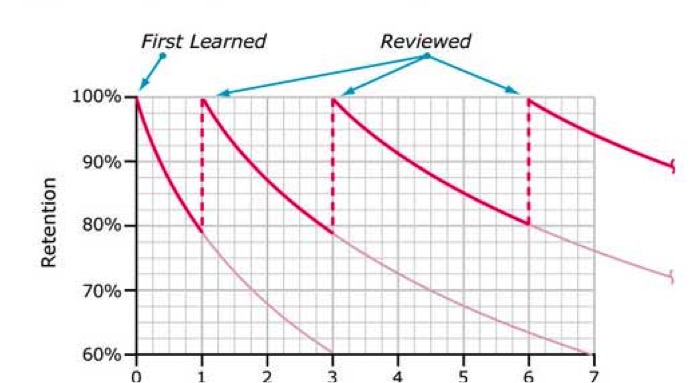
I then shared the forgetting curve, exploring the idea of revisiting to secure concepts in long-term memory, along with Willingham’s advice that ‘memory is the residue of thought’: we remember what we think hard about.

forgetting curve

The two practical implements we focused on were knowledge maps and multiple choice questions. Knowledge maps are hugely useful for three main reasons.

Firstly, they nudge subject leads to make decisions on what to teach. You obviously can’t teach everything about Frankenstein, for example; you must be selective and deeply consider the most vital information you want students to retain for a very long time.

Secondly, they provide clarity to teachers. The first question any new teacher has is ‘what am I going to teach them?’, and a knowledge map answers that in a single slide. They provide further clarity for subject leads in knowing that everyone in their department is on the same page, and are helpful for senior leaders to have more detailed knowledge of what exactly is being taught.

Finally, they are brilliant for revision. Not intended to be only for teachers, students too can be literally on the same page as their teachers. A knowledge map is a powerful tool for revision, helping students to know exactly what it is they need to revise, both as they are taught the unit, and in the months to come.

I then shared three organising principles for knowledge maps. Firstly, they are selective; you should only select what can fit onto a single page. Secondly, their terms are defined – a list of complex vocabulary without definitions is useless as a revision tool. Thirdly, they are organised into manageable sections, allowing teachers and students to focus on the discrete aspects of the unit.

To assuage the fears that MCQs could not test skills, I shared some examples. The first tests pure recall, which is of course important. The second two test application of that knowledge, looking at how well students can infer and analyse. I explained how each of these latter questions still relied on a huge breadth of student knowledge – you need to know the meanings of the poetic terms in order to decide whether they are being used in the example.

  • When did Coleridge write ‘The Rime of the Ancient Mariner’?
  • a) 1665
  • b) 1793
  • c) 1797
  • d) 1815
  • e) 1816
  • ‘I, the true murderer, felt the never-dying worm alive in my bosom, which allowed of no hope or consolation.’ Which language techniques are combined here, and what is the writer trying to suggest?
  • a) In this quotation, onomatopoeia and religious imagery are used to emphasise how disgusting Frankenstein is.
  • b) In this quotation, a simile and religious imagery are used to emphasise that the death of Justine will never be forgotten.
  • c) In this quotation, pathetic fallacy and natural imagery are used to emphasise how destructive what has happened is.
  • d) In this quotation, prolepsis and a metaphor are used to suggest that the creature will wreak his revenge.
  • e) In this quotation, a metaphor and graveyard imagery are used to emphasise how destructive the guilt Frankenstein feels is.

Drawing heavily from people much smarter than I on MCQs, I explained three reasons for using them. Firstly, workload: although requiring a much greater effort upfront, MCQs are quick to mark and can be used year after year, compared with the uphill struggle of the essay, which is quick to set, but must then be marked 30 times, at length, year after year after year. Secondly, MCQs allow for a much clearer diagnosis of what students do and do not know – in an essay, where a student misplaces a comma, we might not be sure if they do in fact know how to use a comma, but were distracted by exploring Macbeth; or if they can use a comma for lists but not to separate clauses, or if they can’t use a comma at all. With MCQs, you can test each of these aspects separately, and have a much clearer diagnosis of what students know and do not know. Thirdly, MCQs enable teachers to test the breadth of their subjects, not just the depth; with MCQs, we can find out what students know about every single theme and language technique, compared with an essay which might focus on one theme, and include examples containing three or four techniques.

After sharing some key principles for creating MCQs – five options to avoid guessing, plausible distractors to make it challenging, unambiguous distractors to avoid contention over multiple responses, building misconceptions into the distractors, and including more than one correct option, subject teams had 15 minutes to make five using a subject-specific text they had brought along.

Finally, teachers re-did the do-now test as a plenary. Looking through teacher responses really helped me to see where my explanation had been clear, and where I need to clarify at a later inset. In particular, almost no-one managed to get the multiple correct options right; often they would get two of the three, for example. This made me consider that multiple correct options might be too tricky for students at the start of using MCQs, or that we should flag up how many correct options there are in the question.

I was excited to find for the rest of the inset days a number of presenters used MCQs, and my colleagues referring to ‘distractors’ as they noted some ‘ambiguous’ or ‘implausible’ ones where they occurred. More than that, though, I was overwhelmed by the excitement and energy expressed by so many teachers on these ideas.

Memory Inset

Handout

Research Ed 2015

There is surely no better way to begin the school year than immersing yourself in the genius of other educators. Compared with the last two conferences, though, this is the first I have attended every session, and not felt overly exhausted by the close – a testament, I think, to beginning the school year in a dynamic school with an exciting role, surrounded by supportive staff, but also to Tom Bennett’s astonishing capacity to gather together the best and the brightest to deliver and to dazzle.

Daisy Christodoulou: Life after levels

A long-time admirer of Christodoulou since reading her fabulous book, this session brought the theory and practice of life after levels to light. Noting that prose descriptors provide only the illusion of a shared language (after all, ‘Can compare two fractions and identify which is larger’ could apply as well to 3/7 or 5/7, 3/4 or 4/5 or 5/7 or 5/9), and ultimately ‘adverb soup’ she went on to share much wiser systems.

First, using the questions themselves, thus showing exactly what students can and cannot do, to provide clarity on exactly what they still need to master. Even better, use multiple choice questions, to probe student understanding more deeply by building in key misconceptions to the possible answers. Second, because of course we cannot get rid of essays, by ranking them instead of using spurious descriptors (as Christodoulou notes, we often get through half a class of marking and realise we want to change the first few – we are always, if only unconsciously, comparing essays for quality as we mark). This sounds tricky in practice, but I’m excited to explore ‘No more marking’, which presents essays to you to rank two at a time, before applying an algorithm to rank the lot.

Listening to Daisy Christodoulou is like listening to the future. I have often felt worryingly far behind where she is, but I am desperate to catch up.

Nick Gibb: The importance of teaching

Gibb, unsurprisingly, used his speech to provide examples of schools doing well as a result of government reforms. Along the way, he cited the BBC’s ‘Chinese School’ as a start to move towards a profession where we are focused not on our preferred teaching methods, but on those which deliver outcomes for children. He noted that ‘for some, a romantic aversion to formal teaching will forever trump the evidence,’ and I hope this is not the case. Gibb went on to also say that ‘pupil performance is not the sole aim of a school,’ explaining that although uniform might have no impact on pupil attainment, we wish to retain it for another reason.

Tim Oates: Other nations’ systems

This session focused on debunking many of the myths of other nations’ school systems. He opened with the assertion that we need to be exploring why some students are so much further ahead than our students, and closed by noting that we can’t adopt another system wholesale. Oates was scathing on a number of individual arguments, demolishing them with a mountain of evidence. On Singapore, for example, their case is often dismissed as their society is overly homogenous and their educational outcomes the result of high levels of private tutoring; yet Oates disputes both counts. He noted there was high social inequality in Singapore and large income variation, and yet their educational outcomes were outstanding (the subject of a worrying conversation later with Dani Quinn, who pointed out ‘if their educational outcomes are brilliant but there is still vast social inequality… Is our mission doomed?’). He noted that private tutoring usually exacerbates a gap between rich and poor, as the rich can afford the best tutors, and yet no such gap exists in Singapore.

Jon Brunskill: Moral psychology

Brunskill began by asking: what can moral psychology teach us about behaviour management? This fascinating session asked more questions than it answered, as we explored various moral dilemmas. He noted that children are often in the ‘pre-conventional’ stage of behaviour, where they believe the bigger the sanction the worse their act, and therefore behave well mainly to avoid such sanctions. He asked the troubling question of strict and successful behaviour systems like those at Mossborne kept students in this paradigm of behaviour, not allowing them to progress to the higher levels of behaving well because it is morally the right thing to do. He also questioned the idea that moral reasoning influenced moral action, sharing the Milgram experiment which involved participants delivering life-threatening shocks to others (luckily, actors) on the orders of men in white coats (also actors).

Towards the end, Brunskill began to unpick why some people act heroically, and explore some ways we as teachers can influence our students – I look forward to hearing more on this in the future.

Amanda Spielman: marking and remarking in exams

I’m not sure I have enough knowledge of statistics to have kept up with Spielman on marking, so I won’t try to poorly paraphrase the bulk of this fascinating talk. When looking at exam marking, Spielman praised the move to electronic marking, much despised by many examiners, for allowing unusual behaviour (overly quick marking; late night marking) to be picked up and addressed more rapidly. She also explored the issue of re-marking, noting that while 99% of grades do not change, often more marks are picked up by students, perhaps as a result of the markers’ sympathy in knowing these students are desperate to move up a grade.

Katie Ashford: The building blocks of literacy

I was so excited to hear Ashford speak, as I’m a massive fan of what she is doing at Michaela Community School with her phenomenal reading programme leading to astonishing student progress. She began by speaking about some of the low expectations we have of students noting ‘I want you to feel bad’ about saying things like ‘it’s not realistic for him’ to achieve a decent GCSE grade. After engaging the emotions, Ashford moved quickly on to the practicalities of teaching children to read, advocating robust assessments (‘a “4b” isn’t going to tell you anything about what a child does and doesn’t know’), a strong phonics programme like Ruth Miskin’s, and fluency and comprehension interventions. Finally, she went into detail about her reading plans at Michaela to have students reading 100 classic texts over their time there (or, ‘100 books kids probably wouldn’t read if they were left on their own’). She also noted the importance of reading across the curriculum, which is something I’m going to think hard about in my current role – what are children reading in every subject, in every lesson?

Sam Freedman: The five big challenges for the next government

Freedman began by asking how far we had come towards a school led system, and ended by asserting that such a system is still preferably to top-down initiatives led by government, which can provide a short-term push but in the long term do not make for sustainable system improvement. While government can devise what students learn, it is probably best for schools to have control over how students learn. The five challenges boil down to one: capacity. He then outlined challenges in resources, infrastructure, teacher supply, leadership and expertise, going over much-talked-of challenges in teacher recruitment and shrinking school budgets, and offering some suggestions for resolving these (make schools direct an easier thing to apply for; scrap fees for PGCE courses). The most important quote for me was that ‘schools are panicking and burning out teachers way too early in their careers.’ This is not a system issue, but a school issue; it is the job of leaders to shield teachers on the front-line from the stresses and strains of accountability, or we will be left with no more teachers.

I’m still digesting the genius of the day, and have added about ten books to my Amazon wishlist. The message of the day seems to me that we need to be critical and think harder, but not necessarily work harder.

researched_logo_small

New year’s resolutions: 2015-2016

I’ve mentioned previously that I like to start the new school year with my resolutions. This year is not only a new year for me, but a new school and a new role as well. I’m extremely excited to be moving back to Southwark, the borough where I first trained, and to an academy and mixed school for the first time. I remember all too keenly the trials of starting afresh: the students don’t know you, so you must build up trust and predictability of follow-through; teachers don’t know you and don’t know how committed you will turn out to be; not to mentioned the umpteen-thousand-million names to learn.

So, this year, I need to simplify my aims and keep it simple. My two resolutions for this year focus on behaviour and curriculum.

Behaviour

Good behaviour underpins a school’s every success. Without excellent behaviour, even the very best teaching is significantly diminished in its impact. Beginning a new school as a more seasoned teacher and with responsibility, I will still prioritise ensuring the behaviour in my own classroom is exemplary. I’ll be re-visiting Doug Lemov’s Teach Like a Champion chapter on the least invasive intervention, and constantly explaining why I’m enforcing the rules, bringing everything back to the students’ learning.

I’ve made several visits to my new school, and have been very impressed with behaviour on the corridors. But I know this is the result of tireless efforts from the teachers to constantly enforce their expectations, always with a smile, ensuring a calm environment. I need to be vigilant to ensure I am a part of that team of continual reinforcement. There can be no priority more fundamental than 100% of students complying with 100% of the instructions of 100% of staff 100% of the time.

And of course, that goes for the classrooms of others. As a senior leader, I pledge to be visible and supportive in ensuring behaviour is excellent. I won’t be taking children back to teachers who have sent them out. I won’t be walking past a chaotic classroom with a struggling supply teacher because a meeting or pile of work awaits me. And, most vitally, I won’t be blaming the supply teacher, NQT or any teacher for the behaviour of their students.

Curriculum

My role at will be to oversee Curriculum Design, so I’ll be drawing on my ideas from E.D. Hirsch, as well as other school examples, for guidance on what makes an excellent curriculum.

My aim for the curriculum is two-fold. Firstly, I would like to see a coherent curriculum, where students’ learning is systematically sequenced, and then revisited. I’d like to see a curriculum where all students are studying high-quality subjects in a clear and coherent way, and intervention for the lowest attainers on entry still ensures students are receiving a coherent curriculum that will enable them to have choices in later life.

Secondly, I would like to see a rigorous curriculum, where every subject is teaching high-quality content in an academic manner. This will also encompass rigorous testing of the curriculum, to ensure students are remembering what they have learned.

It may sound like an immense challenge, but I’ve been privileged to meet heads of faculty and senior leaders at the school who have already worked hard to put many of the structures in place that will ensure the above is a reasonable expectation. The principal has assembled a team of highly committed, impressive individuals and I will have to work hard to prove my worth and live up to their proven excellence.

Finally, I’d like to maintain a healthy work-life balance. I absolutely love what I do, and the temptation is always to plough into work and forget everything else. I’d like to work sensible hours, see friends and family, and read plenty of books.

Results 2015 (or, ‘I can’t sleep’)

19th August 11.52pm

I can’t sleep. I know as a teacher I am not alone in this. Tomorrow, GCSE results are out at 6am. I went to be early so I could wake up refreshed. After hours of tossing and turning I am resigned to a sleepless night and a day of waking sleep.

I don’t know what to think. I am sad I won’t see you all, so sad. I promised you I would be there when you collected your results, but events have conspired to keep me away. I know you won’t notice. You will have more important things to think about.

I don’t know why our English Language results have gone down so much. I had expected a 5% drop; but never envisaged more than 10%. We did intervention; more targeted and more rigorous this time. We did extra mock exams. Your teachers benefitted from extra confidence having delivered the spec before. I was shocked at the number of E grades-more than our total D grades last year. Besides what this means for the school’s headline figures, I am devastated for each of you who missed that magic C. I am told for many of you had B grades and some even A grades in coursework and speaking and listening. The exam dragged you down. This is little comfort to me, and will be less comfort for you.

I find myself wondering: was maths the same? Did they fall too? And what about English Literature, which you all took? Is there solace to be found there? And what could rises and falls like these mean?

We knew you were a ‘weaker’ cohort. Your SATs results were the lowest we had in the school for any year group. But what does it say about our ability to teach you if results rise and fall with your so-called ‘ability’? Is your fate determined before you even arrive to us, fresh-faced year 7s, hungry for knowledge?

And what of the national picture? Already I know of two other schools: one has experienced a similar drop; one has sustained its performance. This isn’t enough to build a picture of what has happened.

Why can’t I sleep? I can’t sleep because I am racked with guilt. What more could I have done, should I have done? But more than this, my faith in education is shaken. I used to believe we could work miracles with you; that hard work would combat all: low prior attainment and deprived background. I have to still believe this is the case. But the means to achieve this end needs a dramatic overhaul. And I won’t be there to do it. I will be far away, in another school, desperately trying to make miracles happen.

All of you students are miracles. You could not have worked harder. You could not have been more pleasant. You could not have deserved more. You bought in to our every intervention, believing our promises of magic C grades.

We don’t always get what we deserve.

We don’t always keep our promises.

I can’t sleep. It will be a long night, a long day, and a longer year of finding a better way.

Keep it simple

It’s really difficult to boil down the most important messages from my short time visiting Michaela Community School. In discussing with people afterwards, I kept hearing myself say: ‘the really key thing is’, ‘the most important aspect’, ‘the best thing’ until I realized the futility of trying to rank each an every special aspect I was seeing.

A week later, I think I’ve got it: keep it simple.

The things that struck me are no different to those that have struck other visitors: silent corridors, with students moving purposefully between lessons; silent classrooms, broken only by the sounds of teachers teaching with joy and passion, students asking questions about the learning out of curiosity, and students turning to one another to whisper their ideas to reinforce their learning; exceptional politeness from every single student in every single interaction; extraordinary quality of student work. I could go on enumerating each tiny miracle I saw.

But I think it boils down to simplicity. Michaela have stripped away every educational gimmick and are just teaching very well. Their behaviour system is simple: merits for hard work or kindness, demerits for getting the details wrong (including failing to track the teacher adequately), meaning pretty much impeccable behavior because the standards are so high (and I believe three demerits escalates to being removed from the classroom). (A useless aside: everything is logged on iPad or iPhone apps, which took me a while to get used to as in assembly when registers were being taken it sort of looked like everyone was texting.)

Lessons are the simplest I have ever seen, and without doubt the most effective. Teachers read with their classes, stopping frequently to check understanding or to add detail and engage their classes with expert ideas or embellishments (or, in one instance, one-man drama performances to illustrate a point). Then students write silently about what they have read, while teachers and teacher fellows (like uber-TAs) circulate, checking for understanding and helping out. Then teachers go over the writing as a whole class, spending more time on the questions they noticed students struggled with while the children self or peer-assess in green pen. And sometimes, the whole sequence isn’t finished, and the lesson just ends, and that seems to be ok. No-one dies because there wasn’t a plenary or card sort or group work or shouting. Lessons at the tail end of the year were tailored in an incredibly specific way; watching a teacher go over and over and over one single concept, with constant questioning, I was interested to be told as she circulated ‘only 19% of the class got this one right,’ thus clearly explaining the focus taken from the needs of the class.

So the assessment is also simple: heaps of multiple choice questions, which are tracked meticulously by teachers so they can re-teach concepts more of the class are struggling with. These quizzes are done electronically and students receive immediate feedback.

The curriculum is also refreshingly simple. Students study English, Maths, French, Science, Humanities (History, Geography, ‘Religion’ [they ‘hate acronyms’), ‘Sport’ and Art. The curriculum is radically skewed towards teaching reading, writing and Maths, with extra time for English and Maths, but without teaching reading as a generic skill – instead, the curriculum planners understand that reading is also about your general knowledge (schools withdrawing students from humanities to teach reading: be warned).

The curriculum is based on something called ‘Knowledge,’ which the Michaela teachers like a lot, and so do their students. Their students chirpily explain to any visitor that they will ‘remember what they learn’ forever; as they explain sincerely and clearly: learning is not just about passing exams, but rather about having knowledge stored in their long-term memory, making them ever smarter.

The normal frills of schools are there in a way – termly trips, a reward event on the last day. But no parents’ evenings draining teachers’ energy; no endless marking of every exercise book; no half termly assessments to grade and complete data entry for.

So, does it work? This radically simple alternative to education? I was convinced in the Autumn term, when Katie Ashford shared paragraphs of year 7 students from the lowest ‘stream’ and they were of astonishing quality. And now there is ‘evidence’ for the data-minded among us: students are making startling progress on the GL assessment tests in reading, writing and Maths. 100% of students made expected or greater than expected progress, and average progress in levels was between 4 and 5 sublevels. Students’ reading ages have soared over the course of the year, with pupils making an average of 20 months progress in 10 months.

But all the Michaela crew will say is ‘time will tell.’ They are humble: the school is new, with only one year group. That too is part of its enviable simplicity. If the school can keep its focus on these simple things as it grows, it will be the making of a revolution in education.

Just one book: ethos

When I started this series, my aim was to distil my thoughts on education through the prism of a single book: which one book, for me, held the key to that particular aspect? For curriculum, it was Cultural Literacy; for assessment, Make it Stick; for teaching, Teach Like a Champion, and for school leadership, Leverage Leadership.

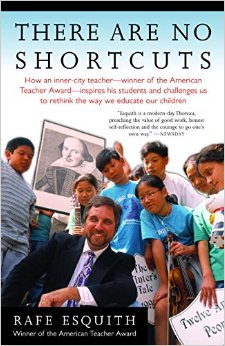
 For me, the book that most exemplifies my ethos of education is Rafe Esquith’s There are no shortcuts.

esquith

 Esquith’s ethos, embodied in the title, was adopted by Mike Feinberg and David Levin shortly before they launched their ground-breaking charter school, KIPP; now a chain boasting significant results for poor children in the USA. KIPP in turn went on to inspire other schools, including King Solomon Academy in West London. Esquith’s legacy is an extraordinary one.

I first read this book during the 2010 Teach First Summer Institute: bright eyed and completely clueless, all I knew was that the amorphous challenge ahead would be grueling. Esquith’s book is often about defying the officials and putting students first, like when he writes: “when my district assigns textbooks to the children that would cure the most seriously afflicted insomniac, I’ve used texts of my own choosing to inspire the children to dedicate themselves to their studies.”

The writer confronts the challenge ahead: “Yes, life isn’t fair. Other kids have more money. Their English is better. Their parents are better connected.” And there are no shortcuts. The students just have to work harder and learn more. I especially liked Esquith’s focus on high academic expectations, notably in text choice (like students studying unabridged Shakespeare, To Kill a Mockingbird, Malcolm X and so on). This is no better exemplified than here:

If fifth-grade students are reading at a first-grade level, placing first-grade books in front of them will never help them catch up with the students across town who not only are in higher-achieving classrooms but have parents and tutors helping them every step of the way. Someone has to tell children if they are behind, and lay out a plan of attack to help them catch up. If this means staying after school or taking extra hours sitting with the child and reading, so be it. There are no excuses.

I have been advised to withhold information like this from students in the name of motivation. But we must aim higher than this, as Esquith reminds us: “society is filled with forces of mediocrity that are going to battle you for the potential that is within your child.”

The second strapline of Esquith’s classroom, alongside “there are no shortcuts” is “be nice, work hard”; KIPP’s founders inverted this, and the founders of Michaela Community School in Wembley altered it to “work hard, be kind.” The message is simple, enduring and essential.

Much of this book is dedicated to examples of Esquith going above and beyond; extra classes, summer classes and the all-important field trips: “as a teacher of children from economically disadvantaged backgrounds, I came to understand that my students would work harder for a better life if they saw the life they were working for.” Esquith details raising funds for these trips which often include travel to a different state by plane and an overnight stay, underwritten by awe-inspiring fund-raising methods. Now, trips are often costly, both in terms of time, money and energy; they frequently, at secondary schools, lead to missed learning time. But I do think Esquith has something here, and I’ll be writing over the next few weeks about field trips and why I think they need to be prioritized despite all of these drawbacks. The learning is the thing, of course, and the ethos behind the learning is relentless progress, defying the odds. But ethos is also nurtured by those aspects of education which cause students to feel that emotional connection, that energy and excitement, and for some this is best achieved outside a classroom setting.

In summary, the key messages on ethos from this book are:

  • There are no shortcuts to success; only hard work
  • All children deserve a rich, challenging curriculum
  • All children deserve to be educated in pleasant, safe classroom environments
  • We as teachers must be honest but positive with our students, always believing they can achieve, and knowing how hard they will need to work to make it
  • Teachers must do right by their students; this needs to be their guiding aim

Of course, this book comes with a major caveat: Esquith is exceptional; exceptional in his ability and exceptional in his commitment. Some people go into teaching to be missionaries; most do not. Some people submerge their lives to the lives of their students; most do not. Early in my career, I sought to emulate Esquith in my priorities and in my dedication.

But I’m not him. I’m a better teacher when I take time out to read fun books, go on holiday, visit a gym, sneak out of work early once in a blue moon to meet friends or go to the theatre, take an entire weekend off to do nothing but watch an entire series of something rubbish on Netflix. I’d like it if this was not true, but it is. I’m flawed.

But Esquith, I’ve come to realize, isn’t the model; Esquith is the touchstone. He is the bar we all strive to reach. So few of us will make it. I know I won’t. But in my best moments, his is the ethos that flows through me; it my lowest moments, his are the words I turn to for the gold standard of caring and commitment.

This is not a book for the practicalities of teaching and ethos. This is a book for inspiration.

Just one book: leadership

In this post I’ll be exploring just one book on school leadership. I’ve previously written on curriculum, assessment and teaching, and my next post will be on ethos.

Leadership is a somewhat tricky subject, in that there are so many bad books on it. Many leadership books seem to spend an inordinate amount of time exploring semantics: what is a leader, and what is a manager? Indeed: what even is leadership?

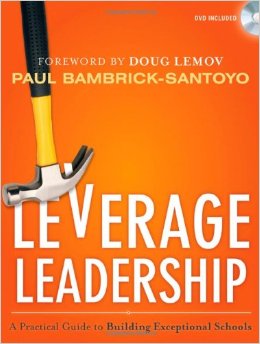
At a school level, it is simply the people who make the decisions which run the school. On that basis, the book I have chosen seems to me to be the best one out there on the mechanics of how to run – or lead – a school.

51atAsiMjwL._SX258_BO1,204,203,200_

This book outlines how a great school should be led, with concrete examples of what works. To begin with, Bambrick-Santoyo states: “Exceptional school leaders succeed because of how they use their time: what they do, and how and when they do it.” Specifically, “instruction and culture are vital, and both must be led simultaneously.”

Data-driven instruction

Noting that: “standards are meaningless until you define how to assess them. Assessments, therefore, are the roadmap to rigour,” the author advises meeting after each assessment and “asking probing questions and deeply considering the results,” while great leaders guide this conversation “from the back pocket” – that is, keeping their “answers” in their pocket, and asking the right questions to guide people’s thinking.

Observations

The greatest lesson I learned from this book was the value of weekly developmental observations, coupled with “bite-sized action steps that allow a teacher to grow.” As the author notes: “you don’t get results by placing your best teachers strategically – you get them by coaching each and every teacher to do excellent work.” Finally, an alternative to pointless graded observations, where we are not judging where teachers are currently, but coaching them to improve student learning all the time.

Planning

Bambrick-Santoyo remarks that too often teachers receive “insufficient guidance” in planning, particularly at the start of their careers. Much more, it is suggested, ought to be centralised, and planned according to “assessment”, which is labelled the “roadmap to rigour.”

Training

Quite simply, with professional development: “increasing student achievement is the ultimate goal… if PD isn’t changing how our students learn, it’s useless.” Bambrick-Santoyo posits that “effective PD must start by answering a basic question: what will teachers be able to do at the end of this session?” The benefits of this are maximised by building in time to make the PD relevant to current practice: “giving teachers time to apply their learning is the difference between an engaging afternoon and sustained improvement in instruction.”

Pupil ethos

It is hard to argue with the assertion that “in schools with strong cultures, students receive a continual message that nothing is as important – or as engaging – as learning.” Bambrick-Santoyo advises that the top leaders “transform their vision into meticulously built systems.”

Staff culture

The culture of the school needs to be embodied by both staff and students, and care must be taken of teachers: “when teachers are out with friends or family, what do you want them to say about your school? How do you want them to feel?” The author advises being careful to pick up non-verbal signs from teachers, as not everything (anything?) is captured in formal surveys. Interestingly, Bambrick-Santoyo notes that: “it’s imperative that a leader confront warning signs as they come. Initially, if a teacher seems disengaged during professional development, a leader may be tempted to let it go; perhaps the teacher’s having a bad day… Yet unless it is addressed immediately, it is likely to weaken your culture.” We must always be vigilant to uphold our school culture; one small chink can undermine the entire organisation. The best way to reinforce culture is to continually reference the school’s mission: “by emphasising a common mission, the leader creates an internal motivation to work harder rather than imposing yet another external incentive to perform.”

Yet this is clearly not a blueprint we can pick up and apply to any school indiscriminately. Only those who are observant and have great listening skills will pick up on how to implement these ideas effectively for the context in which they find themselves.

Not only that, it is clear to me that leadership is about vision, and it is only when you harness the belief and motivation of the whole staff body to buy into that vision do these aspects work most effectively: as Bambrick-Santoyo states, “the core principle of a staff culture turnaround is that teachers need to know the school’s core mission… and must be unified in putting it into practice.” But I am not sure it is a book that will tell you how to have a vision, or how you can inspire others to believe in it: that can only come from your own beliefs, which are often informed by experience. And if you can’t imagine what is possible, you need to see a great school in action. And, of course, if you can’t work out why all kids deserve that then it’s not a book you’re in need of.

So far, this series has explored leadership, curriculum, assessment and teaching. The final post will be on school ethos.