The importance of history

I’m beginning this blog with a very self-indulgent story. If you’re not interested, do feel free to skip the next four paragraphs.

From 2008-9, I embarked on my final “learning for fun” quest, in undertaking, for no particular reason, a Masters in History. I suppose I had loved History at GCSE, and had found few Literature Masters I liked the look of. Truthfully, after four years of stamina reading, I had almost forgotten what reading for enjoyment felt like, and rather wanted to recapture this by fasting from fiction for a short while.

In the long summer between my degree ending and this beginning, I took advantage of my enviably jammy job (theatre box office clerk; the quiet days meant luxurious hours of sneaky reading – sorry to all my managers who told me not to) to read all about a section of history I had never studied before.

I had lived in Ireland for four years, choosing to study in a country lacking in tuition fees (yay!) and student loans (at least for foreigners like me). In my studies and in the many, many jobs I had (such multi-tasking certainly pulled me through my Teach First interview) I had noticed that Irish people (warning: massive generalization coming up) seemed to be much more invested in their history than my English contemporaries. I wondered if this might be partly due to our lack of focus on the history of our own country; or perhaps that history is not compulsory after year 9. I was continually struck in Ireland by the omnipresence of history, and woefully underinformed about the country I had started to call my home.

In my pursuit of an understanding of Irish history, I mostly have the staff of Hodges Figgis to thank. I mean, I was on first-name terms with most of the booksellers in that store; something my new Amazon addiction makes me mournful of. I fumbled blindly in pursuit of even a basic knowledge of that country’s history, and with the help of Hodges Figgis (Dawson Street, Dublin 2) began the course with a more than cursory understanding of it.

What this laborious exercise taught me was the power of self-learning, something I advocate from time to time in my own classroom. The amount we can learn simply by reading, once we have acquired higher levels of literacy, is astonishing. I sought to contextualise my new historical fascination, and even managed to branch out from my country of specialism.

 The mighty Hodges Figgis

Yet history isn’t just about places and names and acts. It is also about culture. One of my favourite books is a history book; Orlando Figes’ Natasha’s Dance explores the highlights of Russian culture (including literature, but also music, dance and drama) in the context of its social and political history. Coupled with an exquisite writing style, I would highly recommend this book for anyone even faintly interested in anything to do with Russia.

In my English degree, my most loved lecturer, Dr. Amanda Piesse (Renaissance drama – and no, that didn’t mean very much Shakespeare) talked about New Historicism: the influence of history on a text, but also of a text on history. This pervasive idea in literary criticism strikes me as one very crucial reason that we should all be readers of history.

Far be it for me to expostulate on what a National Curriculum should and should not contain, but should someone more qualified than I suggest a compulsory study of History from the beginning of primary to the end of secondary, I would very much be in favour of this for our budding literary critics.

The purpose of literature is not only decorative; it is also educative. We read not for pure escapism; we read to inhabit other minds, other places and other times. If we are interested and delighted by fiction, we may also find interest and delight in history. We find story-telling not only in fiction.

Our children deserve a broad and balanced curriculum. Can you study literature without history? Can you study literature without Classics? Well, of course you can. But is it as good?

More Texts or More Depth?

I have been recently challenged to consider what the role of an English teacher is. This usually happens when I meet people whose views I disagree with, which is one of my favourite things to do. I love re-considering what I had initially assumed to be true. More often than not, I end up doing some serious mind-changing; partly because I have never had debating skills, or possibly I am deeply impressionable. I am hoping it is mostly because other people are right, and I am wrong, and I make the right choice.

So, I had always thought, inspired by the Teach for America chieftains and Rafe Esquith, the job of an English teacher was mostly to expose and lead students through as much literature as was humanly possible, preferably, inspired by Joe Kirby’s impressive curriculum here, also showing them the evolution of language, style and content through a beautifully arranged compendium of the whole of literature ever.

It began with library lessons, which I have always maintained are wonderful and valuable. An esteemed colleague put the argument that “students can read in their own time – and I am aware that some don’t” – but is that a problem that their English teacher in their English lesson should be solving? He argued that we have limited time to lead our students, and rather than that being a race through all the literature, we should be going for deep knowledge and embedded skills.

This alternative universe is a new one to me, but it’s one I am willing to explore. Though there are already some parallels: often, when taking out the Shakespeare play we will be studying in year 7, 8 or 9, a handful of children will exclaim: “but I already did that play! In primary school!” Yet those same children seem, at best, to have a shaky grasp on the plot of the play, let alone the nuances of theme and character I would like them to explore. Indeed, my year 11 revisited a play many of them had studied in year 8, and all had an undeniably different experience of reading the play anew and older.

Like all schools, we revisit Shakespeare every year, and I think most teachers would argue very strongly that the repetition of this particular author builds up our students’ understanding and enjoyment. But perhaps how long we spend on Shakespeare needs to be explored. Usually, I give over the entire two half terms after Easter for Shakespeare at KS3. With few exceptions, we study the whole play, minus the truly terrible scenes, and there is a lot of acting, creative re-interpretation and philosophy circles along the way – rest assured, it is not mere ploughing through the text.

Yet I wouldn’t spend a full term on, for example, poetry. I seem quite happy to teach poetry for five or six weeks a year and be done with it until the following year. Other than practicing their understanding, inference and analysis, how much do students really get out of such a short unit? If we are thinking about how we sequence and deliver content and skills, perhaps there needs to be more time spent on deep learning and multiple examples.

This race through the curriculum is especially exacerbated at KS4, when many English teachers feel they are “teaching to the test” with Controlled Assessment after Controlled Assessment, and little time for real, deep learning to occur. (There were times with my last year 11 when I thought in despair: “I haven’t actually taught them anything since year 9. They’ve just been practicing doing it.”)

That said, it may also be argued that familiarity breeds enthusiasm. In my last English department, we were hopeful that the students who end up in year 13 will not look with trepidation on the Wife of Bath’s Tale, but instead associate that text with familiarity and fun they had with Chaucer in year 7.

For a “depth not breadth” approach to truly work, I would argue that a school needs a robust policy of reading for pleasure, which is enforced. Students can read at home, but do they read at home? There is ample “down time” in many school timetables for reading for ten minutes or twenty, for example during form-time, but it needs to be enforced throughout the school.

At this point in time, I’m undecided: I genuinely don’t know what the best balance between quality and quantity is in the curriculum I would offer to students. But I’m going to explore a “depth” curriculum this year and find out.

Vampire Novels and Wizards

I’ve never been an “early adopter”, as I am reminded with depressing regularity. I am often last on the bandwagon for all of life’s ingredients: when you spot me doing anything remotely trendy, you can be assured that trend is in its death throes.

I don’t recall the advent of Harry Potter. I think I first read it in 2001, 5 years after its publication, and incidentally around the time it was made into a film. I had indeed caught on very, very late.

One positive aspect of being a late adopter, though, was the presence of the other Harry Potter books. I’m not sure whether The Philosopher’s Stone and The Chamber of Secrets would never have kept me hooked; it was only the knowledge of the following books which made me persevere. I really did love the fourth book in particular, The Goblet of Fire. Everything about these books appealed to me, even in my late teens. I had always been a complete nerd, and the stories of people who were cool because they excelled at school provided some welcome escapism.

Perhaps more embarrassing is my tragically late awareness of Twilight. I have probably told people that I read the Twilight series when I knew I would be teaching in an all-girls’ school. That would be a lie.

I began reading Twilight when my boss (happily the same age as me) bought me a copy for my birthday. My boss of that time was painfully cool, and extremely intelligent – she will soon be a doctor of philosophy. She handed me the book with joyful glee, and I went home to kill an hour reading. I don’t think I even paused for a tea-break: I was entirely hooked.

At that time, I didn’t know the immense baggage that went with this book. I was also not discerning enough to spot how annoying the central character was, or how utterly unrealistic even the most “realist” parts of the narrative. Like I have said before, I’m a sucker for a story, and I ate up Twilight.

In my excitement, I purchased the other three books in the series shortly after. I was about halfway through that second book when the Twilight craze truly hit; I’m going to guess again that this was when the films began to be released. Who can say whether this affected my response, but I just didn’t enjoy any of the following books. I remember stolidly picking my way through the final installment, telling my bemused husband through gritted teeth “I just need to know what happens at the end.”

When I began teaching, I was extremely grateful to have persevered. (I was also grateful to know the words to all the High School Musicals, as well as Camp Rock. Again, something that, embarrassingly, happened in advance of teaching in a girls’ school.) In my experience, students love that you take an interest in what they love. If you show that you are willing to try reading what they like, they are that much more likely to take on your recommendations.

I will defend, perhaps in the face of popular opinion, the rights of children and adults to read books like Harry Potter and Twilight. For so many children, these cult hits function as “gateway texts”, whetting the appetite for a good story. Their sheer length, in particular of the former, gives many children the feeling of having accomplished something massive; it makes them more confident of tackling the comparatively short class texts. Students move themselves into good habits, taking time to read when they might previously have been more engaged in other activities.

Moving students onto more challenging texts is obviously something I immediately seek to do, but hell will freeze over before I ban these hated tomes from my classroom.

Behaviour

I was in a workshop during my teacher training where we were role playing behaviour management with our peers. (Doesn’t that sound horrific? Since my first year of university when I unexpectedly contracted “the fear” and walked out of a read-through I’ve had a problem with anything acting-related. This workshop was therefore more nightmarish that you can even imagine.) Yet having observed a thousand teachers and read a million books, you would think I could handle this. Hardly. I clammed up; I was speechless. I had no comeback at all for my partner.

I remember that evening, in despair, calling my “leadership development officer” (basically our mum for 6 weeks), in tears, telling her I didn’t think I could do it. Amy was amazing. After giving me the phone equivalent of a massive hug, she told me something along the lines of “you will. When there is a child in front of you, you just will.” “What if I cry?” I asked. “You just won’t.”

I was, and still am, a crier, so I’m not sure I believed her, but I stuck with Teach First. And she was right. I have never ever cried from managing a tricky child, or a tricky class. Not even nearly. More than this triumph, I never clammed up. I always had something to say.

Obviously, it wasn’t always the right thing to say, but you live and learn.

Now, no book on behaviour management will fully prepare you to teach. Even after several years of teaching students will do and say things you can’t even imagine. Some of my personal favourites are so inappropriate I simply can’t write them here. I think reading these books during your first placement, or first term of teaching, is actually more helpful than reading them pre-term time.

So, onto some of my favourite books on behaviour management.

Classroom Behaviour by Bill Rogers

This was definitely the most useful book for me prior to teaching. It is replete with phrases you can practise saying, and above all in the early days you need some stock phrases to fall back on. Rogers espouses a gently gently approach, always aiming to avoid confrontation and focus on the positive. There are some real gems here; rather than “take off that fluorescent orange balaclava” saying “what’s the school rule about scarves?”; adding a “thanks” to the end of an instruction rather than a “please” (I have never done this, because I am a stubbornly traditional user of English sentence structure, but I hear it works well) and advice on when, who and how to tactically ignore.

Assertive Discipline by Lee Canter

This is an example of a book I read and all but dismissed during training and only came to appreciate when I entered the classroom.

“Assertive Discipline” is an ideal solution for the problem of praise: feel like a bit of an idiot praising the one person with their book and pen out? Canter instead advocates “behaviour narration” rather than judgement. Rather than a “well done for doing the absolute minimum I expect of you” you narrate it: “Chanelle has her pen out and is ready to start learning”. This then draws attention to the positive behaviour and nudges others towards following it. To non-teachers this might sound crazy, but it works supremely well, at least in my experience. (There are other tips, but this one is my favourite.)

Why are you shouting at us? by Phil Beadle and John Murray

I began teaching in the halcyon days of Teachers’ TV, and was a bit of a fan girl for Phil Beadle, one of their vanguards. His charisma and creativity was everything I wasn’t, and I loved reading his book “How to Teach” (though his insistence on the efficacy of marking as a sure-fire way to change achievement even when your classroom is a bit chaotic led to me neglecting planning in favour of an unimaginable amount of written feedback, with disastrous consequences. By my second year I marked less and planned more and found it worked. This is almost certainly my error of interpretation, not his writing.)

I know not all teachers are Beadle fans, but I think he is great. Driven by a strong moral purpose and with all the skills you would expect of an AST, this co-written book is a superb round up of effective behaviour management. At 130 small pages the text is lighthearted enough to be read speedily and joyously. It is also fairly honest about what kids can do and how you can combat it.

Less useful are the charisma based methods – I’m not sure I have ever managed to calm a truly angry child with a joke, though I wholly endorse the anti-shouting pages (quiet seething is far better for your health, if less immediately effective).

Reluctant Disciplinarian by Gary Rubinstein

Rubinstein was trained by Teach for America, and this book is the better for the honesty with which he reveals his classroom mistakes; an honesty which comes partly from his subsequent successes in the classroom. I related to this book as Rubinstein, like me, is a self-confessed “softy”.

Acknowledging that behaviour management can never be adequately taught (not least, I would argue, through role play), this book takes you to the possible pitfalls of your initial months in the classroom and shows you the light at the end of that tunnel.

There are some traditional methods explored here in a clear way, for example meaning what you say – something I found surprisingly hard in my initial term of teaching. This is possibly because I wasn’t sure what I wanted, or if what I was doing was right; therefore I really didn’t mean what I said all that often. I will always remember a fellow teacher telling me that it was during her bout of laryngitis that she had become a better teacher; she had so little voice that she needed to mean everything she said.
Of course, the best “behaviour management” comes from familiarity: you with the kids, and the kids with you. It can’t happen straight away or overnight; merely sticking it out, turning up and following through with every consequence you say (at first even if you immediately regret it; only later with a conversation and apology if you were wrong) will work. It will work. It will.

Eventually.

Diary of an English Teacher

The below is a very out of character post for me, comprising what are essentially diary entries surrounding the only thing I have been able to think about all week: GCSE results.

7pm, Benugo, Wednesday 21st August

It’s the day before GCSE results and I am terrified. I have been afraid for this day for what feels like an age, and if I don’t write I will scream. Aloud. In this coffee shop. I come here a lot, so I’m going to write instead.

This culture of results defining kids – for themselves, for the school, for their teachers – is beginning to get me down. I found a picture of my year 11s today, and I found myself looking at each face wondering what their news will be tomorrow. How different their lives will look tomorrow.

And what I remember is their ample success, the success they have banked already. They have studied for 3 years with me, 2 of those years on two GCSEs. We have come through their anger at being in my class –set 2, not set 1, a tough blow for many. We have got through their boundary testing – those year 9 kids were very different to the young women who left in May.

They weren’t a reading class, and at the start I didn’t do a lot to change that. But the class I left had studied some wonderful works of literature: Romeo and Juliet, Macbeth, Dorian Gray, The Crucible, Robert Browning and individual reading projects of classic texts.

They have written some truly amazing essays: one particularly notable one was at least of A-level quality, but was pegged down three marks in our moderation  because it hadn’t fulfilled all the AOs to the same impressive degree.

When kids write beyond the syllabus, I find it cruel to teach them how to jump through hoops. When they can grasp incredibly complex concepts, what a waste of their time to teach them what an examiner is looking for, rather than the very best way to do something.

I was very inspired by the masterful Mary Myatt’s review here of Martin Robinson’s book, “Trivium”, in particular this:

He took his drama students through deep processes to achieve outstanding results. Consistently among the top in the country. This book and the man need to be taken seriously. He saw what was wrong with the course he was expected to teach. So he got rid of unnecessary homework, ‘writing about misery and colouring in pictures of misery’ and replaced it with a notebook in which students would be expected to collect fragments of writing, experiences, dreams, stories, poetry, lyrics, history, theory.  The material transformed from fragments to connections and became the ‘clothesline on which the lessons were hung’.  ‘I refused to take things students to see things they would normally see, so we never went to Blood Brothers; instead we went to see Beckett, Berkoff, Bausch and Brecht. We would take an unashamedly Socratic approach: questioning, arguing and prompting.’ The exam was a celebration of their exploration – not a jumping through the hoop to get the grades.

This is clearly a teacher who stuck to his guns and taught kids what they needed to be taught. Ofcourse that is how you do it, of course that is the best way. Yet I don’t. Not in year 11, the most important year for growing students, before we cast them to the wide world. I don’t because I know I can teach them to pass an exam, and the other way is a gamble.

Incidentally, my own English teacher told me a story of yore about a genius child he taught, who achieved an A-star in every GCSE except English. He related that he had looked over the student’s shoulder as he was writing his exam responses and described his work as “degree level English”. My teacher believed the examiner might simply not have understood what the student was writing.

Does this sound made-up? It’s a story from so long ago, hearsay, that I don’t want to name my teacher for fear I have mixed details. But I myself taught a sixth former this year. Her ideas and oral expression were phenomenal. Her style was inimitable. I had to unpick her beautifully and effortlessly constructed sentences to work out what she was saying, but I suspected she was just a bit too smart for me. I cautioned her to writing clearly, while also maintaining she needed her own style to mark her out at university. I had her pegged for Oxbridge. She received a D in her AS level. What happened?

I fear for my amazing and intelligent 11s. I know how hard they worked and how amazing they are. I know they know more than enough to achieve double A-star.

But will they have remembered to jump through those hoops?

8.25am, 21 bus, Thursday 22nd August

It feels like I fell asleep about twenty minutes before my alarm went off. Hitting refresh on e-AQA for the 6 minutes before results were officially available paid off, as only three minutes in I had my answers.

It’s a strange one. Over the two GCSEs, over 28 students, only one achieved a C – the rest were A* to B. Sounds good right?

I’m not sure how my students will feel. My 6 or 7 best deserved an A star, and the fact that not all were even cripplingly close is disappointing. There are also so many more B grades for Literature than I expected; I had heard it was more easily marked, and certainly we spent class time revising Literature (not Language) to the extent that I wasn’t entirely sure my class would all pass the latter.

I can’t wait to see the students and find out what they think, but overall I feel deflated. Last year the majority of my class exceeded expectations. Not this year. Perhaps that is the curse of having a higher achieving group of students to begin with: you know they will be fine, and there is numerically less room for them to fly above expectations.

5pm, Southbank Centre, Thursday 22nd August

Coming to the end of a long and emotional day. So many students were delighted with their A grades, and due to almost no one getting above a B for the poetry paper we are having lots remarked from my class, which could swing some students towards the grade they deserve. School is happy – we have smashed all previous A* to C (including English and Maths) records.

Going in meant seeing students who hadn’t known I was leaving, which was horrible. When they mentioned it, they tended to ask: “how long have you known for?” I am chronically unable to lie (this has been and continues to be a massive hurdle in my teaching practice) and I couldn’t face the awful truth of how long I had been duplicitous, so I mostly shifted uncomfortably.

Following results, I enrolled students onto our sixth form. I had the pleasure of seeing some of my own students, for whom the world was mostly their oyster, as well as some heart wrenching moments with other students, watching their closely held dreams, usually of medicine, coming to an end.

The whole thing has been so emotionally stressful for all involved. And these students will do it again next year. And the next year.

Perhaps there is a better way. I think I need a few paracetamol, a good night’s sleep and then a long think.

12.30pm, dining table, Friday 23rd August

Nope, still got nothing.

Off-duty Reading

Now is the time that my quest for all-the-book-reading reaches its epic zenith. My educator readers might allow me this self-indulgence; I wanted to share my thoughts on what I have been reading while on holiday. This is partly to combat my previously noted tendency to race through books without pause, in using this public forum to school myself in reflection on what I have read. Partly, of course, this is written because, as much as I love school, students and teaching, my brain doesn’t want to do as much thinking on these subjects during the summer months as it does on novels, and other such “fun books.”

In an attempt to justify my words below, this blog is not overtly about education: it is, rather, about books. Only incidentally do I hope to offer any musings on the former.

So – to the vacation! Let me paint a picture: friends, sunshine, plenty to do and see, and me, in a corner, on my own, with my Kindle. This might give you an idea of why you should never, ever agree to go on holiday with me, and allow you to understand why my friends ostracise me at the poolside.  Here were my favourite reads, read in idyllic surroundings with the greatest of hosts and the greatest of friends.
Hearts and minds, Amanda Craig

I began with a paperback by one of my new favourite authors, recommended to me by one of the most impressively well-read, deeply intuitive and eminently qualified teachers I know, Mrs. Clayton. Anything Mrs. Clayton tells me to read, I know I will love. I am indebted to her for this authorial recommendation. I had previously read “A Vicious Circle”, which explores the sordid world of London publishing, with deep delight, and found “Hearts and Minds” similarly enjoyable for wholly different reasons.

Firstly, I love a book set in a place I have lived. The familiarity of London here brought the author’s reality to life all the more perfectly for me. Craig’s characters are a mix of very real, and very stock, yet this is a mix which works. Her interweaving storylines are always an enjoyable puzzle, and in this novel she takes on different ideas about immigration, by focusing her perspective on a variety of classes and cultures. For a more focused awareness of migrants and a storyline at times as outrageous as any BBC thriller, I would recommend this book.

Dark Lies the Island, Kevin Barry

As noted in an earlier post, here, I am trying to increase my reading of short stories. Barry’s stories had been recommended to me by scores of almost universally Irish friends, and I began with this tome purely as it was the most recent I had heard of. I was not to be disappointed.

These beautiful vignettes of Irish life span the island in its modernity, and veer from SoCo (South County Dublin; Londoners, think of purest West London) kitchen drama with a light tone reminiscent of Ross O’Carroll-Kelly to a Joyce-esque devastating portrait of a man trapped in a routine. Language is used in an enjoyably creative way; Barry describes a clean-cut type with an “orthodontic beam” early on; a man aware of the familiarity of his quest for originality notes that: “every last crooked rock of the place had at some point seated the bony arse of some hypochondrical epiphany-seeker.” A short read, but one I took my time over.
Transatlantic, Colum McCann

Have you read “Let the Great World Spin”? It ranks in my all time top ten books, possibly even top five. I trusted in McCann and took a gamble on his new novel.

While I didn’t feel “Transatlantic” reached the mountainous heights of “Great World…”, McCann’s construction of narrative and meticulous research cannot be faulted. His Irish roots have come to fruition at last, as he turns his attention to the “Irish Question”, as always, in an inventive manner. The way in which he interweaves his stories is not as clear as Craig’s, and yet his work seems all the more literary for that intentional blur.

The especially superb parts of this text are, in my view, McCann’s reimagining of Frederick Douglass’ voyage to Ireland, and George Mitchell’s chronologically later appearance as an unnamed senator detailing the intricate narrative of life and negotiations at that time.

McCann’s language is always succinct: in depicting life in Dublin’s slums of yore he writes: “women walked in rags, less than rags: as rags”, for example. His summary of the British feeling on the Northern Ireland issue, though perhaps coloured, is excellent: “embarrassed by what they have done for centuries in Ireland. Ready to leave. To hightail it out of there. They would wipe their hands clean in an instant, if only they didn’t have to do it in front of the world.”

Revolutionary Road, Richard Yates

In a moment of weakness, I watched this film on iPlayer about a year ago and thus consigned myself to never reading the novel – that’s how it works, right? Then, in a second hand book shop, I came across it for only £2 and couldn’t resist.

I am extremely glad I gave into temptation, for if the film is unremittingly depressing (don’t watch it if you’re even a little bit sad) the book is far, far less so. There is an abundance of humour, both in terms of irony and also in Yates’ playful use of language. One example I was so particularly fond of as to bore those around me in its recital is this: the central character, Frank, justifies his decision to take on an unexciting career by saying:

“Look at it this way. I need a job; okay. Is that any reason why the job I get has to louse me up? Look. All I want is to get enough dough coming in to keep us solvent for the next year or so, till I can figure things out; meanwhile I want to retain my own identity. Therefore the thing I’m most anxious to avoid is any kind of work that can be considered ‘interesting’ in its own right. I want something that can’t possibly touch me. I want some big, swollen old corporation that’s been bumbling along making money in its sleep for a hundred years, where they have to hire eight guys for every one job because none of them can be expected to care about whatever boring thing it is they’re supposed to be doing. I want to go into that kind of place and say, Look. You can have my body and my nice college-boy smile for so many hours a day, in exchange for so many dollars, and beyond that we’ll leave each other strictly alone.”

The crisp narrative appears to fly on apace, although ironically this is a book which turns on inaction.

The tragedy with which the novel ends is surprisingly muted. There is a lack of feeling or emotion in the text, which serves to emphasise the ideas Yates seems to be putting forward in the narrative.
David Copperfield, Charles Dickens

After my recent diet of extremely fun, and universally modern books, I felt like I’d committed the reading equivalent of eating one too many McDonalds. Indeed, I have for a long time felt the English graduate’s smugness of having read pretty much all of the Oxford Classics (when I say read, you might substitute “skimmed” or even “read a series of critical essays plus selected skimming”) at University. But it is time to face facts: there are innumerable “classics” I did not read, or did not read properly, and it is time to put this to rights.

Now, I’m cheating here because I haven’t actually finished this book. But I really wanted to write something about “David Copperfield” because I have rarely enjoyed Dickens. The promise of “Oliver Twist” was not fulfilled for me in “Bleak House” or “Little Dorrit” or “Dombey and Son”, possibly one of my least favourite tomes (shortly followed by “The Faerie Queene” – if you have read and enjoyed it, I bow in your literary honour).

Following university, it occurred to me that Dickens is not best read skimmed. His way with words is the essence of his work; the plot, surprisingly, is not enough. I went on to read “The Old Curiosity Shop” and “Great Expectations” about five years ago, but slowly, and with some surprised enjoyment. Yet “David Copperfield”, at least until page 724, supersedes all the previous Dickens of my acquaintance. It is really, really funny, for starters. The characters in this novel have multiple dimensions and conflicting passions and prejudices in a realistic and natural way unachieved in the texts named above. The use of first person is delightfully employed, and in my year 7 Scheme of Work for Autumn 1 on Dickens, we will certainly be revisiting parts of this novel.

My only wish with Dickens is that the latterday publishers would divide his novels into installments as they were initially published for his reading public. In fact, I feel there is an opportunity for a service which delivers weekly or monthly installments to your inbox, to prevent us slaving away unnaturally at a thousand pages a time.

So endeth the self-indulgent survey of my holiday reading. Lest you non-teachers think I slack, I will assure you I have also read more study guides, Cambridge Companions, literary essays, critical biographies and pedagogy guides than you can shake a large stick at in preparation for the new academic year – do not entirely begrudge me the rest.

Loving Shakespeare

I am going to confess to something which I am not proud of: at age 15, I proclaimed to my English teacher (the famed Dr Byrne, of whom more later) that Oscar Wilde was a better playwright than William Shakespeare. And I wasn’t being deliberately argumentative, like I usually was.

I just didn’t like Shakespeare at all.

I didn’t understand it, I didn’t relate to it, and I certainly didn’t know why I had to study it.

Then something changed my view of Shakespeare forever: the 1996 RSC version of Midsummer Night’s Dream. I was learning a Shakespeare speech for a LAMDA acting exam, something I am incredibly glad I was forced to do, and for the “discussion” part of the exam we had to be able to discuss the play in its entirety. I picked the DVD up from the library, only because there was no video, and settled down one afternoon in the kitchen. I distrustingly loaded the disc into the PC (a new experience) and shuffled onto a hard kitchen chair to watch it.

The set was incredible: from the man-made lake to the stand-alone doors leading to nowhere to the suspended light bulbs illuminating the forest. It was utterly beautiful. I watched this in 2001, with all my teenage disregard for the bard, at our enormous and unwieldy computer, and I was entirely gripped. The beauty of the staging drew me in, but the relevance of the words was delivered, it seemed, directly to me and directly to my own context. It spoke to me, in a way I hadn’t been spoken to by a play before. I laughed, I cried, and at last I understood.

I’m re-watching this version now to use to teach my year 7 and I am brought back again to the start of my love affair with the bard. Indeed, my single favourite thing about living in London is that I can see live Shakespeare for only £5 a show at the Globe Theatre.

Incidentally, another gem worth a watch is the Globe on screen version of Much Ado About Nothing. I remember watching this production in the theatre itself at the tail end of one of my most stressful teaching terms, and despite not even knowing the story (although my helpful teacher theatre companion did her best to enlighten me en route to the playhouse) found myself laughing uncontrollably.

But how to make my students feel this?

I really believe that the key is a great version; reading words on the page, even as an English teacher, is nowhere near the same as an accomplished actor conveying the lines. So much about plays, anyway, is in the staging, the direction and the delivery of the lines; a novel’s intended audience is only ever an individual, its intended reader’s setting irrelevant, its intended backdrop a blank page. A play clearly has very many more complex layers than this.

The brilliance of a Globe production filmed is not only in the superb acting, but in the nearness of the visible audience, all (in the Much Ado Globe on Screen, and in my own experience) cloaked in rain-macs and huddled to each other and the stage; all interacting with the performance. I am certain the responses of these very familiar-looking modern humans will help my students to appreciate that yes, real people right now laugh at this stuff.

I believe that Shakespeare must be seen first, and acted; not read and analysed to death (although that can come later). On showing my year 9 set 5 Baz Luhrmann’s Act 1 Scene 1 of Romeo and Juliet, my students were bewitched. They really loved it. As one commented: “I didn’t think it would be about people like me!” She might have found the language a turn-off when presented with the page, but seeing the live action challenged that initial distaste for Shakespeare.

I, and I am sure all English teachers, am begging directors and producers everywhere: please, please keep giving us game-changing, earth moving and relevant Shakespeare that we and our students can love.

After all this, I’m still not entirely sure I love reading the stuff. But watching – that’s an entirely different story.

globe

In praise of re-reading

I know someone who re-reads books as a habit. When I first heard this, I could barely hide my incredulity: “but why?” In my land, there are just too many books to do this. As I have stated, my aim is to read all the books. When time is short, who has time to re-read?

My immediate second thought was a jealous one. The books he read were full of clever-looking annotations, scribbles, highlights and a dialogue with himself over the re-reading cycles. My books are fairly marked themselves, but usually only with those initial notes – an underlined quote here, an asterisk or exclamation mark there, and only if I happen to have a pen and the inclination about me. Clearly, this was someone who engaged deeply with his reading. Clearly, I skate on the surface of books.

Indeed, I have read so many books that I very frequently forget the names of central characters. My conversations with people reading a book I have read invariably go like this:

“Oh I read that!”

“Really? What do you think?”

“I loved it!”

“What do you make of the [plot twist/character detail/theme/use of delicious language?”

“….”

In contrast, the books I studied at university and A-level (I am forever grateful to my 17 and 18 year old selves for buying my own “revision copies” of texts to scribble and highlight on) are a godsend when I come to teach a text. That hard “thinking work”, which I seem to find increasingly hard to do as term progresses, is already done. I can choose the quotes I want my students to analyse with ease – they are already highlighted. I can even do Ms Moran’s amazing trick: “I’ve made C-grade annotations – now, you add your A* insights”, a task a blank page on a busy lesson-planning Wednesday makes me despair at.

I’m preparing to teach some texts next year which I have read already, and I am determined to alter my wayward ways. I have re-read “An Inspector Calls”, “Waiting for Godot” and “The Yellow Wallpaper”, among others, and I have been strict with myself about making at least two annotations on every page (though, with “Inspector”, it was more like ten – either the text is thechoice for AQA Modern Texts, or I was having a brainy/non-lazy day – I’m not altogether sure). It has been so long, around ten years, since I last picked any of these texts up, that I could really enjoy this re-reading, and I definitely feel I can have a more intelligent conversation with anyone, in particular my future students, about them.

And perhaps, after all, this is the other great part of being an English teacher. Paid to read widely to recommend books to read for enjoyment; paid for reading closely to elucidate or encourage deeper readings for students. And right now, paid to read in the sun. What a life! Don’t tell the taxpayer…

annotated text

Short stories

I must confess, I once bought a book from Amazon by one of my favourite authors and was devastated when it turned out to be short stories (those descriptions can be misleading… or I’m an impulsive buyer). The book sat on my bedside locker for months, until I felt too guilty to buy a new book and had to read it.

I didn’t hate it. In fact, I really rather enjoyed it. And this prompted me to wonder why I was so prejudiced against short stories.

Partly this might be to do with my love of narrative-driven books. I think most people are partial to a book which paces along, keeping us entertained and engaged throughout. I have a particular love for very very long books, where I genuinely miss the characters after (although I dislike going into unintended mourning of a book – those weeks where I pick up and unfinish three or four books after a particularly wonderful tome and can’t find anything to match it fill me with despair). One of my best friends told me at during our A-level English course, after a particularly heady close-analysis lesson: “I just love the story. Isn’t that enough?”

So I think what it boils down to is that, for me, short stories are simply too much work. They are the step between reading a novel and a poem; the former you can absorb in a state of near passivity; the latter you are required to read again and again, pencil in hand, annotating all the way (who studied English Literature at university and manages to read poetry without a pencil? Please teach me how).

If poetry is “language condensed”, then short stories are very nearly there. The ideas, themes, character and language are all the more pertinent and powerful for the shortness of the tale. The structural issues you only glancingly pay attention to when reading a novel begin to jump out at you with force in a short story. It just all seems too deep.

And that is exactly why, as a teacher, I need to read many more short stories. These entities are clearly made for teaching: we all know the perils of a class reader, particularly with our less engaged students. (I’ll allow myself one more digression: in my first term of teaching, I pretty much read the whole of “To Kill a Mockingbird” to my year 10 set 5. They hated it so much that when I finished the last sentence they burst into spontaneous applause, not because I am a wonderful and amazing reader, but because, in their own words: “thank God IT’S OVER.”) (I will also say that I have since gained the experience, skills and pedagogical understanding to be able to effectively teach novels. So please don’t fire me.)

I began teaching short stories with year 9 set 2 three years ago. This was an incredibly able class; they are the year 11 I have so often raved about to my close friends this year, and I’m banking on a host of A*s on results day. I wanted them to experience more of literature than just one novel; I wanted to explore different authors, genres and times with them.

We began with Raymond Carver’s “Fat”, which is made for teaching to girls. The way Carver “shows not tells” us about the characters, the subject matter (if you haven’t read it, the clue is in the title) of the tale, the sparse but beautifully chosen language and the length (it is maybe 5 pages long) all allow an engaging and edifying approach to the unit.

My year 9s also read Poe’s “The Tell-Tale Heart”, James Joyce’s “The Dead” and “Eveline” and J. D. Salinger’s “Franny”. I have taught none of these since, despite utterly loving teaching them, mainly because I’ve found different short stories which seemed better suited to my various classes – not in terms of ability, but more in terms of interest. There is too much to choose from the great literature that is available to wheel out the same stories year on year. I especially loved reading “The Second Bakery Attack” by Murakami for a “fun” (read: non-directly related to the curriculum) lesson with year 12. Another favourite of mine is “Examination Day” by Henry Slesar: a great text for a KS3 class, introducing them to dystopian literature.

In short, short stories are an English teacher’s best friend. They are ready-made for any class; clearly shorter and so more digestible for less confident readers, but open to a challenging scheme of work containing multiple ones for the most confident students.

I’ll admit, though, I’m taking a fat novel or six to the beach. It can’t all be about the kids…

short stories

Creating a community of readers

I have written before here about the importance of loving reading, and this post builds on what I’m trying to do with young readers.

When I was in school, I remember the sad day I told my friends: “there are no more books. I have read them all.” Child genius, you may think. In fact, what had happened was that I had no idea what to read. I had read the books which looked like I should read them, and then had no inkling where to go from there.

All that changed in year 10, with Dr Byrne. I will write about Dr Byrne at length another time, because he truly deserves all credit for anything I have thought or written about anything ever.

One day, for no reason that was clear to me at the time, he put a copy of Samuel Beckett’s Waiting for Godot on my desk. This play changed everything for me: it broke all the conventions of what I thought about drama at the time, in terms of character, unity and realism. It challenged my thinking in a way no other book had.

And the great books kept coming. When I was stuck, I only had to go to Dr Byrne and I would have a giant list of books I could be getting on with.

Due to this personal experience, from the start of my teaching career I endeavoured to make book lists for my students, usually of twenty to thirty titles, and often with a brief explanation as to why I thought that book was great.

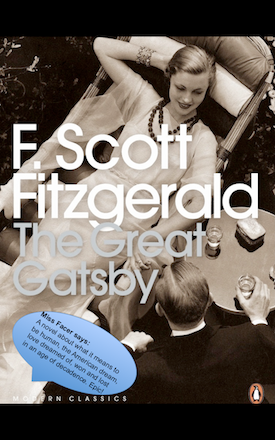
To make this more visible for my students, I picked my favourite four books every term and made a poster of the front cover and something I had said about it, like this:

Gatsby poster

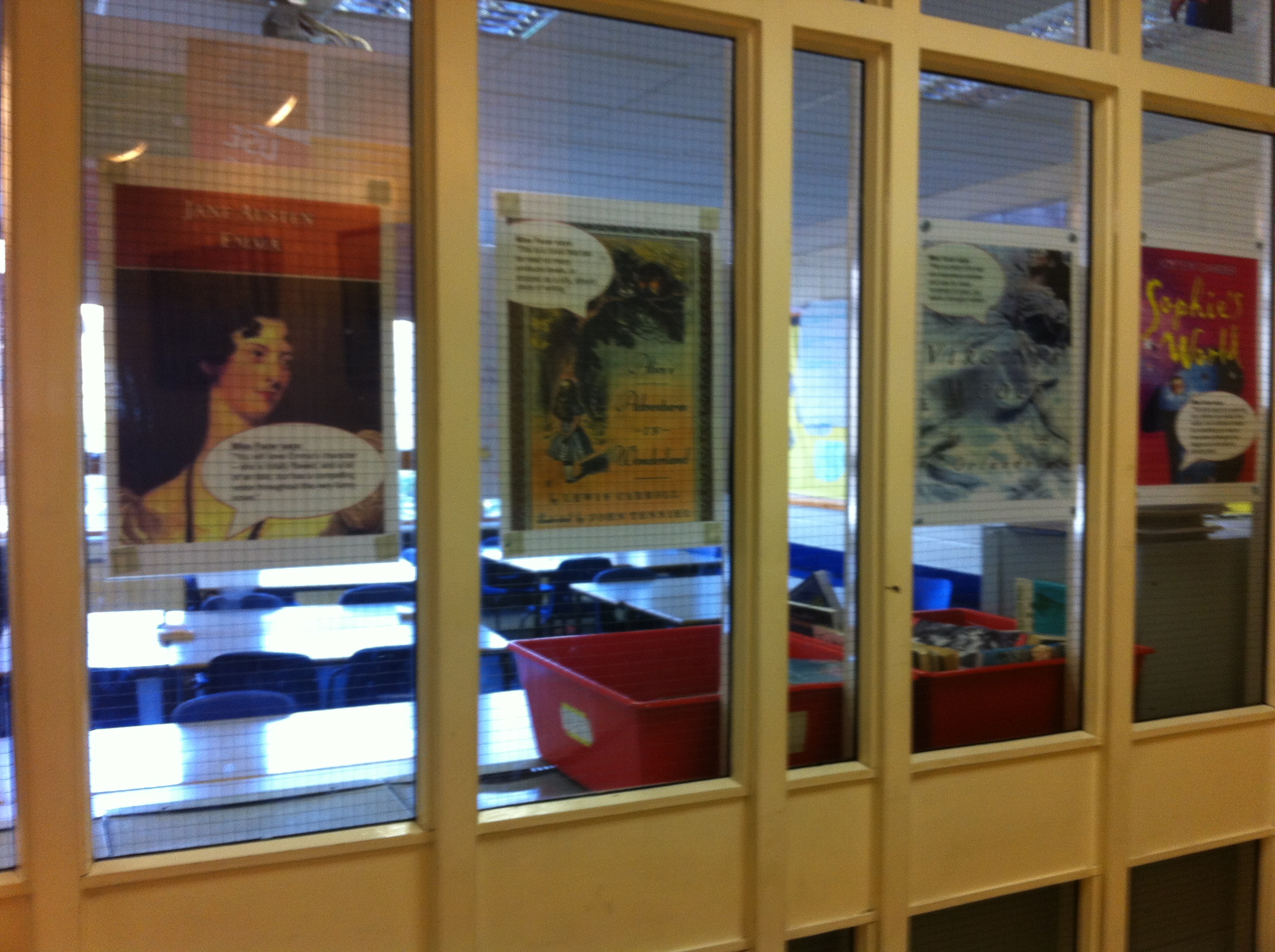
Pretty soon, I ran out of space. Here’s the corridor outside my classroom:

recommended wall

These posters prompted conversations, and, I hope, these conversations prompted reading.

On a visit to a school for a Debate Mate round, I noticed a teacher seemed to have lots of Philip Roth posters in his classroom. Loving Philip Roth, I had to investigate more. On closer inspection, it seemed these were hand-made posters, with a simple black background, which had the words “Mr… is currently reading.” I loved this idea and immediately stole it as my own. My apologies, sir.

Other teachers at my school loved it too. We put these up outside our doors, and changing them took all of two minutes. If a student or another teacher had recommended the book to read, we stuck their name on it too. This had the great side-effect of even more students recommending books for me to read.

ms is currently reading

One of the best interview tasks I have ever been given was a room of 5 delightful students who I had to consult in creating a whole-school “Reading for Enjoyment” policy. I could barely contain my excitement on being given such a task – my keenness was frankly embarrassing. These young people had some fantastic ideas, pointing out that reading sitting up wasn’t how they liked to do it – they suggested we give them an area which is comfortable, and filled with great books. They were also fond of the idea of eating and reading – they brought up the idea of giving dedicated readers free muffins when they came to read together, or even a standard school breakfast or lunch depending on the time of day. Open to abuse they might be, but both of these suggestions seem like small concessions to the reading community they could open up.

Yet the aspect these eloquent youngsters talked most about was recommendations: they wanted their teachers to recommend books to them. And I would guess that nearly all teachers, no matter what they teach, read. Making students aware of the fact that we are a community of readers can only encourage them. And if their students then want to read some Darwin or Dawkins? I’m sure that will be fine too.

i heart english