What education means to me

I’m a huge fan of Chris Hildrew’s blog, and browsing around recently I stumbled over this post on his experience of education. It really inspired me, and caused me to write about what education means to me.

The story, as with so much of what makes me who I am, starts with my Mum. One of seven children, my Mum was the only one to end up in her local grammar school. And she didn’t even pass the eleven plus; the teachers at her new school just thought a mistake had been made when she got there and referred her on.

Grammar school was great for my Mum, and she has always spoken fondly of it. But there are times when her stories have a wistful tone: only one other girl in her year spoke with the same “Suffolk accent” my Mum had (the rest of her side of the family still sport amazing accents; Mum has since dampened hers greatly), and girls used to make fun of the council houses to the extent that my Mum was sometimes ashamed and avoided telling her classmates she lived in one.

At that school, it was discovered she had a huge talent for sport. A coach took her under his wing and opened up a world of opportunity for her through athletics. He even bought her a pair of spikes so she would be able to compete at a higher level, and invited her to dinner at his family’s house, where she experienced a whole different kind of life. Passing all her O-levels well, the teachers pleaded with my Mum to stay on and do her A-levels there. Mum, who had never been outside Suffolk, chose to join the army and to see the world.

She had some experiences in the army that make me feel very proud to be her daughter, and learned a lot – none of it examined, all of it priceless. But when it came to my education, I think she had started to feel like she wanted something different for me. On leaving the army, she found that the world was a very different place, and education was gaining a top billing. I remember my parents arguing when I was around 9 about how they’d be able (or not able) to pay for me to go to University one day. Hugging me after, I reassured Mum: “I’m not going to go to University.”

Soon after, Mum set about finding a way for me to get a better education. At my current school, I was sat at the back of my English class with a textbook, working through it, as the teachers didn’t seem to know what to do with me; in other lessons, like Science and Maths, I was pitifully behind, and tended to mess around to avoid doing the work.

Despite a difficult financial situation as a newly single mother, Mum found a way. She’d heard of Assisted Places, which would cover almost all the fees of a private school, and she was determined I would win one.

I sat an entrance exam for our local private school. I failed it. Something tells me my Mum intervened, and before you know it the Headmaster, David Kidd, had me in the school’s library looking through my paper with me.

“Your English was brilliant,” he told me, “but you’ve scored almost nothing on this Maths paper. What happened? Did you rush it?” I shrugged. He decided to take me through the questions I’d answered incorrectly.

“How about this one? What’s the perimeter of the field. How do you find out the perimeter?” I looked blankly back at him. I had literally never heard that word before. He explained to me, patiently and kindly, what it was, and I answered correctly.

He did that for every question I’d answered wrong, without once making me feel stupid or inadequate. It took a considerable length of time.

I’ll always be grateful for Mr Kidd. Years after I left the prep school, he’d greet me by name in passing. That day, he went to my Mum and told her: “she can do it, but she hasn’t been taught it.” He also put me in the top set for Maths. The level of belief in my potential is something I’m still coming to terms with. The woman who went on to teach me Maths for the next 5 years, who sat me at the front and made me focus, who told me off without raising her voice above a whisper, has inspired me hugely in my own teaching career (Mrs Meadows-Smith: I don’t know how I got an A, but I know it is 100% down to you).

The pitfalls of my own education, however, ran parallel to my Mum’s. I didn’t have siblings to feel estranged from, but I knew that my old friends viewed me differently, especially when my accent changed. Well-meaning friends from my new school who came to my house were often surprised at how small it was, just as I was equally astonished at the vastness of theirs. Although I made some of my best friends at school, I can’t help but feel there is a chasm between us – the only difference being their safety net, perhaps.

I have to stress: I was never made to feel different at school because of my background, either by teachers or by students. But I was, and I felt it keenly, and I wonder today if what I gained in academics I lost in feeling like an ill-fitting piece of a puzzle for so much of my time at secondary school. Like Chris Hildrew, I went on to study English at University; unlike Chris, it was not Oxford, though I sorely wanted it to be. I wanted everyone to see that my transformation was complete: I belonged in that elite world.

At university, I felt even more out of place; there didn’t seem to be anyone like me. Everyone who had gone to a private school didn’t have my financial concerns; everyone who had gone to a state school assumed my background was very different to theirs. I started to feel ashamed of where I had gone to school, as if I was somehow at university by virtue of my privilege – which is also exactly right. It was a privilege fought for, tooth and nail, by my ambitious Mother.

When I heard of Teach First, I knew what I had to do. Education had put me where I was: one amazing teacher had taken a shot on me, and I’d done well. I dreamed of a world where all children, regardless of background, go to a fantastic, local school, as wonderful as the one I attended. I wanted to make that a reality for everyone. We are all entitled to learn and achieve, and we are all entitled to fit in to both our school and our community.


Wellington Festival

Having suffered from the genuine man flu all week, I certainly was not looking forward to a 5:40am wake-up call on a Saturday. Yet by the mid-morning I was already regretting not requesting a Friday off to have attended both days of the education extravaganza that is the Wellington Festival of Education. Here’s my round-up of the best Saturday I’ve had in months:

Arrival

Being met at the train station by a courtesy mini-van was a lovely touch, and crammed inside a school van really brought on some nostalgia. Upon entering the hallowed gates of Wellington College, however, it was clear that this was schooling from a different planet: it was like entering some kind of National Trust facility; all manicured lawns and ancient turrets. A few friendly chats as we signed in assured me this would be one of those “share and have the chat” days. The relaxed atmosphere, strengthened by hay bales and plentiful coffee stands, made it feel more like a day off than I had expected.

Session 1: David Starbuck: Growing a love of learning in your school

Mocked mercilessly by my friends for insisting we arrive super-early for this session, I watched as the room filled to standing room only. I had really wanted to attend this session, as I’m a fully paid up member of the Mindset club; however much of the session was explaining what mindset was rather than how to grow it on a whole school level. If nothing else, though, the slick delivery of this engaging session assured me that sessions like this do help to convert teachers, and really – you have to get the teachers first. Starbuck was also good enough to provide some interesting resources from his own school on this topic, which I greatly appreciated.

Session 2: Alex Quigley: Twilight or Middlemarch?

I think this was the session I was most looking forward to. I’ve followed Alex’s blog religiously and been very inspired and influenced by his thoughts, yet never met him. This session was moderately interactive, but mostly Alex shared his new KS3 curriculum and the thinking behind it. Even though I’m sure I’ve seen it on his blog before, there was something about it up on a big screen that made me just think: wow. This is an inspiring curriculum. He explored some of the tensions in creating a curriculum: what makes a piece of literature “great”? How can we practically engage with literature in the limited classroom time we have? How can we foster subject knowledge in our departments? I especially liked such gems as teaching spelling through stories, teaching “She Stoops to Conquer” to year 8 to explore comedy, and the four threshold concept AOs – reading about this hadn’t convinced me, but in person (and again that massive screen) I really got it, and that is the beauty of hearing people talk about their ideas rather than just reading about them.

Lamenting after that I was hugely jealous of Quigley’s curriculum, a friend said: “just steal it.” I sighed. The thing isn’t actually the curriculum itself; it’s the deep knowledge he has of his school, the excellent relationships within a motivated department, and the skill he has in leading people to consensus that has resulted in this curriculum. More than anything, I felt like this was a curriculum made by a team, and you can’t just “steal it” and expect it to work. Alex reminded me I have far still to go in moulding a department.

Session 3: Kris Boulton: How a codified body of knowledge could make teaching a profession

I won’t hide that I really really like Kris as a human being, so my view on this session may well be biased. Beginning with the awesome words: “I’m just a teacher”, he proceeded to wow the room with his confidence and well-thought-out schemes. He began by pointing out that the very fact that there is a debate over whether teaching is a profession undermines it as a profession. The decision to come at the argument from the perspective of a parent of a child was masterful; we must always keep our key stakeholders at the forefront of any thinking we do on our profession. Through his talk, I was brought back to my first fretful year of teaching, not quite knowing what to teach or how – as Joe Kirby mentioned later, you study English at university, but you’re not teaching Foucault; you’re teaching how to read sometimes. A degree is certainly not enough.

One of the highlights of this session for me was the questioner who brought up sharing and developing subject knowledge in department meetings, something I have embarrassingly never even considered doing but will now be pursuing in full force (especially as my department adore English and all read plentifully in their free time – there is a vast well of untapped knowledge there to share!).

Session 4: Geoff Barton: The Habits of Literacy

 Mr Barton is the Headteacher of a wonderful school in my hometown, and is also a bit of a local (and increasingly national) teacher celebrity – I knew I would have to call into his session, if only to tell my Mum (a huge fan of his frequent columns in the Bury Free Press – bastion of local news). Barton began by exploring the word rich/word poor dichotomy, and explaining we needed to “make the implicit explicit” in order to help the latter develop the skills of the former. He also noted “language carries power”, and it is of course our duty as teachers to ensure this power is more fairly spread. He moved on to share some useful strategies: ask questions and give students a chance to “orally rehearse” their answers, explicitly teach students how to make their writing “not boring”, share great examples of great writing and talk about what makes them great, demonstrate the process of writing in all its messiness (I felt for the first time superior and not ashamed of my board-writing: so messy as to be almost-but-not-quite illegible), and naturalise the process of reading.

To say I was inspired is an understatement: at the close of this talk, my close friend both agreed we needed to quit teaching because we’d never, ever be this good. (After lunch we had cheered up and resolved to just try a bit harder.)

Session 5: Joe Kirby and Katie Ashford: Our School System is Unjust

Again here, I am going to flag up a severe case of confirmation bias: I am entirely on board with what Katie and Joe said on this front. This session was beautifully engineered, with Katie and Joe tag-teaming perfectly, and again starting with the children. The premise of this talk is that students from wealthier backgrounds have a double-advantage: they are supported at home to be school ready, and then go to better schools. There were some strong words about the training provided by Teach First, which didn’t surprise me but did interest me – on being asked as a block of audience “do you think Teach First prepared you as well as possible to start teaching?” I was too shy to be the only person putting up my hand, but I definitely should have. Admittedly, I did try to supplement the training by reading a lot of books (as both Katie and Joe did, I’m sure), but part of me feels that the only way to be a great teacher is to do it a few hundred times. Yet Joe’s argument against this might be that children are too important for us to try, fail and reflect – we must get it right the first time around for them. Hard to argue with that.

The conversation segued into some exploration of what texts to teach – Joe mentioned being told to teach Cirque du Freak, and rebelling in year 2 to teach Oliver Twist instead. I empathise with this, as similarly I was uninspired in my first year (I might even have taught Skellig, but I’ve blocked that from living memory) and went on the following year to photocopy the entirety of Animal Farm in a desperate bid to be a better teacher. I’d actually argue it’s easier to teach richer texts – have you tried analyzing the language in the AQA GCSE language paper? There’s nothing there.

Session 6: Gary Wilson: Boys will be brilliant

You might know that I have only ever taught in girls’ schools, so my attendance at this session was part of an effort to up-skill myself in the other. Wilson began by noting that Scandinavia is the only place in the developed world where boys achieve on a par with girls, which is of course shocking. Noting that only a barely believable 4% of the teaching profession is male and under 30 (and the majority of those in secondary schools), Wilson remarked that we cannot wait for male teachers to join en masse and lead by example. Explaining how he had taken a group of “at risk” boys and engaged them in peer mentoring in local primary schools – but cooking, reading and dancing with the primary school boys – Wilson heightened my awareness in the other part of schooling – we’re not only there to get results. We have a greater duty to these children. Much of what Wilson said concerned combating sexism and labeling of “troubled” boys, and made a lot of sense.

Other highlights:

  • Reuniting with an unexpectedly large crew of teachers from my last school, and remembering why I loved working with them so much.
  • Meeting my first Leadership Development Officer (Teach First Mum) again, and her telling me I hadn’t changed (“at all”).
  • The Mr Whippy van at lunchtime.

Embassy Adventure

Receiving an email from my ex-Leadership Development Office (Teach First speak for your mentor over the two year programme) is always a delight; however, during half term I received a message unlike any other. The email explained that Teach First and Teach for All (a partner organization which umbrellas all the “Teach for” set-ups globally) were running a joint event at the American Embassy in London, and they were looking for someone to come and talk about education from a teacher’s perspective.

Now, I talk about education so much that the lady who does my eyebrows spent our last session trying to convince me to come and set up a school in her home country with her. But the prospect of something so immensely scary as this made me pause.

Then I remembered: I’m Jo. I do scary things. This has to be my new tagline, as, admittedly easily scared, this year I have done more scary things than you could shake any stick at. I’m basically walking around, continually petrified.

I arrived at the Embassy in good time, and soon a group of attendees and I were waiting patiently to go through security. Nerves had taken me over, and I struggled through polite conversation with some extraordinarily fabulous people. I would like to apologise to all of those people.

While we watched on, the almighty Wendy Kopp (founder of Teach for America and a massive idol of mine) waltzed effortlessly in. The woman has power.

Eventually in, after the Ambassador had charmed us all with some informal quips (none of which I remember due to being a puddle on the floor), Wendy stood up and told the story of Teach for America and Teach for All. Shaheen Mistri, the CEO of Teach for India, spoke next. It is safe to say 1. I was in extraordinary company, and 2. I was in no way cognizant of what was going on. After an awkward pause, I realized that it was my turn to speak. I was meant to be representing the “teacher voice.” But would I have a voice? My only hope was to not entirely embarrass myself.

I began by exploring the critical difference in outlook embedded by the “Teach” organizations. Though this is not an attitude exclusive to teachers trained in this way, I am not sure other training routes prioritise and indeed dogmatise this value to the same extent; that is that all children, regardless of background, have the potential to achieve. And I began by recounting a conversation with a colleague which ended with them asserting of a student: “they’re just not smart.” I find this a dangerous comment with the capability of writing off potential, and argued that instead of focusing on targets, statistics and expected progress, we needed to change the conversation to explore what measures we could put into place to help children achieve; what more we could do.

Keen to not cover up the depths of my ineffective first few weeks (months? Terms?) of teaching, I reminisced on my first “tricky” class.

In my first year as a teacher in an inner city school in one of the most deprived areas of London, my year 10 set 5 class taught me a lot about resilience. Our first lesson together started well. I even had them packed up, standing behind their chairs, and dismissed in an orderly manner. It was the Teaching Assistant who let me know that I had sent them off 10 minutes too early. Once they had clambered back to me, trust in my capability to even tell the time shattered, the uphill struggle began.

In the two years I taught this class, I grew to love each student dearly; despite some difficult interludes, there is not a single student I don’t think of fondly. They were patient with me, they who should have been least patient because most in need of decent teaching.

After two years with them, I wasn’t sure I’d actually taught them anything. I wasn’t sure I’d done all I could. I certainly hadn’t done all they deserved of a teacher. Yes, I’d marked books and planned lessons and delivered intervention; but after a difficult exam (the one with the “radio script” – my poor confused children, and equally I, had no idea what to do with this) and results’ day morning’s news that English results across the country were down, I was not hopeful.

The class did themselves proud. In that year our English department achieved the phenomenal result of 94% of students achieving an A*-C in English. But what made me even more proud were the individuals in my set 5. One student, who begged me to sit the higher paper, had achieved a B grade despite being entered for foundation. And two students, Roselyn and Rosina, both on track for D grades according to their “expected progress”, left with an A grade each in English. Those students, with their hard work, their continual effort and their refusal to give up, I hope provided a valuable lesson for every other set 5 student in years to come: just because they are in set 5 doesn’t mean they can’t achieve.

For me, that moment was humbling. I had predicted Rosina an A; I knew she would achieve it (though perhaps not that doom-ridden morning). But Roselyn? I predicted her a B. I didn’t believe an A grade could be possible. Those two taught me I should never put a cap on the ambitions I have for my students.

When I was invited by Teach for All to their Chicago conference in 2012, not only was I made more aware of the multiple challenges facing teachers around the globe: of teachers in Pakistan operating without tables and chairs; of teachers in India pleading with parents to let 11 year old girls attend school after it had been decided that their place was in the home.

I was also taken to visit Charter Schools, each containing powerhouse teachers who were quietly changing lives. Every day my expectations of what was possible were shattered. At Gary Comer College Prep, with 94% of students on free or reduced lunches, an average incoming 9th grader on a 5th or 6th grade level, and a proportion being unable to read or write, by the time of their graduation from the school 100% had gained acceptance to a 4 year college course. 100%. Like Roselyn and Rosina, it was humbling; and like with Roselyn and Rosina sometimes you have to see it to believe it.

After three years in my Teach First placement school, I interviewed for a Head of Department role in a school serving a deprived community in North London, and I spoke of my belief in the possibility of all students achieving at least a C grade in English. 100%. I wondered if this would be seen as wide-eyed naivety. But there was a wonderful moment when the deputy head called me up to offer me the role, saying that he too was a Teach Firster, and he was excited that together we could try to achieve this.

As Head of English, I have been privy to much more information about the lives of the children we are responsible for, and some of that information is heart-breaking. Yet it cannot break us.

And this was my rallying cry: every barrier our students face must make us more tenacious for their success. I know that success against the odds is more than just words because I have seen it; I know that with hard work, resilience and that belief that every child can succeed, it is a reality.

Teach First is a contentious training route, and I don’t wish to debate its efficacy or ultimate value; I only speak from personal experience. I couldn’t have asked for more from them as an organization, as a trainer, as a supporter of teachers throughout their career. I have received countless opportunities through them, but more importantly that that, I fully believe that my experience has irreversibly changed me. I certainly did not expect to be teaching beyond two years when I signed up.

I know that there are many young people around the country about to embark on their Teach First “journeys”. It will be hard. Oh, so hard. I hope they know that change is possible, gruelingly hard, but possible. No – probable. These are children with a well of potential. We can never forget that. 

Time spent on the “other” side

The Department for Education, tucked away on Great Smith Street in the aptly named “Sanctuary Buildings,” is remarkable, if for no other reason than its foliage. My abiding thought of that building is the giant plants, scaling the central atrium area and winding their way through all floors.

Spending time in this hallowed building has been my privilege, having trained with Teach First, who provide the advantage of the DfE’s ear, and who ship we self-selecting few in from time to time to discuss “issues.”

My first adventures in this building came in the Summer of 2011, when I was, again, privileged, to complete a “Summer Project” (Teach First’s kitsch name for an internship) there. My memories of those frantic two weeks are few, but stark. I remember working with some of the most incredibly dedicated and talented humans, fired by a burning desire to do good for our children. I remember they seemed to work endless hours that summer, and rarely took lunch away from their desks. I remember feeling as if their mission was my mission. I remember they seemed eager to reach out to teachers, although not entirely sure how to orchestrate this.

I remember having the same discussion with a number of civil servants, explaining I didn’t think I would ever be able to swallow my opinions and deliver a policy I disagreed with. I believe that, of those who I spoke to for career advice, 100% of them advised me to not join the civil service for this sole reason.

At that time in my early teaching career, I was such a mediocre teacher and such a (comparatively) decent administrator, such a career seemed welcoming – it felt like something I could be successful in, unlike teaching. But I’m delighted with their advice, and delighted I stuck it out in teaching.

Nonetheless, I still relish the opportunities I have been offered to enter that building and have a bit of a rant. The department’s consultations are inconceivably far-reaching, but I am lucky that through Teach First we have a say. I’m also honoured to have spoken on education with Ministers of State, although I believe firmly in the adage: “if you’ve nothing kind to say, say nothing.” And so I will move on swiftly from this particular topic.

This week, as one minute part of a consultation on the child poverty strategy, I was confronted with a government which appears to be trying desperately to make this blight on our social consciousness history. With a Minister who honestly acknowledged that, in times of austerity, we couldn’t simply throw money at the problem. And with colleagues who ranged from passionate and articulate teachers, to well-meaning and well-versed people on the peripheries of the school system, to frighteningly intelligent intellectuals whose job it is to make decisions which affect each and every one of our students.

I’m reluctant to bring politics into this blog, because I like to think the best of people, and I believe that all politicians (like all people) have good intentions. And despite the problems I have with some education policies past and present, I also temper my tendency to dismiss with the knowledge that what our country lacks is consistency; do we ever really have the chance to assess a policy, when one child’s education is steered by more than one political party across their time in school?

And of course, when tinkering with the whole system, we cannot afford to forget that there are individual lives in play. For every policy and draft and body of research and set of opinions, we have a collection of children – all hopeful, all full of potential; some succeeding against the odds, some succeeding because of the odds, and some being failed by us every single day, because the mechanism does not exist to eliminate our world’s ills with mere will. Would that we could.

That summer in 2011, I weighed making an impact on the hundred-or-so students I came into direct contact with every day with the potential to affect the educational quality of all children in the country. But in a way these are two sides of the same coin; when we work hand in hand, the micro and the macro, a picture begins to form of the certainties in each area of the country or city for students from all pockets of belonging; and what needs to be developed and what eliminated, both for these immediate students, and their children long after they have left us.

I remain ever optimistic that we, as teachers, can make a difference. I remain hopeful that we will begin to work together as a unit towards one united goal of equality in education for all. I rest assured that far more intelligent people than I are doing their best to piece together the parts which will bring the eventual day to pass, when all children will go to their local school, which will provide fantastic educational outcomes for them regardless of background.

What we say to our students

I’ve been thinking a lot this week about what we say to our students, and what that says about us.

I’ve spent a good deal of this year encouraging Year 11, as a cohort, in assemblies, classrooms and corridors. But it occurred to me recently that they might not see my words as “encouragement.”

John Tomsett’s excellent blog here made me wonder how year 11 heard me. Did they hear my words as encouraging – “we’re putting on extra revision sessions for you”, “we’re looking at your coursework and we want to help you improve it”, “your speaking and listening exams are over the next couple of months” – or was I actually berating them?

All year, teachers and SLT have reported that the year 11s are feeling “stressed.” For most of the year, I was fairly dismissive of this – after all, it’s year 11. It’s not going to be a cakewalk. They just needed to work harder.

This week, like all weeks, I looked at the data. Instead of being terrified about the 35 or so students who aren’t on track, I decided to look in a “glass half full” manner this term. John Tomsett in the post above wisely says:

“It’s pointless berating Year 11 at this stage, just love them instead. The die is largely cast by now and what they attain in their GCSEs this summer will not be improved by relentlessly getting on their case. Make them feel special and trusted and they might just find a little more enthusiasm for their revision over the next couple of weeks.”

I’ve tried to take this to heart.  Each time I’ve spoken to the year group this term, I have emphasized how positive their position is. On Friday, after a long few weeks of moderation, I told the year group something along these lines: “I’ve looked at all your coursework. It’s brilliant. I’ve looked at your speaking and listening exam results. They’re brilliant. You don’t need to do anything different to achieve amazing grades – just keep doing what you’re doing.” Before, I wanted them to be afraid. I now wonder if this is counter-productive, and has actually made them reject work.

And it’s not just year 11. Students come to school with all kinds of preconceptions; the number this year who have referred me to the received wisdom that “some people are just naturally smart” has made me feel incredibly depressed. I’ve worked hard with my own classes to emphasise effort; one of my happiest moments this year came at an Easter revision session (where targeted students across the year group were invited) when one of my students replied to a student who said the above aphorism by finishing my sentence: “It’s not how smart you are-” “It’s how hard you work!” I’ve had a year 7 say she doesn’t try because she “always gets it wrong”; trying to explain that failing is learning is taking time, but it is valuable to have that conversation every time, I think.

Of course, the caveats placed on “teacher talk” can seem endlessly numerous: never say: “brilliant!” without qualifying your praise; never talk about “work” (it is “learning”); never say a child is a level (they are “working at level…”); say thank you instead of please to encourage compliance with instructions…

I automatically bristle at such rules. They seem to discount the fact that students and teachers are people, who use language to communicate. The over-analysis of tiny words seems like mindless minutiae.

But then there are the students who pick up on our un-thought-out words. In my first year as a teacher, it was not long before I was met with the phrase familiar to all teachers: “you hate me, don’t you?”

Now, I’m one of these method-actor teachers. I’m an open book, and find it impossible to lie or fake an emotion or response. I have to love all students, because if I didn’t, I just couldn’t teach them. I’m also of the firm belief that all children have something lovable in them; something great – if only great potential. So I could face the student in question and quite honestly tell her: “of course I don’t hate you.”

We’re an emotionally oppressed profession, because we can’t tell students we love them, even though we do, and even though we freely tell our friends (every teacher I know has used the L-word about their students).

I know a teacher who bends over backwards for her class; who is in school before 7am and out of school after 6pm; who comes in on Saturdays to work with almost many of her targeted students. And yet one of her students, who I also teach and about whom we have frequent chats of our concerns, believes this teacher hates her. Nothing could be further from the truth. I won’t pretend every teacher loves every single student, but I don’t believe any teacher truly hates any student.

So, above all, I think we have to communicate that love to our students. In short, my resolution for this term, the most difficult term, is to strive to communicate the love I have for my students to my students. Let none say: “Ms Facer hates me.” I don’t. I really, really don’t.

The hardest term

I remember keenly the late March, early April of my first year of teaching. My colleagues, buffeted and disheartened, seemed to be clawing their way through Spring 2 as I blithely looked on, just getting into my teacher stride, wondering why everyone else was having such a hard time of it.

That was the only year of my teaching career I haven’t had an exam class. Now I know. I firmly believe that the Spring term, although it begins calmly enough, is the hardest term, crescendoing into Spring 2 with a the strength of many tornadoes.

Here are some reasons why:

1. Deadlines

All of a sudden, these become very real. I started a countdown in my diary (40 days until language coursework call-up, 30 days until Speaking and Listening exams need to be completed, 20 days to sort out the Literature Controlled Assessment) to try to keep all of these straight. Throw in a bit of self-evaluation and it’s suddenly deadline city. I quickly cancelled as many learning walks/book looks/student surveys as I could get away with. In fact, what was I thinking? In the future, Spring 2 should contain no superfluous deadlines.

2. Coursework/controlled assessment

The above deserves double, if not triple, mention here. It’s all about your students having the strongest portfolio to show the exam board what they can do. A folder which was looking fine to me in November suddenly appears to be full of gaping errors and misplaced apostrophes. Re-drafting (or re-writing) happens in all the snatched time you can find. Other subjects begin to grumble. Year 11 students become gold-dust.

3. Revision becomes crucial

Those gold-dust year 11s who are borderline in your subject also seem to be borderline in everyone else’s, and the bidding war begins. What was previously “only English on a Tuesday” turns into fierce bartering, as actually we’d like the students Tuesday, Wednesday and Thursday this week for Controlled Assessment; so I need to give up some year 11s to you next week. Who’s keeping the revision attendance to inform parents of who was there, not there, and excused on this occasion? Oh that’s me. My spreadsheet begins to look labyrinthine. I have to translate this into something digestible for SLT. They look at me with quizzical faces in the relevant meeting. Even I can’t make it out anymore. I also feel like I spend my life on the phone to parents, chasing children and barring the door at 3.20pm so they can’t leave until I have imparted precious wisdom.

4. Crunch time

The pressure piles onto the poor, crucial year group and you see some children absolutely fly. In our final assembly, I was hard pressed to make a list of 33 amazing students turn into a feasible number to meaningfully reward with lovely stationary treats for being so fantastic. And then there are the others, who crushingly give up. I was reminded by someone far wiser than I on Friday that it is “always our job to believe in them, especially when they don’t believe in themselves.”

5. They’re tired, you’re tired; behaviour happens

Which means exclusions, reports, internal referral and more phone calls home, leaving teachers doubly tired for the next lesson and primed for more behaviour to happen.

6. The fun stuff is over

Well, maybe not over, but definitely paused. No switching rooms with the person in the drama studio to have a real go at some practical work with year 7 – the tiny classroom will have to do as I don’t have the time to organize anything beyond turning up with my wares and ideas. Trips also feel like a far-off memory – I’ve taken only two this term, and each (while marvelous and enriching) nearly killed me.

Do I sound pessimistic? I don’t mean to; I’m just tired, like every other teacher in the country, particularly those with exam classes.

I share this in the knowledge that we are not alone; we are all part of a shared effort to get young people to the best possible position, so we leave as little up to the chance of the exam day as possible. Our students lead hectic lives, and by this point in the year, with some, it becomes apparent that so little of what really matters is within our control as teachers.

Yet I feel a renewed sense of purpose: after all this work, from students and teachers, parents and leadership, how can all the lovely children not reach their target grades? I’m hoping it is enough, and I’m hoping they can keep going for just two more months.

Cambridge, Kings and Changing my Teaching

“I enjoyed the trip very much and it made me sure of wanting to study English at university and that Cambridge would be an amazing place to do this.”

Year 12 student

My year 12 are undeniably a fantastic class. High achieving on entry, they have exceeded expectations this year in terms of the quality of their coursework. I’m certainly not discounting the mountain of work they still need to do to ace their exam in May, but each and every one of them has astonishing potential. And it is becoming more and more apparent that some would like to take English further, for which I am forever grateful. Much of this is down to two incredible universities who have opened their doors to us.

Back in September, in the early heady days of my new post , I contacted what seemed like every London university, explaining I wanted to build links between our sixth formers and a “local” university. Our year 12 are the first in our school to take English Literature A-level, so the time seemed ripe for new beginnings. Many did not respond. Those who did often offered specific days, often entirely unrelated to the course my year 12s are studying, and often at inconvenient times – as a consortium sixth form, it’s almost impossible to take students out of their other lessons (as perhaps it should be, always).

Conversely, two universities have offered numerous opportunities, but have also been open to helping us out in our particular circumstance. They have listened to what our students need and engaged with us on our terms. I am hopeful of a lasting relationship with each.

cambridge river

And the lecturers. Their astonishing knowledge, charisma and humility, as well as humour, was thoughtfully matched to sixth form students’ interests and levels. I was reminded of the very best of what I experienced at University, and found myself in the lovely position of learning alongside my lovely children.

On our trip to Cambridge University on 20th March, we learned how to make a successful application, and what subjects would be useful to do at A-level when applying to do an English degree. Also, we were taught what it would be like to do English at Cambridge. Finally, we were given an English lecture at University level focused on the philosophical question of: “How soon is now?” We looked at several different examples in poems, in the novel “To The Lighthouse” by Virginia Woolf and in the play “That Time” by Samuel Beckett.

Year 12 student

The following Monday, an incredible and generous lecturer from King’s College London relieved me of my duties and came in to teach my year 12 double lesson. I had previously explained to her that the students had been doing coursework, and they were now moving onto the exam. Could she perhaps do a session on Gatsby and narrative?

No powerpoint, no card sorts, no drama; a lengthy handout and some bullet points on a piece of paper had the students entranced. The angle the lecturer took, her questioning and her planning made me feel these short hours had given my 21 students a massive advantage over anyone else taking the exam who was not in that session. Oh, to be such a teacher!

In the frantic movement of everyday life in school, it is hard to find the kind of peace and tranquility necessary to reflect and create. I know that if I slowed down my lessons would be more thoughtful; too often, these days, I cling to success criteria and exam specifications in order to ensure my students know what they “need” to know. This is not enough.

I am going to aim to bring in some University when I plan. To think beyond the rubric. Not just: what do my students need to know? But: what is the most intellectually interesting way we can explore this?

I’ve often maintained that we should all be always learning, but perhaps it is time for me to go back to school with English. It feels like it has been a long time since I have learned anything new about English, and I was reminded last week that the world of the academic moves, at times at least, in a surprisingly sprightly fashion. There are a raft of post-graduate and short course prospectuses piled up by the door, hastily ordered following my recent experiences, and perhaps one of these holds the key to a wiser teacher.

We can always improve, and it is foolish to imagine there could be such a thing as a zenith of teaching practice. These two weeks in particular I have come face to face with greatness, and I’m falling short. I need to know more, so I will read more; I need to do more and plan more and question more and become better at what I do so the children that learn with me can know more, and go further.

But in the meantime, if I can expose my students to these kinds of opportunities, and inspire them to aim for the best they can achieve, I can take some comfort at least.

cambridge logo

Why study A-level English? An(other) assembly

When the Head of Sixth Form asked me to deliver an assembly to year 11 on why they should study A-level English, my first thought was one giant, panicked, bold and underlined “why?”

Why indeed? I went away and spent a couple of weeks pondering, thought of a few lame lines, and came back to admit defeat. Somewhat unadvisedly, I explained that I “had never really thought about why myself”, having myself “not thought things through and just chosen what felt right – that’s how I work.” Given that this person line manages me, admitting to my haphazard decision-making skills was probably an error.

I’m nothing if not honest. I did English Literature A-level because I had to; I was compelled to read and question; it was the only thing I loved and was any good at. No thinking needed.

Fortunately, I have a great line manager, who expertly guided me towards the light. I shared my clumsy “course outline” and “what looks good on your UCAS form” and he shook his head, saying: “what they really need is inspiration.” He referred me to this ad, suggesting that literature is about life: not the biology or the mechanics, but the human, and the emotional.

The assembly begins with the following on the screen, for students to ponder (or ignore) as they await the start of the session:

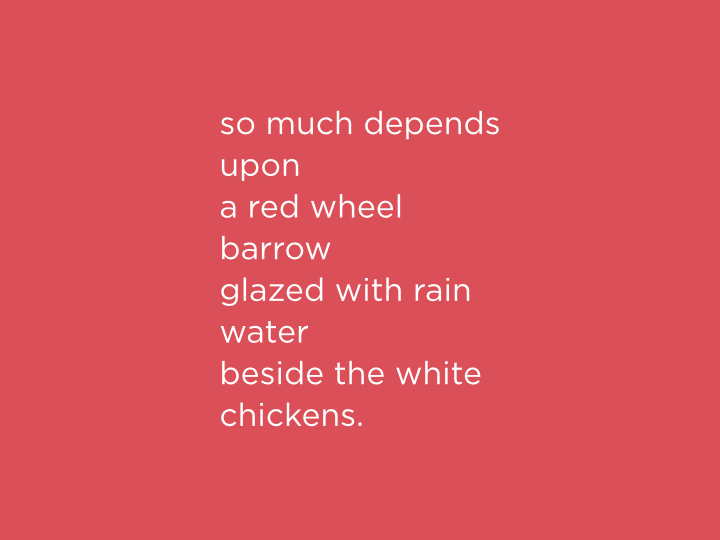
so much depends

I then showed my initial (lame) reasons for studying English Literature: universities rate it, it is more rigorous than English language, and many future careers await you. I then proceeded to explain that none of these are good reasons to choose to study Literature, drawing on the wisdom of Laura McInerney’s research showing that the idea of “facilitating subjects” is often not backed up by evidence. Despite few firm conclusions, I’d rather persuade my students to do three subjects they love and can achieve decent grades in, over any particular combination of subjects.

So, my opener for “why really study English Literature” was a fabulous quote from F. Scott Fitzgerald:

“That is part of the beauty of all literature. You discover that your longings are universal longings, that you’re not lonely and isolated from anyone. You belong.”

 We’ve all had that moment when reading when we suddenly acknowledge that our feelings, emotions and thoughts are not isolated and freak-like; we are connected to others in a tissue of shared feelings.

I then used Roald Dahl’s Matilda as a conduit for my next point (which was fairly similar to the entire assembly I blogged about last week here):

“The books transported her into new worlds and introduced her to amazing people who lived exciting lives… She travelled all over the world while sitting in her little room in an English village.”

I then returned to the initial poem, one of my favourites. I asked students whether they thought it was a poem; opinion seemed fairly split. This worked well for me. If this writing were on a toilet door, or in a fortune cookie, would they think it was a poem? Heads shook. Then I asked: what if it was in a poetry book? Confused faces.

William Carlos Williams calls this a poem. Some of you don’t call this a poem. Who matters more; the poet, or the reader? Or do neither of you matter? What about when the poem was written, or the cultural context? Was Williams trying to make a point about poetry? Or is the only aspect of importance the words themselves?

If you want answers, don’t study English Literature; there are no ticks and no crosses. But if you want to question and debate and argue and never be sure, you’re picking the right subject.

I closed the assembly by saying that if none of those arguments convinced them, I had one more: literature is beautiful. It makes you think things, and it makes you feel things. And I read Robert Frost’s “Fire and Ice.” This is actually one of my year 11’s favourite poems (I expressed to year 11 that I was delighted that someone other than me has a favourite poem, only to have another come up to me afterwards and exclaim somewhat angrily: “Miss, I have a favourite poem too!”), which is partly why I chose it. It is also a wonderfully complex piece of word mastery that even the science teacher I practiced saying it to minutes before the assembly began could appreciate its clever intricacies (I’m not saying scientists aren’t capably of being poets. But it’s good to chase cross-curricular opinions and attitudes).

I then showed my initial (lame) reasons for studying English Literature: universities rate it, it is more rigorous than English language, and many future careers await you. I then proceeded to explain that none of these are good reasons to choose to study Literature, drawing on the wisdom of Laura McInerney’s research showing that the idea of “facilitating subjects” is often not backed up by evidence. Despite few firm conclusions, I’d rather persuade my students to do three subjects they love and can achieve decent grades in, over any particular combination of subjects.

So, my opener for “why really study English Literature” was a fabulous quote from F. Scott Fitzgerald:

“That is part of the beauty of all literature. You discover that your longings are universal longings, that you’re not lonely and isolated from anyone. You belong.”

 We’ve all had that moment when reading when we suddenly acknowledge that our feelings, emotions and thoughts are not isolated and freak-like; we are connected to others in a tissue of shared feelings.

I then used Roald Dahl’s Matilda as a conduit for my next point (which was fairly similar to the entire assembly I blogged about last week here):

“The books transported her into new worlds and introduced her to amazing people who lived exciting lives… She travelled all over the world while sitting in her little room in an English village.”

I then returned to the initial poem, one of my favourites. I asked students whether they thought it was a poem; opinion seemed fairly split. This worked well for me. If this writing were on a toilet door, or in a fortune cookie, would they think it was a poem? Heads shook. Then I asked: what if it was in a poetry book? Confused faces.

William Carlos Williams calls this a poem. Some of you don’t call this a poem. Who matters more; the poet, or the reader? Or do neither of you matter? What about when the poem was written, or the cultural context? Was Williams trying to make a point about poetry? Or is the only aspect of importance the words themselves?

If you want answers, don’t study English Literature; there are no ticks and no crosses. But if you want to question and debate and argue and never be sure, you’re picking the right subject.

I closed the assembly by saying that if none of those arguments convinced them, I had one more: literature is beautiful. It makes you think things, and it makes you feel things. And I read Robert Frost’s “Fire and Ice.” This is actually one of my year 11’s favourite poems (I expressed to year 11 that I was delighted that someone other than me has a favourite poem, only to have another come up to me afterwards and exclaim somewhat angrily: “Miss, I have a favourite poem too!”), which is partly why I chose it. It is also a wonderfully complex piece of word mastery that even the science teacher I practiced saying it to minutes before the assembly began could appreciate its clever intricacies (I’m not saying scientists aren’t capably of being poets. But it’s good to chase cross-curricular opinions and attitudes).

Some say the world will end in fire,
Some say in ice.
From what I’ve tasted of desire
I hold with those who favor fire.
But if it had to perish twice,
I think I know enough of hate
To say that for destruction ice
Is also great
And would suffice.

PP Arial Why Study English Literartue

Why students should read more: an assembly

Last Thursday was “World Book Day.” As Head of English and self-proclaimed “reader”, it was my responsibility to be all over it.

I really wasn’t.

I’ve been shamed by looking at the amazing things schools did on Twitter, and I have no excuses other than: 1. There’s absolutely no way I am dressing up as a book character and therefore I can’t really mandate other people to, and 2. It took me by surprise.

I feel like September was about fifteen minutes ago, when I started the year thinking about all the wonderful and exciting things I was going to implement in my department to do with reading. In our Middle Leaders CPD, I chose encouraging reading in the school as my project, and in November when I touched base with the CPD leader she gave me some inspiring ideas for this World Book Day thing and I became really excited about it.

And then, all of a sudden, it was next week and I had to give out some tokens; oh, and could you do an assembly?

Realising I had entirely missed the World Book Day boat, I tried to pull together the best assembly of my life (not hard – I have delivered precisely one assembly, albeit delivered four times).

The assembly begins with this image, which I stole shamelessly from Tessa Matthews, for students to glance at during the time they file into their seats.

tessa reading

I began by introducing myself, and this has proved to be a valuable aspect – I really ought to have done an assembly sooner, as the number of students who asked me what happened to the previous Head of English and why did I steal his job (he has been promoted to Deputy Head) has been incredible. Even some of my own students came up to me later that week asking: “are you really the Head of English?” which I felt was a bit of a title-fail on my part.

I then said that my opening gambit was that every book will teach you something, and I reeled off a variety of lessons I had learned from books. These were: amazing vocabulary from Woolf’s Orlando, about the Napoleonic Wars in War and Peace, how it feels to lose someone you love from Looking for Alaska and form Lord of the Rings that I don’t like that kind of book – but that’s ok, because you won’t like every book, you just have to read them all to find that out!

The initial image was then shown again, and I explained that it makes me think of all the things I don’t know, and all the things I haven’t done. I then listed some of the things I haven’t done:

  • Been to California
  • Lived in the Victorian era
  • Married a prince
  • Been elected to office

and explained that, through reading (The Grapes of Wrath, Middlemarch, Grimm’s Fairy Tales, The Audacity of Hope) I could experience all of these aspects, even if I will never experience some of them in reality.

For what I don’t know, I showed a slide with just an ellipsis, and waxed lyrical on how we don’t know what we don’t know, complete with Socrates’ famous quote.

I segued from this to say that it wasn’t only “really cool English teachers who love to read”, but that people slightly more famous than us also do. I used three examples, all of whom were white and male (and two dead), thus undercutting my own preference for an inclusive representation in all aspects of life – in my defence, I made the assembly at high speed. I spoke about Steve Jobs, who loved William Blake; Phil Knight (founder of Nike) who has a library in his house and makes his guests take their shoes off before entering (books before shoes!) and Winston Churchill, who accomplished many great political things but has a Nobel Prize for Literature.

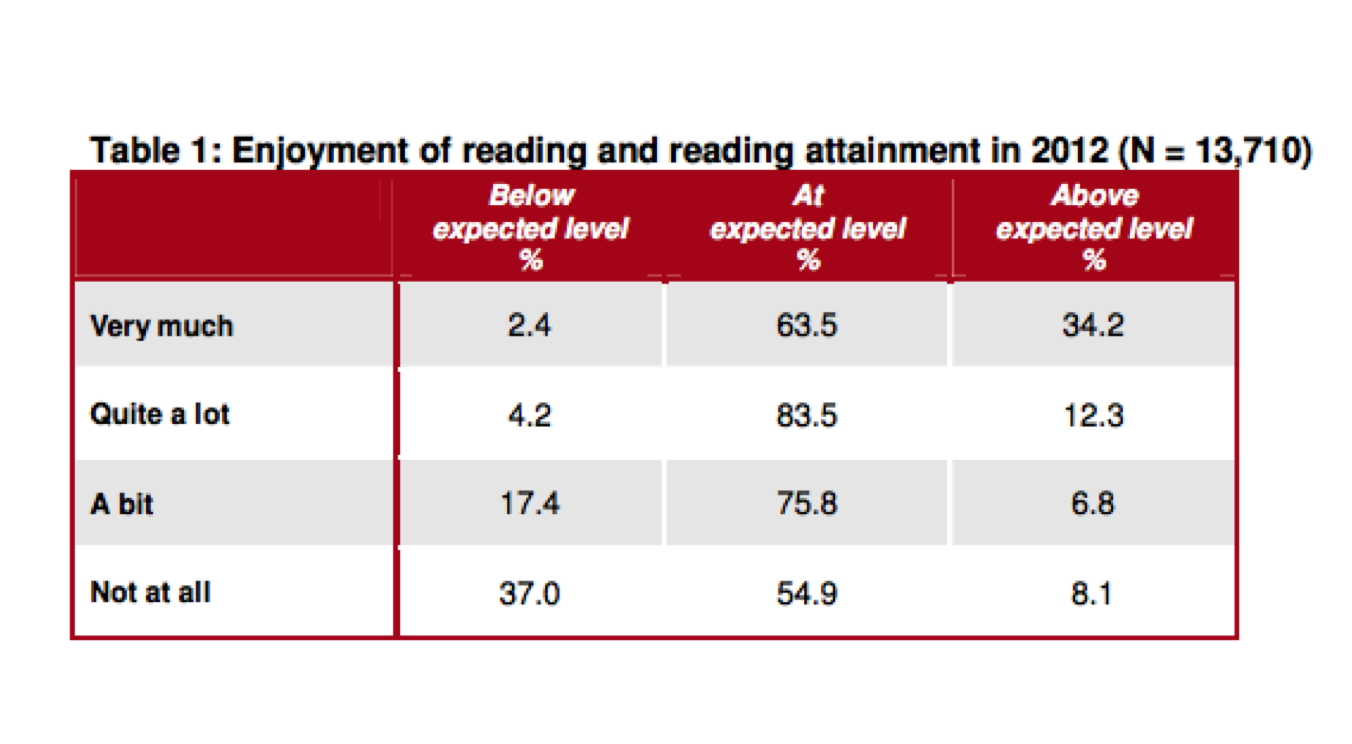
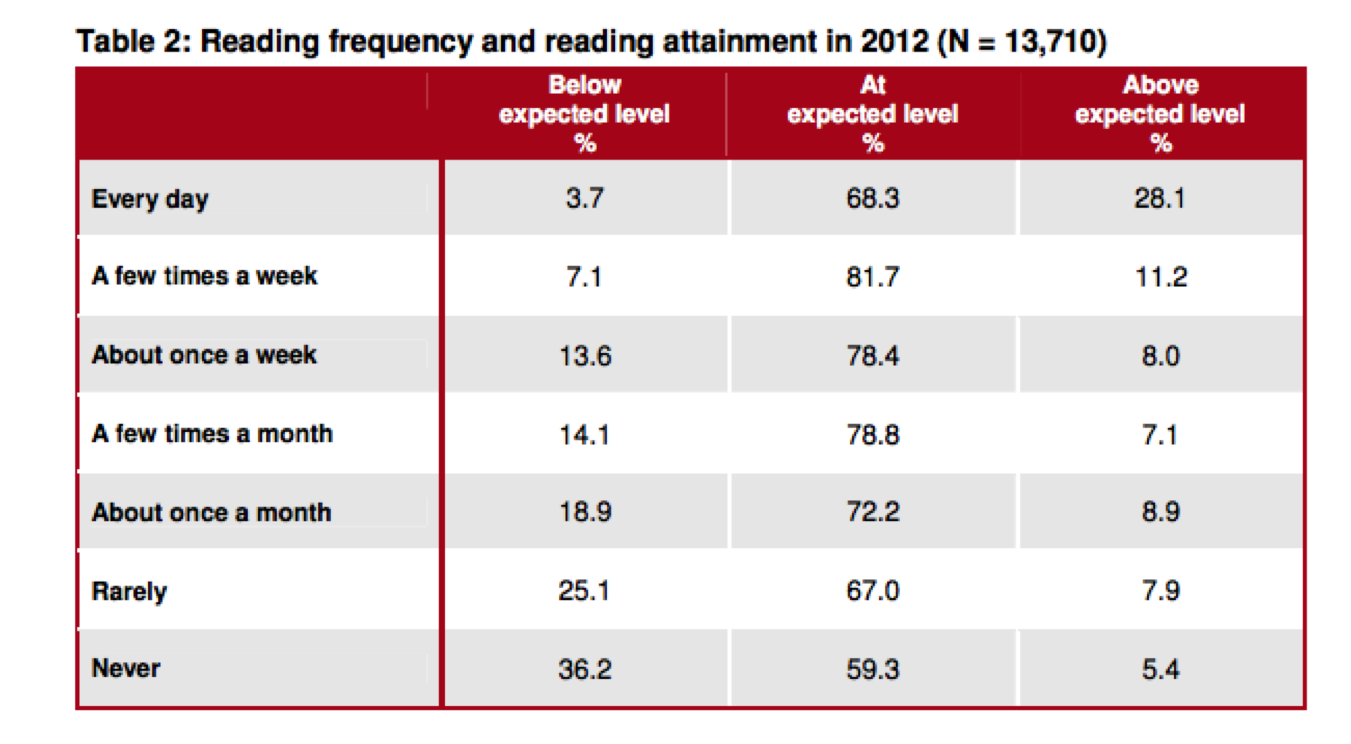
Perhaps the most powerful part of the assembly came when I used Maths to back up my arguments – our kids seemed to love the facts and figures. I showed the following charts from the National Literacy Trust and talked the students through what they were showing – the more you read, and the more you love reading, the more you will achieve:

table 1

table 2

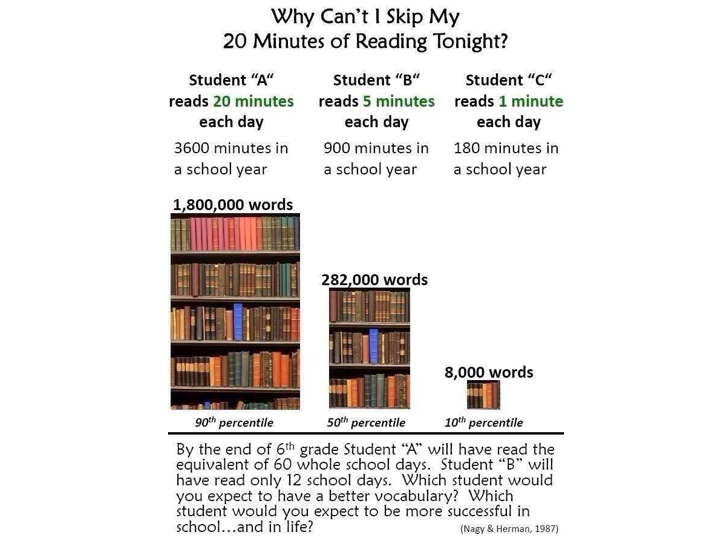
I also stole this image from someone on Twitter, but now don’t know who to thank:

why can't i skip

This image had a massive impact, and I enjoyed saying “one million eight hundred thousand words” about seven times in the course of the assembly.

All of which led to my final argument: the more you read, and if you enjoy reading, and the more you read great books, you will be smarter, happier and more successful.

I’ve had a lovely response to this assembly, including some warming comments from staff members. The best outcome is undeniably the number of students who I’ve not had any dealings with, coming up to me in corridors or in the lunch hall and telling me what they have read, what they would recommend to me, or asking for a book recommendation.

All in all, World Book Day came and went and I hang my head in shame; but I hope that my message of reading will live on regardless. Now: to plan next year’s reading assemblies!

Reading assembly

Five things that scared me

This week has been perhaps the busiest of the year so far, and I’m mostly just delighted to have survived it. My lesson of the week has been to always do what scares you: only when out of our comfort zone will we truly learn and become our best selves.

That being said, I’m a stickler for routine, so leaving my comfort zone is no small feat. This week I have done a personal record of five scary things. Here they are:

1. Reading assembly

In honour of World Book Day on Thursday, I delivered a reading assembly to three different year groups this week. I’ll blog about this separately at a later date; suffice it to say it was scary and wonderful in equal measure.

2. Speaking and listening exams

For the iGCSE English language, speaking and listening still counts as 20%. The exam is recorded and sent off for moderation. Ok, these were definitely more scary for the students than me; but there was definitely the worry that I’d ask the wrong questions and a student would end up with a less than wonderful mark because of me. These went well, and broadly speaking the students were happy as clams.

3. Miss Representation trip

Taking a trip is always scary, as you’re responsible for students out in the big bad world of cars, buses, other humans and slippery floors. On being offered tickets by Boster Group to see the documentary Miss Representation, exploring how women are presented in the media (I blogged about it here), as well as attendance at the panel discussion afterwards with a load of female luminaries, I could hardly pass it up. The students got a lot out of it, and all returned alive, which is the main aim of any trip.

4. Sixth form assembly

I spoke to Year 11 about why they should take English A-level. To close, I used one of my student’s favourite poems, and quipped: “I was just so delighted someone other than me has a favourite poem.” The main awesome outcome of this was the student who angrily informed me afterwards: “Miss, have a favourite poem too you know.” When you think kids can’t get more wonderful, they just do. I’ll blog in more detail on this soon, I promise.

5. Pedagoo

The scariest of all the scary things was being asked to give a workshop at Pedagoo by the marvelous Helene Galdin-O’Shea. I hadn’t presented before so I’m very grateful to have been given the opportunity. Some wonderful people also came to my session, which was fabulous, and they discussed and debated and engaged and were lovely. Some smiled and nodded, which I’ve never realised was so important before, until being up there myself.

I was seriously impressed by the quality of sessions at Pedagoo, a testament to Helene’s gift for getting educators together.

I later visited Rachel Stevens who shared ideas on lesson study, as well as some nuggets for making teaching and learning the hub of any school. Rachel was also funny, friendly and very willing to share her experience and resources. Our talking questions on the advice we would give to teachers made me realise I need to seriously refresh myself: I’ve spent most of this year wrapped up in curriculum and data, but what really matters is pedagogy: teaching and learning forever!

I then attended a session run by Jude Enright and Jo Leaver-Cole on coaching. This was a brilliantly planned session, with the speakers complementing each other wonderfully. They explained how they’d moved to a model of coaching in their school, and some of the challenges they had faced. I loved that they were willing to share both what had worked and what hadn’t. Their teacher improvement plan was supportive, thoughtful and challenging, and left me wishing I worked at their school!

I know I have a very long way to go to be such an accomplished and inspiring speaker as the many who I witnessed yesterday, but I also feel inspired to work harder and do more.

Here’s my presentation from yesterday, and thanks again all who came!

Pedagoo