Just one book: teaching

Perhaps I ought to have begun with teaching. Two years ago, I probably would have done. The primacy of teaching then for me was that it was the everything: in a school with no schemes of work and no curriculum plan, part of my teaching was choosing my curriculum and then assessing whether I had effectively taught it.

Now, I’ve moved schools, and seen the benefits of a more stratified approach. All students learning the same curriculum, with the proviso that it be high-quality, is surely more equitable and manageable. I wouldn’t want my children learning Skellig if the folks next door were tackling Oliver Twist. 

For some of the books in this series, I deliberated for weeks, going back and forth over which book to choose. The only topic I didn’t even have to think about was this one. Because, obviously:
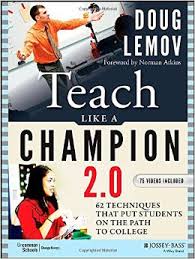
TLAC 2.0

Doug Lemov: Teach Like a Champion

Why is this book so good? Because it tells you what other books won’t. This book tells you the nitty gritty practicality of how you should set your classroom up and then what you do in it in order for learning to occur. You don’t go to a book like this for vision and broad strokes, although those too are present; you go to Lemov for practical guidance. This book is the awesome mentor you might not be lucky enough to have in your early teaching years; the fantastic coach you almost certainly will not have in later years of teaching.

I first encountered this book in a lukewarm Guardian article, and decided to give it a miss. A few weeks later, a respected colleague from an ARK school called me up, telling me something had completely changed her practice, and it was this book. I’m so glad I listened to my friend and not the Guardian. Why does TLAC work so well?

Lemov has painstakingly observed hundreds of teachers at work, (“there is no gap that has not been closed already by some teacher somewhere”) and has drilled down into what they do to be effective in their classrooms. The results are distilled into manageable actions anyone can take, with examples you can watch on an accompanying DVD. They’re not quick-fixes; they’re not gimmicks. They are habits which, if embedded, will change the amount your students learn and want to learn from you.

Lemov notes that “perhaps the most salient characteristic of a great teacher is her ability to recognize the difference between ‘I taught it’ and ‘they learned it.’” Too often, I find myself despairing that students still cannot embed quotations and analyse language, given how many times I have taught it. Lemov reminds me that there is always a tweak; always a way I can improve my practice.

Just some of the key habits Lemov advises include avoiding the use of yes/no questions; instead, we must use pointed questioning to distil the students’ true understanding. Cold-calling is the widely preferred method of questioning, ensuring that all students are primed and listening and always ready to respond to your questions – by which he means no hands up. (Incidentally, one major benefit of the prevalence of TLAC parlance is the creation of a shared vocabulary of teaching.) Alongside cold-calling, which transformed my practice, he advises “No Opt Out” – students can never be excused trying. Wrong answers are ok, not even trying is not: “everybody learns in a high-performing classroom.”

Yet for methods such as these to be truly effective, we must create what Lemov terms a “Culture of Error” in our classrooms – less ironic than it sounds, this means students need to be willing to “share their struggles, mistakes, and errors” so teachers “spend less time and energy hunting for them and more time fixing and learning from them”. This might seem like overly broad brush advice, but Lemov follows this up with precise examples of how to do this, which include narrating growth, celebrating improvement, and praising struggle (“great question!”).

On structuring a lesson, I can’t think of a simpler or more easily applicable method than Lemov’s “I do, we do, you do”: therein lies lesson planning. Firstly, the teacher models. Then, the class practises together. Finally, students practise independently. Peppered in this structure you can have your cold-calling; your “Turn and Talk” (a much nicer way of saying “pair share” to my mind, rolling, as it does, so much more easily from the tongue: “turn and talk to your partner about…”).

One of the most helpful additions to the new edition of TLAC is the section on reading, which I have revisited more than any other this year – again, full of useful tips on how to encourage students when reading aloud in class, explained in lucid detail and with helpful examples.

As frequently thumbed in my own copy is the section on managing behaviour. Lemov’s overarching idea of making the “least invasive intervention” has changed the dynamic in my most challenging groups. Helpfully, he details examples of these interventions: positive group correction (“I need to see everybody writing”), anonymous individual correction (“I need two more sets of eyes”), private individual correction (quietly, one to one, with the student in question), lightning-quick public correction (always followed up by praise).

For those who fear that the outcome of these techniques is the creation of tiny obedient robots, Lemov reminds us all to “seek not only to be both warm and strict but often to be both at exactly the same time.” We must be strict, and never excuse poor behaviour; yet just as imperative is to be warm and kind, and love our charges, infusing our corrections with reminders of this love.

TLAC distills what the best teachers do:

  • Cultivate classroom culture, systems and routines
  • Enforce high behavioural expectations
  • Build trust
  • Set high academic expectations
  • Plan, pace and structure their lessons
  • Increase cognitive ratio (making students do the thinking) through questioning, writing and discussion
  • Check for understanding

To go on further would run the risk of plagiarism. In my view, to summarise, this is the book on teaching.

So far, I’ve explored curriculum and assessment, two aspects of education which are inextricably linked. The final two posts will be on leadership and ethos.
Just one book: assessment

In my last post, I outlined what I believed to be the foundational concepts that must underpin a school’s curriculum, using E.D. Hirsch’s Cultural Literacy as the one text I felt most clearly displayed what a great curriculum should be. Of course, it is almost impossible to create a curriculum without simultaneously thinking about assessment: it is all very well to teach students great stuff, but if they immediately forget it all, or show you that they’ve understood none of it by the end of your teaching, you might as well have taught marbles.

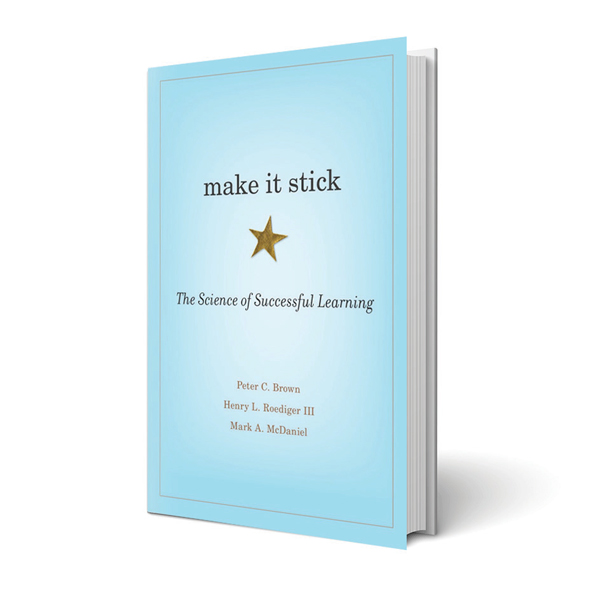
make it stick

The one book that has truly changed my view on assessment is Make it Stick by Brown, Roediger and McDaniel. Prior to reading this book, I too believed in the value of re-reading, highlighting, and testing students’ knowledge and understanding using extended essay after extended essay, running the risk of breaking my own will to carry on teaching due to having to endlessly plough through immense paragraphs riddled with small misconceptions and tiny errors, all of which I would painstakingly correct, before trying to rationalise each error into a single “target for improvement.” Then, weeks, months, years after I’d taught students, what did they recall of what I had taught? Too, too little.

I want to make a clear distinction between feedback and assessment. I define feedback as qualitative commentary, and assessment as quantifiable, measurable snapshots showing a teacher what their students have and have not understood. Both have their place, but my feeling is we have over-emphasised the former to the detriment of both student learning and teacher well-being.

The key messages from Make it Stick seem to me to be:

  • “Learning is deeper and more durable when it’s effortful.”
  • “We are poor judges of when we are learning well and when we’re not.”
  • Retrieval practice – recalling facts or concepts or events from memory – is a more effective learning strategy than review by rereading.”

The authors note that: “One of the best habits a learner can instill in herself is regular self-quizzing to recalibrate her understanding of what she does and does not know.” Joe Kirby has brilliantly explained how this might work in practice over the long term for individual students here. In lessons, I would suggest, we need to not only assess what students have retained in order to know what to teach them, but also to model what this kind of self-quizzing looks like and enable them to practise prior to doing it alone.

And when should this quizzing occur? There frankly does not seem to be a bad time to quiz, according to this book. Students do better in the long-term if they have pre-quizzes (even if they get everything wrong, as “unsuccessful attempts to solve a problem encourage deep processing of the answer when it is later supplied, creating a fertile ground for its encoding”), immediate quizzes (“in 2010 the New York Times reported on a scientific study that showed that students who read a passage of text and then took a test asking them to recall what they had read retained an astonishing 50 percent more of the information a week later than students who had not been tested”) and quizzes after partial forgetting has occurred.

The latter is of particular importance: “When retrieval practice is spaced, allowing some forgetting to occur between tests, it leads to stronger long-term retention than when it is massed.” The most helpful quizzing, they suggest, takes place long enough after learning that the quiz isn’t “mindless repetition” but not so long that “retrieval essentially involves relearning the material”.

“Quiz” does not necessarily mean multiple choice, or even teacher-directed. Brown et al give examples such as students simply writing down ten facts they didn’t know before reading a passage. Another user-friendly option is a “free recall” homework where students: “spend ten minutes at the end of each day sitting with a blank piece of paper on which to write everything they can remember from class”. This enables students to know what they have not yet learned, and so pinpoint their future revision of key facts and ideas. Even cloze exercises can be of benefit, as “the act of filling in a missing word in a text results in better learning and memory of the text.”

In practice, quizzing works best when it is:

1. Purposeful

Students understand why quizzing is beneficial – they buy into the idea of frequent quizzes when they understand the benefits it will have for their long term retention of key ideas.

2. Targeted

Quiz questions are thoughtful and targeted to the specific ideas students need to know, isolating individual facts or key pieces of information.

3. Instantly Corrected

Wrong answers are corrected immediately to ensure students do not leave your lesson carrying misconceptions.

4. Low-Stakes

The stakes are low – there is no need for any of this to stress students out. This, along with emphasising the learning benefits also tends to preclude cheating.

Taking the advice of Make it Stick, schools would do well to build frequent, low-stakes quizzes into their day-to-day teaching. High-stakes, long-answer assessments should be less frequent, partly because the feedback teachers can give on these will not be as accurate, as students will be displaying a much larger breadth of skills and knowledge. Short, frequent quizzes allow teachers to break learning down into its core components, and isolate exactly where students are weakest, and then teach to that weakness. They should also reduce the need for overly extensive feedback on long-answer questions, thus reducing teachers’ workload significantly.

My next post will explore teaching, and one book that I will suggest provides the clearest guidance.

Just one book: curriculum

There are countless books on education. Some will entirely change your outlook and thinking, revolutionising what happens in your classroom and in our schools. Some will be a complete and utter waste of your time.

It is with this in mind that I propose to put forward just one book for some of what I see as the key aspects of education. Over the coming weeks and months, I will be exploring one book for each of the following aspects: curriculum, assessment, teaching, school leadership and school ethos.

It has been easy to pick just one book for some of these categories, and devilishly difficult for others. Of course, my choice will be a personal one, informed by my own personal view of education, and I accept that it may not be a view all share. Hopefully, those who disagree with my choices will put forward alternative single wondrous tomes. We are, I think, always honing, always refining our thinking.

I’m beginning with curriculum. I take curriculum to mean the stuff a school teaches its children. Taking the “what” before the “how” is incredibly important to me, and is one of the defining aspects of the writer I have chosen.

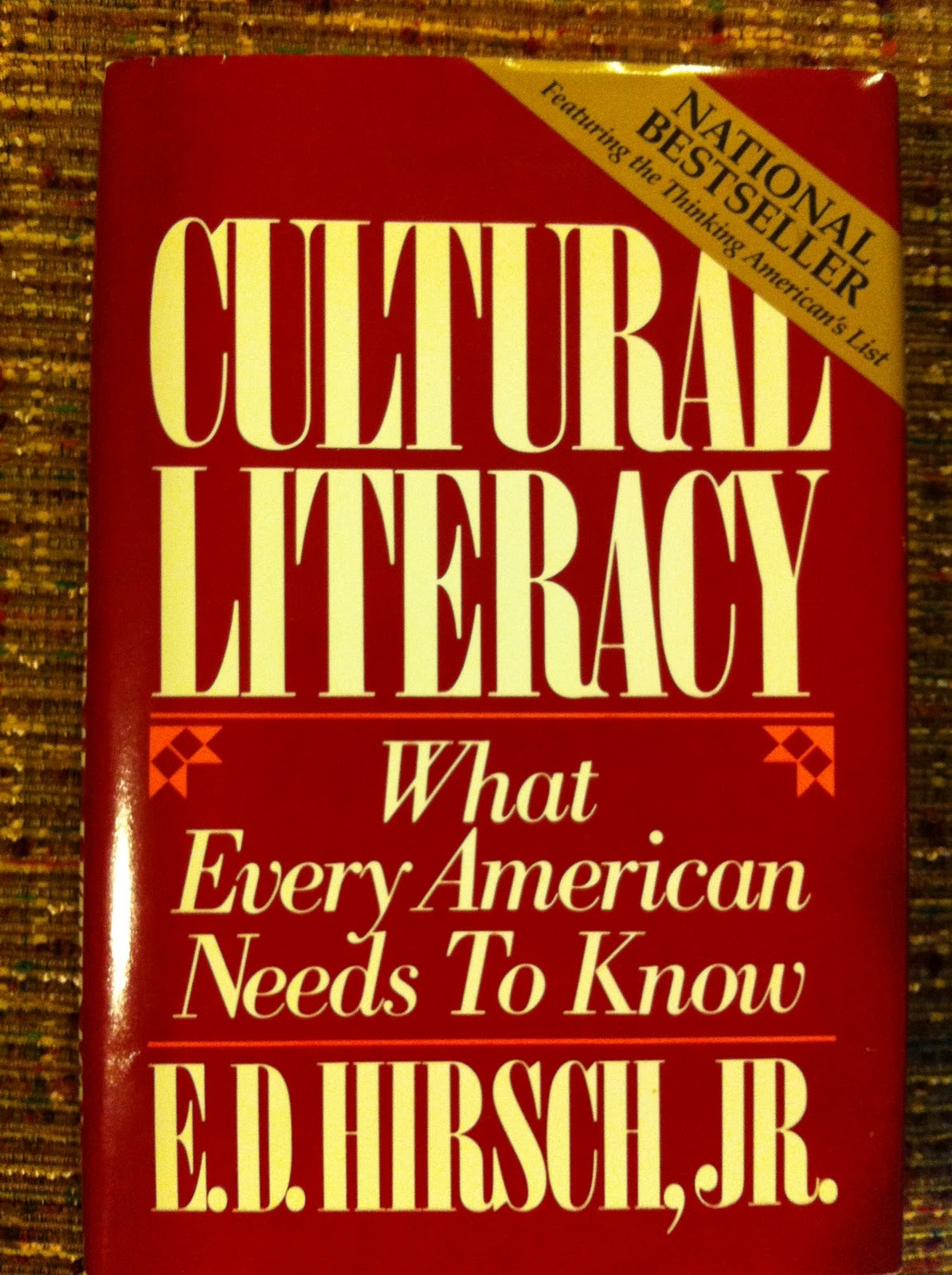
E.D. Hirsch: Cultural Literacy

hirsch

 I’ve always had a longing to teach children challenging texts in English, but I have often shied away from articulating a curriculum-wide position. I’ve come to believe, now, that we must unapologetically teach the best stuff to all our children; but especially to the children who are least likely to encounter it outside of school, as Hirsch explains:

“Middle class children acquire mainstream literate culture by daily encounters with other literate persons. But less privileged children are denied consistent interchanges with literate persons and fail to receive this information in school. The most straightforward antidote to their deprivation is to make the essential information more readily available inside the schools.”

To be culturally literate, according to Hirsch, is “to possess the basic information needed to thrive in the modern world.” In our everyday interchanges, even in reading a daily newspaper, our comprehension and therefore ability to interact with, question and enact change relies on our background knowledge. The broader our background knowledge, and the more honed to the important “stuff” of the world, the more effective we will be at understanding and communicating.

Contrary to some dissenters, Hirsch reminds us, this “literate” culture “is not the property of any group or class.” I saw this on a small scale when visiting the first school I worked in, in South East London. There, at a fabulous concert in aid of a school trip to Malawi, I saw the children I used to teach uproarious in their enjoyment of classical music, hip-hop and spiritual songs, among others. Just as these children could enjoy every type of music without seeming aware of its cultural baggage, so we can anticipate children will enjoy and be interested in all different strands of literature, history, art, politics.

The key to my agreement with Hirsch is in his drive for social justice: we have a moral imperative to teach the good stuff: “illiterate and semiliterate Americans are condemned not only to poverty, but also to the powerlessness of incomprehension.”

A strong curriculum builds up this crucial, important knowledge piece by piece. We may begin by knowing only a small amount about a wide range of individual topics or people, but that little allows us a place to hang our later acquired knowledge and understanding on. At one point, Hirsch lists off several names, some of which I’ve only heard of, but can at least locate in a time period, discipline or ideology due to this background knowledge I have somehow absorbed (names like James Fennimore Cooper, Emily Dickinson, Benjamin Franklin, Ulysses S. Grant) and notes: “most of us know rather little about these people, but that little is of crucial importance, because it enables writers and speakers to assume a starting point from which they can treat in detail what they wish to focus on.” Simply put, “The more you know, the more you can learn.”

Hirsch’s message in this book is a hopeful one: all students can be “highly literate” if they are “presented with the right sort of curriculum.” This curriculum should be organized, according to Hirsch, as a vivid system of shared associations.” He does not advocate arbitrary prescription of the stuff children should know, commenting almost flippantly: “almost any battle will do to gain a coherent idea of battles. Any Shakespeare play will do to gain a schematic conception of Shakespeare.”

But clearly, analysing Shakespeare play is always better than analysing an advert. His comment “in each classroom somebody always does decide what material our children will be storing in their minds in the name of skills acquisition. All too often it is content for which our children will have no use in the future” rang true to me. I have spent too many lessons analysing language in simple advertisements and leaflets with 16 year olds in the run up to an English Language exam that did not teach a thing. This is time wasted, and for the children I teach this is an atrocity. The new, strengthened curricula in English at KS4 at least provide an impetus to teach far, far beyond such trivialities.

Finally, Hirsch makes the point that: “it isn’t facts that deaden the minds of young children… It is incoherence – our failure to ensure that a pattern of shared, vividly taught, and socially enabling knowledge will emerge from our instruction.”

So, a strong curriculum for me has the following components:

  • Selection: of core knowledge: what are the ideas, concepts and facts students need to know in each subject in order to be able to access higher order ideas in that subject?
  • Sequence: your curriculum sequence must build on prior learning; knowledge builds on knowledge.
  • Revisiting: within this curriculum, there is space to revisit content and concepts, to strengthen them and aid learning.
  • Coherence: a strong curriculum dovetails with other subjects where suitable, so that the overarching schema over the course of a year coheres.
  • Challenge: the curriculum contains high quality, challenging stuff that is interesting and worth learning for all young people.

It is nearly impossible to write about curriculum alone; any construction of a curriculum requires simultaneous consideration of how we assess what has been learned, understood and retained. My next post will be exploring just one book on assessment.

Ten kids’ books you should read (if you want to be an English teacher)

This week, we welcomed a would-be PGCE student to our department for some experience of the wonderful world of English teaching. One of the things which struck me was how far removed recent graduates are from KS3, and the kind of books you want to be encouraging KS3 students to read. She mentioned the classics, but probably you want to teach these; a huge part of being an English teacher is encouraging students to read widely and for pleasure.

With this in mind, I recommend just ten wonderful books you can read and pass on to your future year 7, 8 and 9 students.

The Fault in Our Stars

Ok, if you haven’t heard of John Green you’re about to spend the next six weeks reading everything, and then wishing you’d gone slower (probably). The above is already a classic, and promoted Green to the stratosphere of great writers for young people. Green’s protagonists are often preternaturally wise, and alongside a brilliantly expressed story you can often glean interesting factual snippets. The characters are also both real and unreal at once; an unusual feat.

The Book Thief

I always despair when a popular book is turned into a film, because students start to tell me they have seen the film and therefore don’t want to bother to read the novel. Luckily, the adaptation of this was not as good as it could have been, and so I’ve found students largely receptive in reading this. An amazing creation in terms of perspective, this novel is narrated by death and takes students through the trials of surviving in Nazi Germany.

The Giver

This novel is a teaching staple in some classrooms (notably American ones, I’m reliably informed), but I’d not come across it until recently. A sci-fi look at a dystopian future where colour has been forgotten along with many aspects of freedom and experience we take for granted means this novel raises some thoughtful questions and issues for its young readers.

The Curious Incident of the Dog in the Night-time

You will undoubtedly be familiar with this, if not from the hugely acclaimed novel itself, at least from the stage adaptation. Seeing the world through the lens of an autistic boy is masterfully done by Haddon, and this is a brilliant book for year 9 (or even 8) students to read to help them to empathise with those different to them.

What is the What

Eggers is an epic story-teller, and each of his novels feels so distinctive I wouldn’t be shocked if you told me they were penned by different people. This one is definitely the most student-friendly, telling the true story of a young man’s plight in leaving war-torn Sudan.

The Knife of Never Letting Go

Though really, anything by Patrick Ness will be fabulous; he really is one of the foremost children’s writers today. I wrote about A Monster Calls here, but Knife was the first of his books I read, and it is the one I have most successfully managed to pass on to reluctant readers, chiefly due to the opening’s inclusion of a talking dog.

Looking for JJ

A sympathetic exploration of a child who has been re-assigned a new identity having committed a horrific crime. Written with bracing pace, and guaranteed to raise some moral dilemmas of interest.

Chains

Laurie Halse Anderson is another one of those authors who writes a wide variety of generally excellent novels for young people; Speak is similarly excellent though entirely different to the above. Chains explores aspects of American slavery and racism, so will often complement the kind of “civil rights” explorations in English many schools now offer at KS3.

We Were Liars

A year 10 student recommended this one to me, but I think most year 9s could handle it. This novel is engagingly written, with one of those shocking-twist endings that will stay in a student’s mind and have them coming to tell you they’ve reached it. Doesn’t everyone love a mystery after all? I really enjoyed this book too for its allowing me to live vicariously through rich, pampered young people with nothing much to do and their whole glorious lives ahead of them.

Wonder

I’m not sure there is a better children’s book out there, but I’d love to hear what others think. This book stayed with me long after I read it; I read the first gripping page to year 7 and year 8 during assemblies last year and I have lost count of the number of students who subsequently read it and let me know they had read it. The book tells the story of a boy with a disfigured face, exploring society’s expectations and making us question the extent to which we are hopelessly superficial. About halfway through this book I cried like a small child. Luckily, the ending is uplifting.

If you’d like more recommendations, I’ve blogged previously about reading lists:

And I would also definitely recommend looking at the Carnegie prize website for further inspiration:

Women through the ages

A few months ago, I enthusiastically tweeted:

twitter women through ages

I was increasingly excited about the prospect of teaching some of my favourite texts to my year 10 class. I’ve written about year 10 before, but in a nutshell they are an intervention group whose literacy could be better than it currently is. My main aim for the scheme of work was to build their vocabulary and improve their creative, informative and persuasive writing skills through exposure to some of the best examples I could find.

Oh, and I wanted to make them feminists.

I teach in an all-girls’ school, and so this kind of aim pretty much suffuses our curriculum, not to mention the SMSC and other varied acronyms. I’ve written before about feminism’s place in the classroom, so perhaps this scheme of work was partly my way of making such arguments heard and understood.

Because I don’t think we can take it for granted that our students are cognisant of the challenges that might face them because they are girls. Despite continually out-performing their male counterparts in the education stakes, girls continue to enter a world in which women, to paraphrase Sheryl Sandberg, are not making it to the top of any profession anywhere in the world. Women continue to do the vast majority of housework and child rearing, and they continue to earn far less than men over their careers. More terrifyingly, our children are growing up, as the film Miss Representation makes clear, surrounded by media which dictates that girls looking attractive to men is what matters.

Yet the message of feminism is by no means undisputed. Sandberg has been critiqued for exploring only a very tiny subsection of society in her analysis; Roxanne Gay has pointed out that women of colour are experiencing gender inequality in different ways which must also be heard; Caitlin Moran has been called “dismissive” for her comments on the hijab and why women ought not to be wearing it. This is a complex discourse, and one I very much would like my students to be able to enter into.

I’ve pasted the lesson powerpoints below, but will be making some key changes in preparing a similar scheme of work for the new Key Stage 4 curriculum. The revised scheme will be longer – six weeks instead of three. It will span a greater length of time, and take account of these alternative feminisms. It will be focused on key questions to interrogate, rather than key texts to read. I’ve posted a week-by-week below in case this is of interest.

I’ve also omitted textual exploration of masculinity, although we did watch the trailer for The Mask You Live In and go on to explore depictions of masculinity in adverts. This kind of scheme taught in a mixed school would definitely benefit from more gender balance, perhaps including the “He for She” campaign and exploring the challenges boys and men face in today’s society.

If we need to teach non-fiction, I do think there are some key messages we can use those schemes of work to put across to young people. There are too many inequalities in our society; I want my students to be empowered and inspired by knowledge and understanding of these inequalities to put them right.

*     *     *

Revised SoW: Week by week outline

Week 1:

  • Coverage:  Modern femininity
  • Key question: how are women seen in today’s society?
  • (Everyday Sexism; MissRepresentation; feminism today)
  • (Opposing branches of feminism (Wolf/Benn/Gay/Moran))

Week 2:

  • Coverage: Women under oppression (Malala; Wadjda; Reading Lolita in Tehran)
  • Key question: do women everywhere experience the same freedoms and constraints?

Week 3:

  • Coverage: Historical female oppression (Suffragettes)
  • Key question: how has the female experience changed?

Week 4:

  • Coverage: Female communication: journalism
  • Key question: Is there a female voice?
  • (Lean In excerpts; Lena Dunham (write to entertain), India Knight (write to shock)

Week 5:

  • Coverage: Female communication: political
  • Key question: how successfully do women convey messages in a political setting?
  • Speechwriting (Margaret Thatcher, Hillary Clinton, Benazir Bhutto, Harriet Harman/Theresa May?)

Week 6:

  • Coverage: Roles and perceptions of women
  • Key question: how are women seen, and how do they see themselves?
  • Hillary Bill Clinton; Eleanor Roosevelt; Sandberg commencement speech; Fey Bossypants

Year 10 feminism SoW

Emotions in education

I’d always simply assumed that emotions were a good thing in the school setting. After all, I’ve built my “teaching persona” around my genuine emotions: I love the students, and teaching makes me happy; I am always my best teacher when I project this happiness and love into my classroom.

But there are obvious downsides to such an approach. When you love your students, does this make it harder when they let you down? When you love your students, and they do something terrible, unspeakable, outside school, does it become less easy to be their advocate in the classroom? When you love your students and they shout and swear at you, do we leave ourselves open to feeling a deeper swathe of negative emotion? And what is the impact of this emotion on the rest of the classes we teach that day?

And then there is anger. It has been a long time since I have heard real bellowing at a class or child, but I can’t help but shrink from the idea of it. The school where I trained was explicitly “no shouting” – that was rule number one. But it didn’t mean it didn’t happen. And I’ve heard it said that shouting and anger are fine, except when the emotion behind this is real, because then you’ve “lost it”, and that’s never ok.

I’m not so sure I agree. See, I don’t find anger a helpful emotion in a school setting. I’ve definitely had to suppress my anger, sometimes weekly, but I can’t see a time when to express this emotion would be helpful for the settings I’m working in. If a class won’t listen, why raise the volume? If you are angry, why not stay calm, and discuss the issues?

Then there’s anger directed at teachers from other teachers. Surely there is never a place for this. We’ve probably all been at the receiving end of some anger. When it occurs, it does make me consider: has this emotional response helped me be better at my job? Has this anger made me more likely to want to help you, or to change my behaviour or choices in the way you would like? We are professionals in a work environment; surely a better response would be supportive, considerate; searching not blaming, asking not demanding. I don’t believe it is possible to motivate teachers with anger.

Now, I’ve caught myself telling students I’m “disappointed” in them. Doug Lemov points out how unhelpful this is: when we make our responses more about us than our students, they are unlikely to change behaviour; the typical student will simply shrug it off (“oh, how unfortunate for you Miss that you are disappointed. I still don’t care”). Far better to remind students of the purpose of their learning, and the path they need to be on, and push it back to them.

A colleague once told me a story about leaving her first teaching job many years ago. On going to the Principal to hand in her notice, she was told that she was a “disappointment”; that she was “letting the school and the children down”. Similarly, what does this emotion achieve? Does this make it more likely for someone to change their mind?

When I went to my first Headteacher to say I was thinking about leaving, she listened to my concerns, and calmly asked me what she could do to make me happier in my work at that school. She then told me a story about how she became a teacher (something I will write about in the future with her blessing), and played into my strong sense of mission. I left that office feeling ten feet tall; a soldier in the war against educational disadvantage, following in the footsteps of a colossal educator. I did not seek another opportunity that year.

So is it best to leave emotion at the school gates? Are we stronger and more purposeful educators without it?

And then I come back to love. Because on those hardest of hard days, when all the class is against you, and colleagues are filled with frustration, and you wonder if you might just retire to a cubicle in an accountancy firm where no humans will ever disturb your placidity again, it comes right back to love. This is the driving emotion that brings us back to the classroom, back to focusing on the learning, back to putting in the extra emotional effort that strong behaviour management can often require.

On those days of rawest emotion, the remedy for me is to remember my students, close my door, and teach them – with love.

These kids

There are some students who storm into your teaching life, and you know immediately: they’re going to be fine. They will have issues and problems and troubles, of course; they will have tantrums and bad days and choice words used at the wrong time, of course; they will miss detentions and not read enough and worry about you calling home, of course. But they will be fine.

By “fine”, of course, I mean, they won’t have any problems reaching the C-grade we teach them to dream of. They’ll almost certainly achieve B grades. You’ll spend your teaching time trying to stretch them towards the A grades; reminding them that you can’t give them the answers, trying to make them become independent thinkers. I’m not saying those students are easy. But they will be fine, in the sense that there is no scenario in which they won’t be picking up a string of B to A grades at GCSE with the odd C (bad day?), and dancing on to sixth form, followed by university.

And then there are these kids. I’m not sure why they’re so behind, because we’ve had them in our year 7, 8 and 9 classes and done a bit of huffing and sighing because they don’t seem to be anywhere near a level 5 for three years of trying; in fact, for three years of trying they seem to be stuck on the same level they came to us on. And while we know that’s not good enough, what did we do? With the best of intentions, we “tried our best”, which means we did more when we could, and when we couldn’t, we felt guilty, because we teach six classes English four times a week, and there are only so many hours in the day, and we’re teachers so we work all of them. No-one was filing their nails when they could have been helping these kids.

So, we’re not sure what happened, but here they are: in some crucial year group, languishing at the very bottom of the scale. Except they’re often not here; so often are they excluded or kept out of lessons or bunking in the toilets or bunking at home or genuinely sick but sick so much of the time you’re not sure they even have an immune system.

What can we do?

I once sat at a parents evening waiting for these kids. It seemed as if every “fine” child in the year group had turned up, while “these kids” hadn’t. Where were they? Would I ever know? And I would call the next day, and not get any answer, or leave a message that wouldn’t be returned, or hear an incorrect number tone.

And you know, there aren’t many of these kids. In fact, they’re an incredibly tiny number, and an infinitesimally small proportion of what will be our A-C achievement that will judge us as a school.

So what can we do? And if we do nothing, will anyone notice?

After that parents evening, I came home devastated. I couldn’t get through to “these kids”, I couldn’t get through to their parents, I couldn’t get anyone else to care as caring too much with “these kids” will only end in hopelessness. These kids are doomed. They turn up in year 7 with nothing; they leave in year 11 with nothing.

The next day, I went to visit the new teacher. It was Friday, period 6, and I’d just spent the previous lesson with some of these kids. Not too many; two were sick, one was AWOL, one excluded, and another suspiciously in school for all the other lessons that day. During the lesson, we’d practised listening to others without speaking, we’d learned that board markers shouldn’t be used on school property, and we’d been reminded that we definitely don’t throw our property across the room, and definitely definitely not at another student.

And then, in the new teacher’s classroom, there was calm, focused endeavour. Those children were all on the right path, hurtling ahead, doing the right thing without question. Because the new teacher had set up her classroom to ensure that all would achieve, and she was reinforcing those expectations, and she was firmly challenging them to do better, and they were internalizing her messages, her belief, her expertise.

So I have to do better by these kids. I have to transform my classroom. They have to want to be there, and their parents have to want to take my call, because what I will say will be meaningful. I have to learn from the new teacher, who gives me great hope that what happens in the classroom can make all the difference for these kids. I have to hope my classroom can start to be enough.

Reach Summit

Reach Academy, a Free School set up by Teach First ambassadors Ed Vainker, Rebecca Cramer, and Jon McIntosh, is now three years into its journey to “transform the lives of all of our pupils by providing them with the skills, attitudes and academic qualifications to flourish in any career and live happy and fulfilled lives.” Following an absurdly impressive Ofsted Outstanding report, the school opened its doors yesterday to share some of its core principles and their learning.

The warmth and humility of the teachers and leaders of Reach radiated, alongside their supreme confidence, now buoyed by system approval, and made for an energetic and challenging day. Three students, impressive in their self-possession, preparation and clarity, opened the summit, telling the story of “Ed” and “Rebecca” (unsettling for teachers used to the traditional “Ms/Ms” but a small paradigm shift I rather liked (respect, of course, comes not from monikers)) and their journey to create a school that would transform life chances for children in their community. Having speculated previously on the underachievement of white working class children, I was especially interested to hear one student remark: “I know I’m part of a group. White British boys underachieve nationally, and I’m not going to be one of them.” I’d be very interested to know the conversations that have gone into such clear but unobtrusive awareness.

The first session I attended was run by the inspirational Secondary Headteacher, Rebecca Cramer, who took us point by point through their recent Ofsted inspection, and shared some tips for preparation.  Chief among the take-aways were: to prepare your paperwork to lessen the burden of administration on the day, know your data fully, and to communicate your beliefs about your school clearly (“the more times they hear that this is an Outstanding school, the more they believe it” – “don’t be too self-deprecating”). Rebecca’s tenacity to ensure the grade would be given was evident, along with her and Ed’s willingness to take on almost all of the Ofsted bureaucracy to free teachers to simply deliver great lessons.

Next, assistant principal Grace Wilcox led us through a clear and detailed session on the new Progress and Attainment 8 measures. Although I had familiarity with these measures, her presentation was invaluable in clarifying key questions I had, as well as raising issues regarding the trade-off between school accountability and what is best for the individual child (Reach’s emphasis is firmly on the latter). A serendipity of seating meant I was placed next to the formidable Max Haimendorf, who I have admired since the Teach First 2010 Summer Institute, where sitting in a session run by himself and King Solomon Academy’s first year 7 cohort, he transformed my own ideas of what a transformative education for children would look like. Unfortunately, our first interaction was in doing some simple Maths together to work out a student’s Attainment 8 score, whereby I revealed (too soon, too soon) that I did not know my times tables.

Finally, a session on coaching run by Beck Owen ran through, and most importantly demonstrated, what a Leverage Leadership coaching conversation looks like. It is always good to revisit and practice elements you have some knowledge of, and I know that asking open questions to coach teachers to improve is one of my targets (in the time pressures of the working week it is often too tempting to say: “do this”).

The day ended with further inspiration, as those who had set up schools shared their learning. Ed Vainker noted that “the things we can easily measure are not always the most important in achieving our vision”, exploring the strands Reach would be focusing on to improve ever further. Of recruitment, he mentioned that sharing of core values and vision was more important to Reach than the technical ability to do the job, which was an interesting prioritisation, and emphasises in some ways that the difference of such a school lies in its mission, not its methods.

King Solomon Academy’s Max Haimendorf spoke next, humbly failing to mention the school’s stunning KS4 results, which are by any measure extraordinary (67% FSM; 93% A*CEM; 76% EBacc). He noted that the school had won over the community by getting them, and the children, excited about the goal to attend and thrive in an academically selective university, but that they were always reviewing their methods, and what needed to occur in every week, every lesson, to make this a reality. He spoke of the need, as an organization grows, to “systematize the things that are magical” to ensure sustainability in years to come.

Finally, Jenny, Vice Principal at Dixons Trinity Academy in Bradford, shared her reflections, speaking of the ease with a very small staff to build strong relationships, and the need to always prioritise these even as the staff body grows as it is these strong relationships which hold the key to overcoming life chances. Most resonant for me was her imploration to “do the boring things well every day”, ensuring all the little things are being followed up. She also noted that they would need to be mindful of intake, to ensure they were always serving the students who motivated them to “get up everyday.” She mentioned that one of DTA’s focuses was autonomy, and scaffolding in this for students to guard against them ending up age 18, at university, and coming home without the structures that had sustained them.

All in all, my key takeaway from this day was that education is changing, school by school. Inspirational teachers build their visions into inspirational schools, of which they become inspirational headteachers. Their dedication to their students leads to results which defy the beliefs of the naysayers, and prove that a child’s starting point need not determine their end. There is a revolution afoot in education, and we need to all be part of it.


All change: new KS5 specifications

I’ve never been entirely at ease teaching A-level. I’ve often joked I won’t consider myself a “real” teacher until I’ve taught Othello, and to some extent this is due to my own experience of English at KS5, which was, in a word, transformative. I’m not convinced that I’ve ever taught a year 12 or 13 class in that transformative manner, and this is partly (I think) down to the curriculum on offer.

I’ve taught Gatsby, but only in the tight confines of a coursework unit; I’ve taught Much Ado About Nothing and Waiting for Godot through the restrictive lens of comedy; I’ve taught Macbeth, Doctor Faustus and Frankenstein, mainly as a vehicle for understanding “the Gothic.” I don’t feel I’ve ever just taught a text.

For me, this is what English in the sixth form needs to be about: exploring a number of excellent texts in more depth than you ever thought possible. The issues I’ve had with the two specifications I have taught, WJEC and AQA Literature B, is that they want the focus to be ever narrower (the latter significantly more so that the former).

So it was with these issues to the forefront of my mind that I delved through the new KS5 specifications, looking for a bit of breadth.

Being part of a sixth form consortium, though, I was somewhat limited in the choices I would make. The consortium had taken the decision to enter 100% of students at the end of year 12 for the A/S qualification, meaning that any specification I chose had to be deeply co-teachable. Although every exam board claims its spec is co-teachable, in reality the difference in papers at A/S and A2 reveals this as a fallacy. If you need to re-teach the whole of year 12 to different assessment objectives or exam layout in year 13, you could be seriously disadvantaging those students.

(An aside: in my ideal world of never, we teach the A-level over two years, spending the first half of year 12 reading widely texts which are nowhere near the specification, just because; because it’s edifying to read a lot, and know different things about different texts, and to read without being relentlessly tested – but I digress.)

Aside from co-teachability, I wanted a spec which contained texts which I knew I could teach myself or oversee others teaching, but, more importantly, texts which had the potential to change students’ perceptions of literature and English and language and life, love, the world.

I’m excited about the two year overview. I’ve chosen AQA Literature A, and the only irritation is the requirement to study a post-2000 text. The simplicity of the specification is its real selling point; the exams are sensible and allow for wide reading and focus on the key issues and themes in the texts. Plus, it allows me to finally become a real English teacher – by teaching Othello, at last.

Year 12: Love Through the Ages

Studying:

Othello: greatest Shakespeare play of all time (I acknowledge my own bias here)

The Great Gatsby: because if you don’t read about true, painful love when you’re seventeen, it will never feel as visceral in later years

Wuthering Heights: see above. (Also, “I cannot live without my life! I cannot live without my soul!”)

Poetry pre-1900: as I find the poems slightly more beautiful and therefore teachable than post-1900.

Year 13: Texts in Shared Contexts

I’ve gone for 1945 to the present day, as I felt this would open itself to more varied readings than those in the immediate aftermath of WWI.

Studying:

A Streetcar Named Desire: the production in the Young Vic last year is without doubt the most incredible piece of theatre I have ever seen, and I’m hopeful there is a way to bring the year 13s to see a screening of it. Also, it’s a great play and one through which so many great American themes can be elicited.

Revolutionary Road: I love the idea of teaching this. I’m concerned the students will find the central concepts hard to relate to, but hopeful that they will respond to the inner turmoil and flawed characters.

Duffy: Feminine Gospels: Because they have to study something post-2000, and you can’t go far wrong with a poet who draws so richly on literary history.

Coursework unit: This will be determined by students’ personal choices and guided by the teacher who takes this unit.

Above is what we will teach: what of the how? I’ll come on to that over the coming weeks.

How do I revise English?

Around this time of year, “how do I revise for English?” becomes the clarion call of many a desperate student. It seems that no matter how many times I talk through precisely this question on a powerpoint slide in a lesson (from which students dutifully scribe notes), I still receive feedback from various tutors, mentors, parents and other interested parties who tell me: “she has no idea how to revise English.”

It struck me all too recently that perhaps the answer is to begin to “do” the revision in lesson time. It took me a long time to realize that much of teaching was a gradual recognition of things students did not know which I had assumed they did (my year 10, for example, who dropped the bombshell of not knowing what the word “vocabulary” meant, thus rendering half a year’s worth of feedback essentially meaningless (“is it ‘connectives’?”)). In the same way that I would not now set an essay for homework for any class that is not sixth form (as I did for the first homework for the first year 10 set 5 class I taught), I would not now send children into the wilderness to flail about with highlighters. We need to begin this in class.

Starting with year 13, I decided to show them the evidence. Last year, I read Make it Stick, and I cannot recommend it highly enough. One of the central messages in this text is that students learn by retrieving from their memories. So, as so many others have written at length about, not by re-reading, underlining and highlighting.

No: we need to learn by testing ourselves. This seems more straightforward when your subject is orientated around “facts.” Making a test on how many nitrates make up a – sorry, I don’t think I can finish the sentence without completely embarrassing myself. But you get the idea. English is a skill-based subject, right? How could you possibly quiz yourself?

Except when I think back on how I revised, I start to see a way this might work. I recall for GCSE English Language learning around forty-five key technical terms (oh, what I would give to retrieve that scrap of revision paper) using an alphabet-based mnemonic. Before even opening the paper, I wrote each word on the question paper. I then ticked off each term as I used it, thus, in my own mind, securing my top grade.

But it wasn’t until University that I really became self-test-super. By my final year, I had perfected the technique of mind-mapping everything I needed to know about a text (key quotes, critical quotes, key ideas, main concepts), hiding the mind-map, writing it again, checking back with the mind-map to see what I’d missed, adding the ones I’d missed in a different colour, and beginning again.

This seemed like a sensible way forward for my year 13s in preparation for their AQA Lit B “Texts and Genres” exam. Following our weekly “quote quiz” (in which I blank out some key words to test they have learned some quotes from one of the three texts, then go through each quote, writing in the words and reviewing the comments we might be able to make about them), I shared some of the wisdom from Make it Stick:

•       “Learning is deeper and more enduring if it is effortful.”

•       “The act of retrieving learning from memory has two profound benefits. One, it tells you what you know and don’t know, and therefore where to focus further study to improve the areas where you’re weak. Two, recalling what you have learned causes your brain to reconsolidate the memory, which strengthens its connections to what you already know and makes it easier for you to recall in the future”

•       “Retrieval practice—recalling facts or concepts or events from memory—is a more effective learning strategy than review by rereading. Flashcards are a simple example. Retrieval strengthens the memory and interrupts forgetting. A single, simple quiz after reading a text or hearing a lecture produces better learning and remembering than rereading the text or reviewing lecture notes.”

In order to begin, students would create a ten-question quiz on each text. I could then collate all of these into a handy “quiz-pack” for each student to assist in their revision. I advised students to use the quotes, but also the key critical ideas we were engaging with, and shared with them the mind-map idea.

This is all a work in progress, and not something I’ve previously done with classes. I do think it is worth considering, and I will report back on how year 13 find it. I’m planning to share the same concepts and ideas with year 11 later on in the year. I’ve posted the slides below exactly as I taught them to year 13.

Lesson 9 critical views Frankenstein 4.2.15