What can schools learn from successful communities?

Amy Chua (of ‘Tiger Mother’ fame) and Jed Rubenfeld have analysed outlier communities in the USA and distilled what they have learned into a readable tome called ‘Triple Package: what really determines success.’ The book provides a fascinating insight into what makes particular communities successful, but I think it can also lend its insights to schools. After all, every school is a community: how can we create the conditions within our schools to leverage the success in our community felt by those outlier groups in society?

The three conditions found across a variety of outlier groups are:

  1. A superiority complex (‘a deeply internalised belief in your group’s specialness, exceptionality, or superiority’)
  2. Insecurity (‘The paradoxical premise of this book is that successful people tend to feel simultaneously inadequate and superior.’)
  3. Impulse control (or ‘the ability to resist temptation’)

One example group given are the Mormons: this group represent 1.7% of the US population, but are dominate in politics and business, with a few representatives breaking through in the creative arts (such as Stephanie Meyer of ‘Twilight’ fame). The roll call of successful Mormons is quite extraordinary, and Chua and Rubenfeld explain it in their possession of the ‘Triple Package’: while Mormons consider themselves a ‘chosen people’, they are also broadly rejected, ridiculed and side-lined by society (see: ‘The Book of Mormon’). Their church also inculcates a deeply ingrained work ethic, among other ways, by a two-year ‘mission’: ‘While other American eighteen-year-olds are enjoying the binge-drinking culture widespread on college campuses, Mormons are working six days a week, ten to fourteen hours a day, dressed in white shirt and tie or neat skirt, knocking on doors, repeatedly being rejected and often ridiculed.’ Other successful groups explored in depth in the text include Indian, Iranian, Nigerian, Cuban and Lebanese immigrant groups.

Here are some ways schools could harness each ‘Triple Package’ element for the benefit of their pupils:

Superiority

Like Mormons, ‘Jewish children were raised hearing… that they were God’s chosen people’. Their ‘outsider’ status (of which more below) instils a ‘chip on the shoulder;’ an ‘I’ll show them’ mentality. Although ‘superiority complexes are hard to maintain… All the forces of assimilation work against it,’ nonetheless it is worth cultivating a superiority complex in our schools. How do we do this?

We could repeatedly tell our kids they are special; different. In every school I’ve worked at teachers give pupils this message in a variety of ways – the most successful schools get their pupils to feel a sense of huge pride that they wear their school’s uniform, and not, for example, the school across the road. In my first school there was always a sense that you were different to others in the community because you went to our school. It helped that the school was massively oversubscribed, Ofsted Outstanding, with amazing results at GCSE and A-level. Other schools may have to try different methods to achieve similar results. At Michaela, we overtly tell our pupils: ‘you are not normal. You are Michaela.’ We want them to feel like the chosen people: by virtue of the school they attend, they are different, and destined for greatness.


Insecurity

The tension of the ‘Triple Package’ comes in ensuring superiority and insecurity are present; for the Jews, the obvious motivator of centuries-old anti-Semitism comes into play massively, as Chua and Rubenfeld refer to the ‘fear for their survival’ playing into a drive to do well. Another wildly successful group of over-achievers are Asian Americans, who ‘regularly report low self-esteem despite their academic achievements. Indeed, across America, they report the lowest self-esteem of any racial group even as they rack up the highest grades’ (the authors share one anecdote that: ‘Conversations at the dinner table read like status updates of outstanding Asian kids our family know. So-and-so’s son just got into Stanford…’).

Conversely, ‘Children brought up in self-esteem centred schools and families are not taught to endure hardship or to persevere in the face of failure. They’re sheltered from disappointment and rejection by devoted, exhausted parents who monitor their every move, desperate to make their kids feel “special”.’

What, as a school community, can we do to mimic this insecurity? In some ways, this is an easier feat for schools who are not Ofsted Outstanding, or who do not have the results to back up their superiority message. Such schools are the ultimate underdogs, seeking entry to the mainstream with the proof of their results.

At Michaela, we remind pupils that they have a long way to go. We are honest with them: pupils at private schools have parents who are paying up to £30,000 a year for their education: you can bet they will come out with some terrific results, and statistically they do. If our pupils slack or misbehave, we remind them of the consequences; when they don’t do their homework we tell them about their boarding school peers who simply do not have an opportunity to not do homework. Even within class, we can drive pupil insecurity by pointing out the gap between their effort and their more successful peers. Pupils need to be afraid: someone, somewhere else, is doing better than them. They need to raise their game.


Impulse Control

Most educators are familiar with the ‘Marshmallow Experiment’: children are told they can eat the marshmallow now, or wait and be rewarded with two. The children who are patient, who have ‘impulse control’, ‘go on to get better grades; spend less time in prison; have fewer teenage pregnancies; get better jobs; and have higher incomes.’ Interestingly, this test was re-run in 2012, with an addition: some pupils experienced an unreliable interaction with an adult prior to the test; so an adult told them they would bring them crayons to play with but didn’t follow through. Those children were then much more likely to eat the marshmallow straight away, not trusting that the adult would follow through on their ‘two marshmallows’ promise.

This is of interest because our pupils from poorer backgrounds have come to distrust the system, and ‘if people don’t trust the system, if they think society is lying when it tells them that discipline and hard work will be rewarded – if they don’t think that people like them can really make it – they have no incentive to engage in impulse control, sacrificing present satisfaction in hopes of future gain.’ In many schools, we are battling with an ingrained distrust of the values and possibilities we present to parents.

Yet we know from many studied that ‘willpower and grit prove to be better predictors of grades and future success than did IQ or SAT scores;’ and that ‘IQ is not a complete predictor of success. IQ without motivation lies fallow.’ The authors remind us that ‘impulse control is like stamina. If you ran five miles every few days for several months, you’d build up stamina, which would allow you not only to run farther, but to perform all sorts of unrelated physical tasks better than you could before… If people are made to do any impulse-controlling task – even as simple as getting themselves to sit up straight – on a regular basis for even a few weeks, their overall willpower increases.’

At Michaela, our pupils are instructed to sit up straight in every lesson, and can be issued with demerits for turning around or slouching in their seats. The impulse control ingrained through this one simple policy is extraordinary: visit our school, and you will see 100% of pupils sitting up straight for six solid hours a day, facing the front, rarely speaking, listening to their teachers and writing. Hands are raised to contribute to the lesson, but a pupil may speak only twice in an hour’s lesson; perhaps less in some (though much more in others). Despite this, pupils wait patiently with hands raised to speak, and calling out is prohibited. Homework and holiday homework is set through centralised systems which ensure very nearly 100% compliance and 100% of non-compliant children being issues with a sanction. Firm consequences reinforce positive habits and develop our pupils’ impulse control.


If we can harness each of these elements, superiority, insecurity and impulse control, we create pupils who know they are special, need to prove themselves, and develop the will-power and dedication to persevere despite difficulties. Such pupils, I believe, will become the outlier overachievers of our school system. But perhaps, after all, it is better to steer clear of the extremes set out in this survey, and rather focus on their calmer, simpler cousins: quiet confidence, humility and work ethic.

Tiger Teachers

In Amy Chua’s Battle Hymn of the Tiger Mother, there are two key messages for parents and teachers. The first: hard work pays off. The second: strict discipline is the best way to ensure our kids succeed. Statistical evidence shows that Chinese kids are ‘stereotypically successful’: in 2014, Chinese children were the highest performing ethnic group, with 74.4% achieving 5 A*-C EM compared with the national average of 56.6%. What is the secret?

Chua notes: ‘In one study of 50 Western American mothers and 48 Chinese immigrant mothers, almost 70% of the Western mothers said either that ‘stressing academic success is not good for children’ or that ‘parents need to foster the idea that learning is fun.’ By contrast, roughly 0% of the Chinese mothers felt that way.’ The idea of learning as ‘fun,’ ‘discovery’ or ‘exploring’ does not seem to exist for Chinese parents. Throughout the book, Chua makes references to poor teaching methods holding Western children back: ‘While the other kids were learning to count from 1 to 10 the creative American way – with rods, beads and cones – I taught Sophia addition, subtraction, multiplication, division, fractions, and decimals the rote Chinese way.’ When Chua talks about skills, she explains: ‘I don’t mean inborn skills, just skills learned the diligent, disciplined, confidence-expanding Chinese way.’ Underpinning this comment is the highest of high expectations: children can learn anything, as long as they are taught it explicitly and drilled enough in it.

To those who may argue that not all children can be successful with hard work, Chua cites her sister Cindy, who was born with Down’s syndrome: Chua’s mother ‘[spent] hours patiently doing puzzles with Cindy and teaching her how to draw. When Cindy started grade school, my mother taught her to read and drilled multiplication tables with her. Today, Cindy holds two International Special Olympics gold medals in swimming.’ As the mother of young children, Chua notes: ‘As I watched American parents slathering praise on their kids for the lowest of tasks, I came to see that Chinese parents have two things over their Western counterparts: 1. Higher dreams for their children, and 2. Higher regard for their children in the sense of knowing how much they can take.’

And by ‘how much they can take,’ Chua is referring not only to how much children can learn, but how much discipline they can handle. Each of Chua’s daughters, Sophia and Lulu, play instruments; Chua, a professor of law at Yale university, attends every music lesson and every practice session at home, coaching, guiding and, in reality, shouting. The extraordinary results are achieved through this disciplined and strict practice. She explains: ‘What Chinese parents understand is that nothing is fun until you’re good at it. To get good at anything you have to work, and children on their own never want to work, which is why it is crucial to override their preferences.’ Furthermore, while Western parents worry about self-esteem, Chinese parents: ‘assume strength, not fragility.’

Chua’s harshness has been condemned in the media, notably when given a sub-standard birthday card, hand-made by her daughters. She quotes herself saying: ‘I work so hard to give you good birthdays! I deserve better than this. So I reject this.’ In a later letter, her daughter notes: ‘funny how some people are convinced that Lulu and I are scarred for life. Maybe if I had poured my heart into it, I would have been upset. But let’s face it: the card was feeble, and I was busted. That’s why, when you rejected it, I didn’t feel like you were rejecting me. If I actually tried my best at something, you’d never throw it back in my face.’

It is not easy to discipline children in this harsh way: ‘you have to be hated sometimes by someone you love and who hopefully loves you, and there’s just no letting up, no point at which it suddenly becomes easy.’ We believe exactly the same thing at Michaela. There are times when I really, really don’t want to give a pupil a demerit or a detention: I know how hard they are trying, even though they are still doing the wrong thing, and I love them so, so much. I’ve started saying in my head: ‘do I love them enough to give them a demerit right now?’ By turning our thinking from indulgence to discipline, I do think that in the long term our children will be more successful, not to mention more resilient.

For hard work is the gateway to future success: if a child achieves lower mark than wanted in a test ‘the Chinese mother would get dozens, maybe hundreds of practice tests and work through them with her child for as long as it takes to get the grade up to an A. Chinese parents demand perfect grades because they believe that their child can get them. If their child doesn’t get them, the Chinese parent assumes it’s because the child didn’t work hard enough.’ Even on holiday, Chua insisted on daily instrument practice, telling her children: ‘every day that you don’t practice is a day that you’re getting worse.’ She reflects: ‘Will Sophia recall with bitterness the time I laid in to her at a piano in Barcelona because her fingers were not kicking high enough? If so, I hope she also remembers Rocquebrune, where the manager of our hotel heard Sophia practising and invited her to perform for the entire restaurant that evening, overlooking the Mediterranean, [getting] bravos and hugs from all the guests.’

She rails against the indulgence of choice in Western parenting: ‘they just keep repeating things like “you have to give your children the freedom to pursue their passion” when it’s obvious that the “passion” is just going to turn out to be Facebook for ten hours which is a total waste of time.’ Children do not know enough to make the right choices, which is why indulgence will lead to lower academic success. Nearly half of young people are leaving school without even the minimum qualifications: this is a national tragedy, and something we need to take seriously. When Chua’s rebellious younger daughter gives up the violin in her most rebellious teens, her mother feels she has lost – but when she takes up tennis the coach comments to her: ‘she has an unbelievable work ethic – I’ve never seen anyone improve so fast. You and your husband have done an amazing job with her. She never settles for less than 110 percent.’ And today she, like her older sister before her, attends Harvard.

We want a happy ending for our children. But this means hard work, and discipline to ensure they do that hard work: ‘In Disney movies, the “good daughter” always has to have a breakdown and realize that life is not all about following rules and winning prizes, and then run into the ocean or something like that. But that’s just Disney’s way of appealing to all the people who never win any prizes. Winning prizes gives you opportunities, and that’s freedom – not running into the ocean.’

Winning prizes, passing exams: these give children choices. In the short term it is so very, very hard to be strict, to be demanding, and to not settle for less than 100%. At Michaela, we have very, very high standards, and are not afraid to tell our pupils: ‘that’s not good enough. Do it again.’ In the short term, it feels bad for them to have ‘failed,’ but the extra practice, and seeing the improvement in the second piece should stand them in good stead in the long term.

Chua writes: ‘All decent parents want to do what’s best for their children. The Chinese just have a totally different idea of how to do that.’ This resonates strongly with me: at Michaela, we do things totally differently. We all want our children to succeed, but we just have a very different approach.

Battle hymn

Giving feedback the ‘Michaela’ way

I’ve written before about marking, but just to summarise: it has always been something I’ve loved doing. There was something in that Boxer-like satisfaction of ploughing through an unending pile of books, leaving lovingly crafted comments in an array of coloured pens and stickers that just looked like it would work so well. How could pupils fail to make progress when I’d spent so many hours on them?

So something I was nervous about when starting at Michaela was their approach to marking; that is, don’t do it. I’d read Joe Kirby’s blog and spoken to him at length, but remained steadfastly concerned that marking worked – if you ensured pupils

acted on feedback. I then moved to the idea that marking worked, but at what cost – a teacher with six or ten classes cannot be expected to give the detailed feedback the lightly-timetabled members of SLT seem to manage on a weekly basis.

In my second week at Michaela, we had a department meeting where Joe brought up the excellent question: it’s great for workload that we don’t mark, but how do we make sure we’re giving feedback to make pupils’ writing better?

One of the main reasons I think I find marking helpful is because it holds me accountable – I am actually reading if I am putting a pen to paper to say something about it. (I annotate the books I read in the same way – it helps me to remain focused.) But while this is an essential strategy when it is 7am on a Saturday, pre-intervention, and you want to clear the last 20 books to enjoy a semblance of a weekend when you return home that afternoon, or 9pm on a Wednesday when you just want to sleep, actually, I had underestimated my ability to focus.

To begin with at Michaela, I couldn’t get out of the habit of marking. I would spend two hours with about 60 books, circling and underlining when I couldn’t resist; writing limitless notes to share with the class, photocopying paragraphs to get pupils to annotate their peers’ examples. Joe’s comments on this kind of feedback were: ‘would you want all teachers to be photocopying twice or three times a week? Is it worth the time getting the pupils to annotate a piece of paper they are then just throwing away? What else could you be doing with that time?’ Moreover, I was reminded of why marking is not always the best method – if I’d put the merest hint of a mark on a child’s book, their hands shot in the air: ‘why is this circled?’ ‘I can’t read your writing on this spelling correction.’ ‘Why is there a question mark here?’ Marking breeds over-reliance on the teacher.

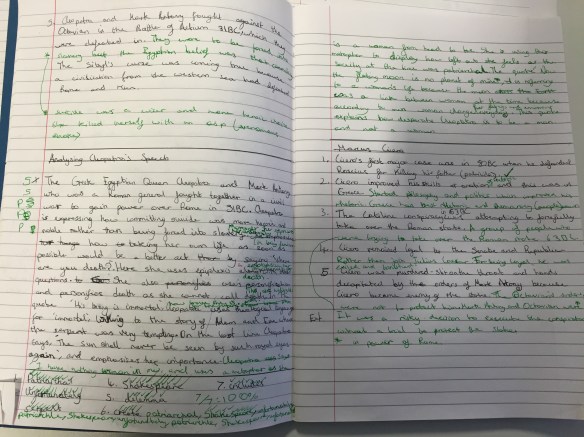
Now, I’m getting into the swing of the Michaela way. I read my pupils’ books once or twice a week. I teach four classes, each with between 28 and 32 pupils, so it is about 120 books in all. I read 60 books in 30 minutes. As I read, I make notes: spellings lots are getting wrong, things they’re all doing well at, and the main issues they need to improve. I note down anyone whose paragraph is amazing to reward with merits or show the class; I note down anyone whose work is messy to give a demerit to. It looks something like this:

FullSizeRender

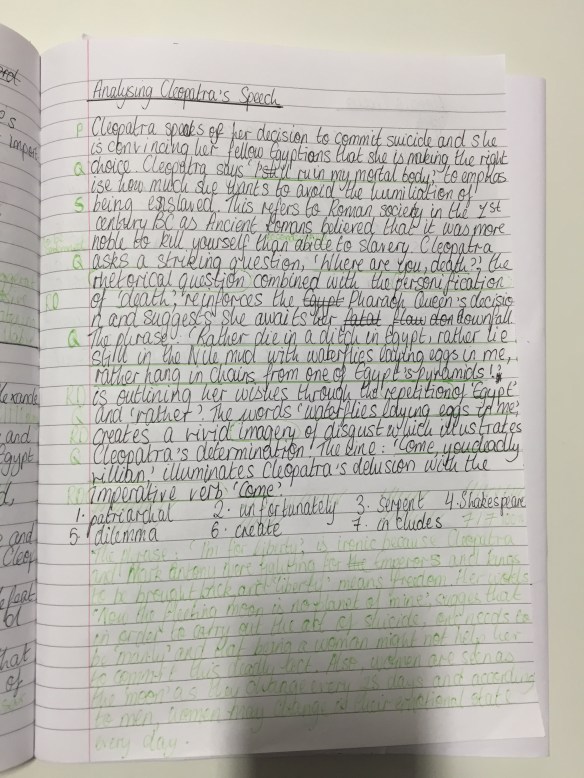
In the following lesson, I teach the spellings from the front, and then test pupils. They will write their corrections out in green pen, interleaving the ones they got wrong, or the ‘toughest three’ if they managed, on this occasion, to score 100%. I’ll test them again the following day. I’ll share the positive things I found and celebrate the star paragraphs, and then explain carefully, perhaps modelling on the board (as Katie Ashford has described brilliantly here or occasionally putting a great paragraph from the class under the visualiser, how they can all improve their own paragraphs. And then they improve them, in green pen. It looks like this:

FullSizeRender

FullSizeRender[1]

IMG_6305

The second powerful tool is in-class feedback. With an excellent behaviour system, silent writing for 25 minutes means I can see every child’s paragraph twice while circulating, giving them suggestions and tweaks while they write. On my colleague Lucy Newman’s suggestion, I’ve also started using my visualiser more. This way, we can take a pupil’s book, display it to the class, and show pupils how to edit their mistakes in that very lesson, just by giving oral feedback on the common errors they are making, or the aspects they really need to focus on improving. 

The thing is, what makes the difference in their writing is the quality of the feedback and how timely it is. They don’t need feedback on a paragraph they wrote two weeks ago. At Michaela, they can improve the paragraph they wrote yesterday, while it is fresh in their minds. I miss marking, I do. But I’m realising I did it for me, not for the pupils.

A guide to this blog

Featured

I’ve worked in education since 2010, as an English teacher, Head of Department, Assistant Head, Deputy Head and Principal. I’m currently Head of the NPQ Faculty for the National Institute of Teaching. I write about curriculum, pedagogy, theory, English and books. You can read about what education means to me and why I do what I do here.

Curriculum

Pedagogy

System and Theory

English

Reading Lists for Adults

Reading Lists for Kids

The Means and the Ends

In the past, I have confused the means and the ends.

In my first year of teaching, I thought back to my most recent experience of school: A-level English. Looking at the oldest class I taught, year 10 set 5, I thought there could be no better path than the one teachers older and wiser than I had taken me on. At ages 17 and 18, I had written an essay a week.

So, I decided to set my year 10 set 5 an essay a week.

Obviously, this was doomed to failure. My poor struggling year 10s, so far behind in literacy, failed so utterly in this first homework I lost their trust entirely. It took a very long time to build it back up.

I had confused the means and the ends. Of course I wanted year 10 to write beautifully crafted, intelligent essays. But I hadn’t considered that the way to get someone to write a great essay is not to just write a lot of essays.

I see this a lot in unit planning, especially at KS4. We’ve become awfully good at drilling to the exam. But two years is a very long time to drill to the exam. We have two years to teach, with perhaps two weeks (or, if desperate, months) to drill exam practice. Too many KS4 units on English language, for example, teach using unlinked, decontextualised texts, like random novel openings or random excerpts from unlinked news articles. Although this is the format students will encounter in their eventual exam, it is surely a wasted opportunity to only teach disparate content in the ‘teaching’ stage. Of course in the end, we want students to be able to write about decontextualised pieces of writing, but in the run-up it is surely much more effective to lead students through a well-designed scheme, for example short stories, or articles linked by a common theme like feminism, or social justice – schemes that will allow students to practice key exam skills, but also learn something.

The means don’t have to look like the ends. In fact, they rarely do.

When successful adults turn around and say: ‘I didn’t enjoy school. I want our children to have a more fun experience than I had,’ they are confusing the means and the ends. We all want children to have fun; or rather, fulfilling, happy lives. But you don’t get to those ends by making school all about having fun. Many adults have succeeded because of schooldays filled with hard, hard work, not fun and games. We can have fun and games now, because of that hard work.

In Education is Upside Down, Eric Kalenze writes about ‘engagement first’ teaching. This is the paradigm in which I was taught to teach. It was only after too many years of seeing my poorest students make insufficient leaps in their education that I realised my error. We can’t put fun first; we can’t even put exams first.

We have to put learning first, and the means do not often look like the ends.

What is mastery?

On leaving my job as Assistant Principal for Curriculum Design, I was charged to write down everything I knew about mastery. I sent it around to the smartest people I know, the ones I stole all of the ideas from, and one of them said it might be useful to other people. It is just under 2,500 words, so rather than paste it into the blog, I’ve attached the booklet. It outlines: what mastery is, the science of learning, what a mastery curriculum looks like, what a mastery lesson looks like, and some suggestions for further reading.

Mastery Handbook JFA

Starting at Michaela

Starting at Michaela is unlike any other school I have started at. In the three other schools I have started at, in my first lesson I have introduced myself, told them a bit about myself (especially if I have a position of any clout) and where I’ve worked before (showing them I’m not a newbie and won’t be walked over), stamped my authority on the class as kindly as I could (in particular, showing them I know the behaviour system) and then just done what I do. I’ve taught as I’ve always taught, improving incrementally each year (I hope).

In a first week at Michaela, there must be three hundred new things to learn every day. Some examples: all teachers say ‘3-2-1 and slant.’ No child does anything until you say: ‘go.’ Each lesson begins with children handing out books; this takes ten seconds and you count it down. Every second of every lesson is used; routines are meticulous to ensure this happens and everyone uses the routines. This, for me, has been the hardest part: on top of learning 240 names (the expectation is that every teacher knows every child’s name), you’re always thinking about the systems that others have long since automated. It is hard.

But necessary. Because what you don’t need to do when starting at Michaela, even mid-year, is stamp your authority on children. Children will happily file in absolutely silently, wait for all your cues, and do exactly as you say. Within 30 seconds on Monday, I was teaching my first Michaela lesson. Contrast this with the first lesson I ever taught: asking a colleague what I should do, she replied: ‘well, you have to give them their books. So you won’t have much time after that.’

Behaviour is so good I am having to fine tune my radar. Demerits are given for infringements than at any of my past schools would have gone unnoticed: turning around slightly, leaning over instead of sitting straight or not ‘tracking’ the page or me. Demerits are given publically and quickly: ‘Hayder, that’s a demerit for not tracking. We listen so we can learn.’ And the pupils’ response? So far, for each demerit I have given, pupils have responded by desperately trying to get back into my good books: sitting up straighter, putting their hand up more, writing faster, trying harder. They don’t sulk; they don’t argue back. They want to do the right thing; the demerit is the reminder to meet the sky-high standards.

Teaching, something that takes up 59 minutes of every Michaela hour, is a joy. With 100% focus, we get a lot done. I am constantly being given feedback to ‘speed up’ my teaching. Previously, I’ve been told: ‘slow down – they don’t get it.’ I’m starting to think that pupils didn’t ‘get it’ because they weren’t listening. Their behaviour and habits were such that I had to go over and over key concepts to ensure they understood. Every moment is used, and the pupils expect this. On packing up my last reading group of the week at 4:29pm, saying how much I enjoyed reading with them, I noticed no-one had closed their books. One pupil raised their hand and, eyes shining, said: ‘we still have one minute! Can we keep reading?’ A dozen nodding heads agreed. We read on.

I’ve been observed a lot – at least once a day, sometimes twice. Sometimes it is someone wandering in the back for five minutes; sometimes they stay for the full hour, usually bringing their own work to get on with at the same time. I’m given written feedback immediately, meaning I can put it into practice in the next hour. There are no grades. There are two, maybe three, small action points (‘narrate when you give a merit.’ ‘When you parse the sentence, start with the nouns and verbs, not the first word.’ ‘Don’t ask them an open question they can’t answer.’ ‘Don’t say “we shouldn’t be.” Say “We don’t.” Should suggests people are going to defy that expectation.’) The feedback has felt incredibly supportive.

What has also felt incredibly supportive is the response of the pupils. On my first day, children were thanking me for my lesson with beaming grins as they exited. Then came family lunch, where I sat with pupils whose names I could not remember, as they told me how much they were enjoying poetry. By the end of the week, pupils I taught were telling me: ‘my friend thinks you’re a great form tutor.’ I have never had such positive feedback in my life, and it makes me love each lesson all the more. At one moment on Wednesday, I looked at the clock: 12:20pm, ten minutes to lunch, and I actually felt sad. I felt a deep sadness that my lesson was nearly over. I desperately wanted to keep going. Similarly, on Thursday evening, I asked my other half if it was ‘Thursday or Friday tomorrow?’ He looked bemused: ‘Friday!’ It didn’t feel like the end of the week. Even this first week, which has to be the toughest, I could have kept going.

Teachers work hard at Michaela. We teach intensely, making every moment count. We have lots of duties, maximising the time we are with pupils. We are reminded to engage the pupils at break time and lunch time: they are our top priority. We have lunch together every day, talking and chatting with them. And yet teachers do not work late: the work is intense, but manageable; with pre-planned resources, my own ‘planning’ can be done on half a post-it note, and most of that is reminding me to give the books out.

IMG_5963

What has surprised me most? The noise. It can be loud. If more than half the class have their hands up to give you a one-word answer (‘what poetic technique is this?’), you get a choral response: ‘one two three:’ ‘ALLITERATION!’ Thirty-two children shouting an answer is loud. This happens several times in everyone’s lessons. Lining up ready for lunch, children are chanting poems they have learned by heart, speeches, times tables or subject chants, in unison. It is loud. They love it. The looks on their faces are joyful to behold.

These are normal kids. But they are exceptional. And at Michaela, a normal teacher like me can begin to feel exceptional too.

IMG_5966

New Year, New School (Part 2)

I can honestly say I did not foresee 2015. For me, 2015 was a year of dramatic changes, both personal and professional. In 2015, I saw things differently, and it was really, really hard.

Could it be a product of turning 30? Could my willingness to move away from what I had always taken to be a given have been signaled by my growing awareness of the brevity of life? Have I, in plain terms, had a mid-life crisis?

It is possible. I’m going to talk about one of the big, controversial choices I made in 2015 and why I made it.

In September, I took on a post as Assistant Principal for Curriculum Design at a large academy. I couldn’t believe it: my dream job in my dream school. It was everything I had wanted: a big promotion, whole-school responsibility, and an opportunity to change the minds and practices of every teacher in a big academy. When I started in September, it was even better than I had hoped. People listened, engaged, argued, and, swiftly, started to get on board. Change was, in many ways, rapid. I realised straight away I was working with some phenomenal people: an understanding line manager who ‘got it’ on every level; a Head of English and Head of Communications who were not only smart but massively fun to hang out with in the office we all shared, and a core group of individuals I ‘clicked’ with. Then there were the children: they were something else. Despite coming in massively far behind, despite every conceivable deprivation and difficulty, they were joyous. Within days, children I didn’t teach were greeting me politely; classes at first a little wild soon accustomed themselves to my preference for silence and made ridiculously good progress, and I was even beginning to enjoy the challenge of teaching, for the first time, out of my specialism. I could see myself building my career here.

So why on earth would I leave such a job?

I met Joe Kirby, Katie Ashford and Bodil Isaksen for the first time in January 2013. Between the three of them, they changed the way I thought about everything in education. They presented a radical departure from the norm to me, and although I held firm for a long time, eventually truth and research won me over. I could argue no more: there was a better way of doing what I did. I had to kill my darlings: group work, student-led activities, student research, and skills-led lessons. In the summer of 2013, when Joe, Katie and Bodil were about to found what would become Michaela Community School, I thought briefly about trying to join them. I dismissed the idea almost immediately. Why would I join something so untested? How did they know these ideas would work in practice? Then there was my own career trajectory – I was about to become Head of English; my next career move would be Assistant Head, not Head of Department again.

Then I visited. I saw what they had created, and I was awestruck. Here the ideas were, in their purest form. The children were amazing; so engaged; their progress more rapid than I could even have imagined. The curriculum was inspirational – the very best texts, the most important ideas, carefully organised for maximum student learning. And I met, for the first time, Katharine Birbalsingh, who in 20 minutes of discussion taught me more than I’d ever learned in such a short time about leadership, and what it meant to be a brave and bold leader.

But I was on the cusp of my next job, the job I’d always wanted; the trajectory I had so desired. Why would I leave that? Again, the job advert had come at the wrong time. Taking a step ‘back’ to be Head of Department again is hard on the ego. It is hard when you think about perceptions, and what others will think. ‘Oh, she couldn’t hack it at a tough school.’ ‘She wasn’t ready to be a senior leader.’ ‘It was too hard for her.’

Let them think that. I could have impact in my school in my context as Assistant Head. But as part of the Michaela team, we have the potential to change the whole education paradigm. If the ideas work, and it is a big if, predicated on massive amounts of work and effort, when the school is to scale, it could be the exemplar that moves leaders in education around the country to change what and how children are taught, and to avoid teacher burnout on a massive scale. I don’t want to stand by and watch as my closest friends change the world. I want to be part of that team.

So I have, after a short term, left my dream job. I have defied my own expectations for what a career progression should look like. I have let down colleagues and children at a school I promised to be a part of for long-term change. All of this is true.

And yet, I am hopeful. I am hopeful that, at Michaela, I can build an English curriculum that will endure for twenty years or more. I am hopeful that, at Michaela, I can learn from some of the best professionals in the country. I am hopeful that, at Michaela, we can destroy all the remaining doubts that ‘children like these’ can achieve at the highest levels in the hardest subjects. I am hopeful that, at Michaela, I can be a part of a school that will change the way children are taught and the way our profession is run.

IMG_0490

Challenges to a ‘mastery’ curriculum

In my role this term, I’ve been implementing a knowledge-led mastery curriculum across all subjects, following the thoughts of great educationalists like E.D. Hirsch to shape students’ learning around core knowledge to increase their social and cultural capital and ensure they can access the greatest number of choices in their future lives.

So far, the three greatest challenges to implementing this kind of curriculum have been the concerns of SEN and EAL students, along with behaviour.

SEN

My school has a very high percentage of pupil premium students, and it is the peculiar case that students from disadvantaged backgrounds are far more likely to be diagnosed with special educational needs (SEN) than their wealthier peers. Our school certainly has an extensive SEN list.

Now, while I am not an SEN expert, I do tend to the view that, as it seems unlikely that poor children are just predisposed to having special educational needs, there must be something else at play to explain the higher numbers on the SEN registers of schools serving economically deprived communities. Partly, I wonder if this is just one symptom of the wider knowledge and practice gap between our students and their more advantaged peers, diagnosed and labeled to be worked around.

Whatever the root cause, there can be no doubt that there are certain children who take much longer to learn stuff – any stuff. Try to teach all children incredibly rigorous material, and these children in particular will struggle. I don’t think that is an issue – struggle is the very stuff of learning, after all. But there is the inescapable issue of time: if these students will take longer to learn, how to we ensure we allow them the same space to master core content?

One solution is to focus the curriculum offer, giving more time to the key subjects (like humanities, science, English and maths) to ensure these students have time to truly master the key subjects. It is a point of contention at what stage such a focus should take place – is it in the early years of KS3, to drench them in the basics and catch them up, or should they have equal access to all subjects at KS3 and narrow at KS4 in preparation for the exams?

In general, I would advocate focusing sooner, as the latter can tend to lead to students pushed through a clutch of technical qualifications in an attempt to ensure they leave school with something they can use later in life. Too diffuse a subject offer at KS3 for these subjects means some will continue to struggle, and even fail, thus perpetuating a vicious circle of lack of buy-in.

EAL

The second challenge to consider in our school’s particular context is its EAL students. We have a particularly high number of new arrivals, and a phenomenal job is done by the EAL team with these.

But there are students who still really struggle with the basics of communication in English. As one teacher told me, ‘to allow one student to access the lesson, her TA has to look up the words in Portuguese just so she can answer the questions – in Portuguese. What is the point in her learning a nineteenth century novel?’

I have much sympathy with this view. Of course, we would like all our EAL students to miraculously pick up perfect English just by sitting in mainstream lessons, but there might need to be a smarter solution for these students.

It also depends how much time they have before their all-important exams; clearly a student in year 7 can struggle through the year and probably make enormous progress in mainstream lessons, where a new arrival in year 10 or 11 might need alternative curriculum provision to ensure they are not drowning in syntax.

Behaviour

The greatest and widest-ranging challenge to a mastery curriculum is behaviour, because behaviour affects every teacher and every student in a school. If in the past I was guilty of delivering lessons with too much group work and student independent research, this was partly because it was incredibly difficult to deliver to a class that you couldn’t reach silence with. In that circumstance, in my early years as a teacher, I believed it was better to teach them something than to have a complete riot with nothing being learned.

But I know now that I failed those children in many ways. We do not have time to waste – the gap is too large, the stakes too high. These children do not have time for guessing, for card-sorts, for making posters with their friends. They need to read, write, and learn.

Delivering a lesson which is composed of reading, questioning and silent writing is not easy with students who are used to a variety of engaging activities which allow them a quiet word with their friends. A year 11 student only recently reminded me ‘I’m doing the work while I’m talking!’ when challenged, as if to say that as long as their pen was near the paper they were fine to not be 100% engaged with the lesson. (I firmly disagreed with the student, for the record.)

The major concern with implementing a rigorous knowledge curriculum is that the people who deliver it, especially NQTs, teachers who are new to the school or trainee teachers, all run the risk of immense challenge from students who have grown accustomed to lessons which are part learning, part social time.

To be able to deliver effectively to children, for them to really engage with and reflect on the knowledge they are learning, for them to learn enough in a short enough time to close the gap, behaviour must be absolutely impeccable. And if it isn’t, that has to be the number one priority to allow mastery to take place.

At what cost?

I know that what I do works.

I know, albeit from just over five short years of experience, that the way I teach children English works. Students enjoy coming to English. They do what I tell them to do. They interact with ideas. They put up their hands, give responses when prompted, discuss when directed, and smile lots. They make good progress, sometimes excellent, progress.

Before, when I was challenged about my practice, I would probably have said something similar to the above.

Now, I am not so sure this is a valid response. Because there is a second, unsaid and often unconsidered half to this sentence.

I know what I do works… But at what cost?

Marking

I mark every student’s book every week, unless they are ill when I take them in. In addition to this, I mark any essays or assessments students have done, whether for a pre-decided mock exam or assessment point, or simply exam practice. When I made the change from fortnightly marking to weekly marking, I saw a dramatic improvement in my students’ progress.

But at what cost?

I have marked, for the last five years, constantly. I have marked in free periods, before and after school, at home, during the weekend and even on flights. Some might say this is the inescapable fate of the English teacher. Yet now I am on a very light timetable, with very small classes, and my marking load appears undiminished. Although what I do works, would I want it to be replicated by every teacher in my team on a full timetable? Absolutely not. If I were to continue in this way, would I remain in the profession? Absolutely not.

If the cost of student progress is teacher burnout, it cannot be worth it.

Intervention

Last year, as Head of English, I checked student data weekly for exam classes. That is because it was constantly changing, what with redrafted coursework, completed Speaking and Listening exams and constant teacher-assessed mock essays and exams. Using this data, I picked out students and created personalised intervention plans. I would confidently estimate that there is practically no year 11 student who was not in some way “intervened” with.

I have given up before school time, after school time, lunchtime, Saturdays, half-terms and Easters over the years. I have altered entire holidays to fit in with a schedule of revision, to the point of cancelling and re-booking flights.

Our students achieved phenomenal results; only King Solomon Academy achieved better in English the year before last for schools in London with comparable amounts of students receiving free school meals.

But at what cost? If I knew I would have to run intervention in this way until retirement, would I stay in this profession? Absolutely not. Do I want to stop running intervention and instead delegate it to my team, asking them to similarly give up weekends and holidays? Absolutely not.

And what of the students? Tired, stressed, but well-prepared; what happens to these students at sixth form? At university? Learning there will always be “extra” put on for them can’t incentivise them to make the most of lesson time.

If the cost of student progress is complacent students and teacher exhaustion, it cannot be worth it.

All the activities

I used to spend hours lesson planning. I would research existing plans and resources, cross-referencing with other teachers’ and TES resources, and trying to make every lesson an individual snowflake, never repeating the same series of activities. I would ensure there was something for everyone, and plenty of opportunities for students to talk together, research independently, collaborate and postulate together. I would review their “learning” and value the “ideas” they came up with, however ill-founded; however misunderstood.

I have had students carouselling, moving, making, standing, dancing, clapping, acting, advocating, laughing, enjoying and even learning while they did this.

And those students did achieve good results.

But at what cost? How many Cs could have been Bs, Bs As, if I had stopped cramming in activities for the sake of engagement and fun, and started simply telling students what they needed to know, and then testing to make sure they had learned it?

Would I have still been addressing classic misconceptions after 3 years of teaching the same class – no, Shakespeare was not a Victorian; no, that’s not where you put a comma…

With my year 10 intervention class last year I tried something different. Shocked by their lack of knowledge and understanding, their lack of retention, I relentlessly talked to them, got them to write independently and then quizzed them. It was a massive uphill struggle, but that struggle was as much against pre-conceived expectations of what their lessons should look like and the expectations I should have of what they were able to access as it was about changing what they remember. And while I struggled on, students knew more, could explain articulately, and could remember and apply challenging concepts. It was far from perfect, but I haven’t seen better progress previous to employing these methods.

If the cost of student engagement is student learning, it cannot be worth it.


We have a responsibility to students, and a responsibility to ourselves. We must be open to new ideas, to new approaches. The proof is in the results: certain methods lead to increased student achievement, happier teachers and a more workable system of education. Whether what I do works is irrelevant – it must work, be sustainable, and lead to the best possible student results.

So the next time someone dismisses your ideas by telling you “I know that what I do works”, you can bite your tongue and keep doing what you do, reaping the benefits for yourself and your own students, or you can ask: at what cost?