A guide to this blog

Featured

I’ve worked in education since 2010, as an English teacher, Head of Department, Assistant Head, Deputy Head and Principal. I’m currently Head of the NPQ Faculty for the National Institute of Teaching. I write about curriculum, pedagogy, theory, English and books. You can read about what education means to me and why I do what I do here.

Curriculum

Pedagogy

System and Theory

English

Reading Lists for Adults

Reading Lists for Kids

The Means and the Ends

In the past, I have confused the means and the ends.

In my first year of teaching, I thought back to my most recent experience of school: A-level English. Looking at the oldest class I taught, year 10 set 5, I thought there could be no better path than the one teachers older and wiser than I had taken me on. At ages 17 and 18, I had written an essay a week.

So, I decided to set my year 10 set 5 an essay a week.

Obviously, this was doomed to failure. My poor struggling year 10s, so far behind in literacy, failed so utterly in this first homework I lost their trust entirely. It took a very long time to build it back up.

I had confused the means and the ends. Of course I wanted year 10 to write beautifully crafted, intelligent essays. But I hadn’t considered that the way to get someone to write a great essay is not to just write a lot of essays.

I see this a lot in unit planning, especially at KS4. We’ve become awfully good at drilling to the exam. But two years is a very long time to drill to the exam. We have two years to teach, with perhaps two weeks (or, if desperate, months) to drill exam practice. Too many KS4 units on English language, for example, teach using unlinked, decontextualised texts, like random novel openings or random excerpts from unlinked news articles. Although this is the format students will encounter in their eventual exam, it is surely a wasted opportunity to only teach disparate content in the ‘teaching’ stage. Of course in the end, we want students to be able to write about decontextualised pieces of writing, but in the run-up it is surely much more effective to lead students through a well-designed scheme, for example short stories, or articles linked by a common theme like feminism, or social justice – schemes that will allow students to practice key exam skills, but also learn something.

The means don’t have to look like the ends. In fact, they rarely do.

When successful adults turn around and say: ‘I didn’t enjoy school. I want our children to have a more fun experience than I had,’ they are confusing the means and the ends. We all want children to have fun; or rather, fulfilling, happy lives. But you don’t get to those ends by making school all about having fun. Many adults have succeeded because of schooldays filled with hard, hard work, not fun and games. We can have fun and games now, because of that hard work.

In Education is Upside Down, Eric Kalenze writes about ‘engagement first’ teaching. This is the paradigm in which I was taught to teach. It was only after too many years of seeing my poorest students make insufficient leaps in their education that I realised my error. We can’t put fun first; we can’t even put exams first.

We have to put learning first, and the means do not often look like the ends.

What is mastery?

On leaving my job as Assistant Principal for Curriculum Design, I was charged to write down everything I knew about mastery. I sent it around to the smartest people I know, the ones I stole all of the ideas from, and one of them said it might be useful to other people. It is just under 2,500 words, so rather than paste it into the blog, I’ve attached the booklet. It outlines: what mastery is, the science of learning, what a mastery curriculum looks like, what a mastery lesson looks like, and some suggestions for further reading.

Mastery Handbook JFA

Starting at Michaela

Starting at Michaela is unlike any other school I have started at. In the three other schools I have started at, in my first lesson I have introduced myself, told them a bit about myself (especially if I have a position of any clout) and where I’ve worked before (showing them I’m not a newbie and won’t be walked over), stamped my authority on the class as kindly as I could (in particular, showing them I know the behaviour system) and then just done what I do. I’ve taught as I’ve always taught, improving incrementally each year (I hope).

In a first week at Michaela, there must be three hundred new things to learn every day. Some examples: all teachers say ‘3-2-1 and slant.’ No child does anything until you say: ‘go.’ Each lesson begins with children handing out books; this takes ten seconds and you count it down. Every second of every lesson is used; routines are meticulous to ensure this happens and everyone uses the routines. This, for me, has been the hardest part: on top of learning 240 names (the expectation is that every teacher knows every child’s name), you’re always thinking about the systems that others have long since automated. It is hard.

But necessary. Because what you don’t need to do when starting at Michaela, even mid-year, is stamp your authority on children. Children will happily file in absolutely silently, wait for all your cues, and do exactly as you say. Within 30 seconds on Monday, I was teaching my first Michaela lesson. Contrast this with the first lesson I ever taught: asking a colleague what I should do, she replied: ‘well, you have to give them their books. So you won’t have much time after that.’

Behaviour is so good I am having to fine tune my radar. Demerits are given for infringements than at any of my past schools would have gone unnoticed: turning around slightly, leaning over instead of sitting straight or not ‘tracking’ the page or me. Demerits are given publically and quickly: ‘Hayder, that’s a demerit for not tracking. We listen so we can learn.’ And the pupils’ response? So far, for each demerit I have given, pupils have responded by desperately trying to get back into my good books: sitting up straighter, putting their hand up more, writing faster, trying harder. They don’t sulk; they don’t argue back. They want to do the right thing; the demerit is the reminder to meet the sky-high standards.

Teaching, something that takes up 59 minutes of every Michaela hour, is a joy. With 100% focus, we get a lot done. I am constantly being given feedback to ‘speed up’ my teaching. Previously, I’ve been told: ‘slow down – they don’t get it.’ I’m starting to think that pupils didn’t ‘get it’ because they weren’t listening. Their behaviour and habits were such that I had to go over and over key concepts to ensure they understood. Every moment is used, and the pupils expect this. On packing up my last reading group of the week at 4:29pm, saying how much I enjoyed reading with them, I noticed no-one had closed their books. One pupil raised their hand and, eyes shining, said: ‘we still have one minute! Can we keep reading?’ A dozen nodding heads agreed. We read on.

I’ve been observed a lot – at least once a day, sometimes twice. Sometimes it is someone wandering in the back for five minutes; sometimes they stay for the full hour, usually bringing their own work to get on with at the same time. I’m given written feedback immediately, meaning I can put it into practice in the next hour. There are no grades. There are two, maybe three, small action points (‘narrate when you give a merit.’ ‘When you parse the sentence, start with the nouns and verbs, not the first word.’ ‘Don’t ask them an open question they can’t answer.’ ‘Don’t say “we shouldn’t be.” Say “We don’t.” Should suggests people are going to defy that expectation.’) The feedback has felt incredibly supportive.

What has also felt incredibly supportive is the response of the pupils. On my first day, children were thanking me for my lesson with beaming grins as they exited. Then came family lunch, where I sat with pupils whose names I could not remember, as they told me how much they were enjoying poetry. By the end of the week, pupils I taught were telling me: ‘my friend thinks you’re a great form tutor.’ I have never had such positive feedback in my life, and it makes me love each lesson all the more. At one moment on Wednesday, I looked at the clock: 12:20pm, ten minutes to lunch, and I actually felt sad. I felt a deep sadness that my lesson was nearly over. I desperately wanted to keep going. Similarly, on Thursday evening, I asked my other half if it was ‘Thursday or Friday tomorrow?’ He looked bemused: ‘Friday!’ It didn’t feel like the end of the week. Even this first week, which has to be the toughest, I could have kept going.

Teachers work hard at Michaela. We teach intensely, making every moment count. We have lots of duties, maximising the time we are with pupils. We are reminded to engage the pupils at break time and lunch time: they are our top priority. We have lunch together every day, talking and chatting with them. And yet teachers do not work late: the work is intense, but manageable; with pre-planned resources, my own ‘planning’ can be done on half a post-it note, and most of that is reminding me to give the books out.

IMG_5963

What has surprised me most? The noise. It can be loud. If more than half the class have their hands up to give you a one-word answer (‘what poetic technique is this?’), you get a choral response: ‘one two three:’ ‘ALLITERATION!’ Thirty-two children shouting an answer is loud. This happens several times in everyone’s lessons. Lining up ready for lunch, children are chanting poems they have learned by heart, speeches, times tables or subject chants, in unison. It is loud. They love it. The looks on their faces are joyful to behold.

These are normal kids. But they are exceptional. And at Michaela, a normal teacher like me can begin to feel exceptional too.

IMG_5966

New Year, New School (Part 2)

I can honestly say I did not foresee 2015. For me, 2015 was a year of dramatic changes, both personal and professional. In 2015, I saw things differently, and it was really, really hard.

Could it be a product of turning 30? Could my willingness to move away from what I had always taken to be a given have been signaled by my growing awareness of the brevity of life? Have I, in plain terms, had a mid-life crisis?

It is possible. I’m going to talk about one of the big, controversial choices I made in 2015 and why I made it.

In September, I took on a post as Assistant Principal for Curriculum Design at a large academy. I couldn’t believe it: my dream job in my dream school. It was everything I had wanted: a big promotion, whole-school responsibility, and an opportunity to change the minds and practices of every teacher in a big academy. When I started in September, it was even better than I had hoped. People listened, engaged, argued, and, swiftly, started to get on board. Change was, in many ways, rapid. I realised straight away I was working with some phenomenal people: an understanding line manager who ‘got it’ on every level; a Head of English and Head of Communications who were not only smart but massively fun to hang out with in the office we all shared, and a core group of individuals I ‘clicked’ with. Then there were the children: they were something else. Despite coming in massively far behind, despite every conceivable deprivation and difficulty, they were joyous. Within days, children I didn’t teach were greeting me politely; classes at first a little wild soon accustomed themselves to my preference for silence and made ridiculously good progress, and I was even beginning to enjoy the challenge of teaching, for the first time, out of my specialism. I could see myself building my career here.

So why on earth would I leave such a job?

I met Joe Kirby, Katie Ashford and Bodil Isaksen for the first time in January 2013. Between the three of them, they changed the way I thought about everything in education. They presented a radical departure from the norm to me, and although I held firm for a long time, eventually truth and research won me over. I could argue no more: there was a better way of doing what I did. I had to kill my darlings: group work, student-led activities, student research, and skills-led lessons. In the summer of 2013, when Joe, Katie and Bodil were about to found what would become Michaela Community School, I thought briefly about trying to join them. I dismissed the idea almost immediately. Why would I join something so untested? How did they know these ideas would work in practice? Then there was my own career trajectory – I was about to become Head of English; my next career move would be Assistant Head, not Head of Department again.

Then I visited. I saw what they had created, and I was awestruck. Here the ideas were, in their purest form. The children were amazing; so engaged; their progress more rapid than I could even have imagined. The curriculum was inspirational – the very best texts, the most important ideas, carefully organised for maximum student learning. And I met, for the first time, Katharine Birbalsingh, who in 20 minutes of discussion taught me more than I’d ever learned in such a short time about leadership, and what it meant to be a brave and bold leader.

But I was on the cusp of my next job, the job I’d always wanted; the trajectory I had so desired. Why would I leave that? Again, the job advert had come at the wrong time. Taking a step ‘back’ to be Head of Department again is hard on the ego. It is hard when you think about perceptions, and what others will think. ‘Oh, she couldn’t hack it at a tough school.’ ‘She wasn’t ready to be a senior leader.’ ‘It was too hard for her.’

Let them think that. I could have impact in my school in my context as Assistant Head. But as part of the Michaela team, we have the potential to change the whole education paradigm. If the ideas work, and it is a big if, predicated on massive amounts of work and effort, when the school is to scale, it could be the exemplar that moves leaders in education around the country to change what and how children are taught, and to avoid teacher burnout on a massive scale. I don’t want to stand by and watch as my closest friends change the world. I want to be part of that team.

So I have, after a short term, left my dream job. I have defied my own expectations for what a career progression should look like. I have let down colleagues and children at a school I promised to be a part of for long-term change. All of this is true.

And yet, I am hopeful. I am hopeful that, at Michaela, I can build an English curriculum that will endure for twenty years or more. I am hopeful that, at Michaela, I can learn from some of the best professionals in the country. I am hopeful that, at Michaela, we can destroy all the remaining doubts that ‘children like these’ can achieve at the highest levels in the hardest subjects. I am hopeful that, at Michaela, I can be a part of a school that will change the way children are taught and the way our profession is run.

IMG_0490

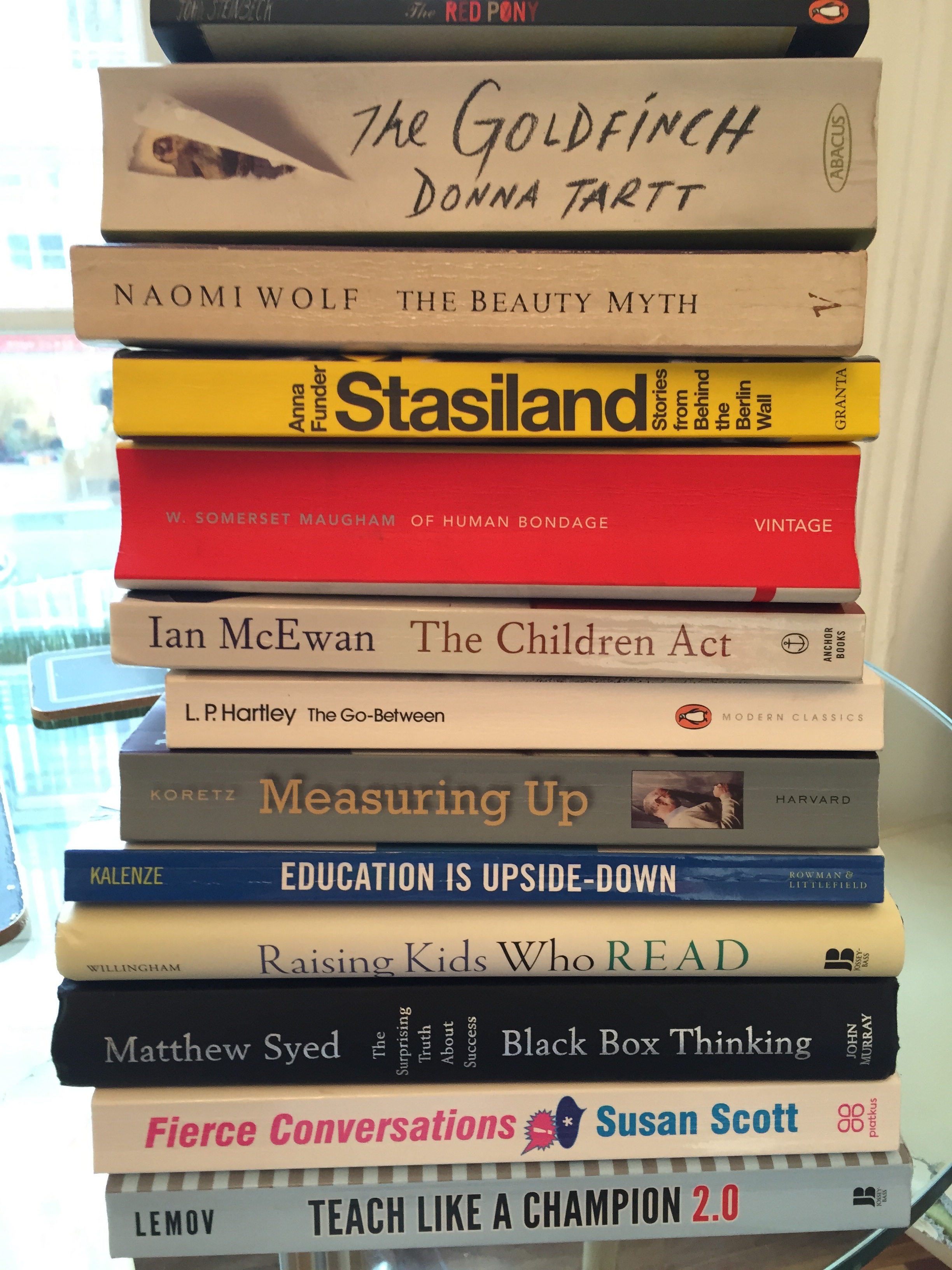
Top reads of 2015

Non-fiction

Naomi Wolf – The Beauty Myth

This book is a scathing attack on the messages the media sends to women about how they should look and act. It made me really angry, in a good way.

Matthew Syed – Black Box Thinking

Syed explains how we learn from failure, and if we don’t, we are idiots. This is great for getting a new perspective on the ‘gift’ of feedback.

Susan Scott – Fierce Conversations

Sarah Donachy, the smartest person I’ve met this year, told me to read this. It really challenged my tendency to be a bit too cuddly rather than having the difficult conversation that is needed, and I’ve revisited it lots.

Irvin Yalom – Love’s Executioner

Joe Kirby told me to read this when I was feeling a bit stewed up. It’s great for giving perspective, and making you realise your emotions are in your control.

Eric Kalenze – Education is Upside Down

Since Research Ed 2015, I haven’t stopped hearing about this book, and it lived up to the hype. A great exploration of why education is set up to make disadvantaged students fail, and what we can do about it.

Anna Funder – Stasiland

I read this in Berlin, and it really brought to life the reality of living in the German Democratic Republic. The injustices suffered in East Berlin and East Germany in general astonished me.

Daniel Willingham – Raising Kids Who Read

Having listened to Katie Ashford, the guru on reading, for 2 full years, this was the year I finally began to grasp the reality of how children read, and this book really helped.

Daniel Koretz – Measuring Up

Daisy Christodoulou recommended this book at Research Ed in 2014, and it explained excellently the flaws in our current assessment model, and a better way forward.

Doug Lemov – TLAC 2.0

The first ‘Teach Like a Champion’ changed my life, and yet Lemov has improved even on this. The only guide a teacher needs for improving their classroom practice.

Fiction

John Steinbeck – The Red Pony

I read this and wept. A wonderful exploration of growing up, told beautifully in Steinbeck’s ever-complex simplicity.

Somerset Maugham – Of Human Bondage

This novel has stayed with me more than any other I’ve read this year. The horribly flawed characters and their ghastly choices felt so real and so close as I read it.

Donna Tartt – The Goldfinch

Unbelievably, even better than ‘The Secret History.’ An astonishing tome of a novel, feeling epic in its scope.

Ian McEwan – The Children Act

This book has one idea, and it explores it in great depth. A searing look at love and relationships.

L.P. Hartley – The Go-Between

My last line-manager recommended this book to me. I adored the narrator’s innocence which was gradually eroded throughout, and the ideas of class and community.

image1

Challenges to a ‘mastery’ curriculum

In my role this term, I’ve been implementing a knowledge-led mastery curriculum across all subjects, following the thoughts of great educationalists like E.D. Hirsch to shape students’ learning around core knowledge to increase their social and cultural capital and ensure they can access the greatest number of choices in their future lives.

So far, the three greatest challenges to implementing this kind of curriculum have been the concerns of SEN and EAL students, along with behaviour.

SEN

My school has a very high percentage of pupil premium students, and it is the peculiar case that students from disadvantaged backgrounds are far more likely to be diagnosed with special educational needs (SEN) than their wealthier peers. Our school certainly has an extensive SEN list.

Now, while I am not an SEN expert, I do tend to the view that, as it seems unlikely that poor children are just predisposed to having special educational needs, there must be something else at play to explain the higher numbers on the SEN registers of schools serving economically deprived communities. Partly, I wonder if this is just one symptom of the wider knowledge and practice gap between our students and their more advantaged peers, diagnosed and labeled to be worked around.

Whatever the root cause, there can be no doubt that there are certain children who take much longer to learn stuff – any stuff. Try to teach all children incredibly rigorous material, and these children in particular will struggle. I don’t think that is an issue – struggle is the very stuff of learning, after all. But there is the inescapable issue of time: if these students will take longer to learn, how to we ensure we allow them the same space to master core content?

One solution is to focus the curriculum offer, giving more time to the key subjects (like humanities, science, English and maths) to ensure these students have time to truly master the key subjects. It is a point of contention at what stage such a focus should take place – is it in the early years of KS3, to drench them in the basics and catch them up, or should they have equal access to all subjects at KS3 and narrow at KS4 in preparation for the exams?

In general, I would advocate focusing sooner, as the latter can tend to lead to students pushed through a clutch of technical qualifications in an attempt to ensure they leave school with something they can use later in life. Too diffuse a subject offer at KS3 for these subjects means some will continue to struggle, and even fail, thus perpetuating a vicious circle of lack of buy-in.

EAL

The second challenge to consider in our school’s particular context is its EAL students. We have a particularly high number of new arrivals, and a phenomenal job is done by the EAL team with these.

But there are students who still really struggle with the basics of communication in English. As one teacher told me, ‘to allow one student to access the lesson, her TA has to look up the words in Portuguese just so she can answer the questions – in Portuguese. What is the point in her learning a nineteenth century novel?’

I have much sympathy with this view. Of course, we would like all our EAL students to miraculously pick up perfect English just by sitting in mainstream lessons, but there might need to be a smarter solution for these students.

It also depends how much time they have before their all-important exams; clearly a student in year 7 can struggle through the year and probably make enormous progress in mainstream lessons, where a new arrival in year 10 or 11 might need alternative curriculum provision to ensure they are not drowning in syntax.

Behaviour

The greatest and widest-ranging challenge to a mastery curriculum is behaviour, because behaviour affects every teacher and every student in a school. If in the past I was guilty of delivering lessons with too much group work and student independent research, this was partly because it was incredibly difficult to deliver to a class that you couldn’t reach silence with. In that circumstance, in my early years as a teacher, I believed it was better to teach them something than to have a complete riot with nothing being learned.

But I know now that I failed those children in many ways. We do not have time to waste – the gap is too large, the stakes too high. These children do not have time for guessing, for card-sorts, for making posters with their friends. They need to read, write, and learn.

Delivering a lesson which is composed of reading, questioning and silent writing is not easy with students who are used to a variety of engaging activities which allow them a quiet word with their friends. A year 11 student only recently reminded me ‘I’m doing the work while I’m talking!’ when challenged, as if to say that as long as their pen was near the paper they were fine to not be 100% engaged with the lesson. (I firmly disagreed with the student, for the record.)

The major concern with implementing a rigorous knowledge curriculum is that the people who deliver it, especially NQTs, teachers who are new to the school or trainee teachers, all run the risk of immense challenge from students who have grown accustomed to lessons which are part learning, part social time.

To be able to deliver effectively to children, for them to really engage with and reflect on the knowledge they are learning, for them to learn enough in a short enough time to close the gap, behaviour must be absolutely impeccable. And if it isn’t, that has to be the number one priority to allow mastery to take place.

At what cost?

I know that what I do works.

I know, albeit from just over five short years of experience, that the way I teach children English works. Students enjoy coming to English. They do what I tell them to do. They interact with ideas. They put up their hands, give responses when prompted, discuss when directed, and smile lots. They make good progress, sometimes excellent, progress.

Before, when I was challenged about my practice, I would probably have said something similar to the above.

Now, I am not so sure this is a valid response. Because there is a second, unsaid and often unconsidered half to this sentence.

I know what I do works… But at what cost?

Marking

I mark every student’s book every week, unless they are ill when I take them in. In addition to this, I mark any essays or assessments students have done, whether for a pre-decided mock exam or assessment point, or simply exam practice. When I made the change from fortnightly marking to weekly marking, I saw a dramatic improvement in my students’ progress.

But at what cost?

I have marked, for the last five years, constantly. I have marked in free periods, before and after school, at home, during the weekend and even on flights. Some might say this is the inescapable fate of the English teacher. Yet now I am on a very light timetable, with very small classes, and my marking load appears undiminished. Although what I do works, would I want it to be replicated by every teacher in my team on a full timetable? Absolutely not. If I were to continue in this way, would I remain in the profession? Absolutely not.

If the cost of student progress is teacher burnout, it cannot be worth it.

Intervention

Last year, as Head of English, I checked student data weekly for exam classes. That is because it was constantly changing, what with redrafted coursework, completed Speaking and Listening exams and constant teacher-assessed mock essays and exams. Using this data, I picked out students and created personalised intervention plans. I would confidently estimate that there is practically no year 11 student who was not in some way “intervened” with.

I have given up before school time, after school time, lunchtime, Saturdays, half-terms and Easters over the years. I have altered entire holidays to fit in with a schedule of revision, to the point of cancelling and re-booking flights.

Our students achieved phenomenal results; only King Solomon Academy achieved better in English the year before last for schools in London with comparable amounts of students receiving free school meals.

But at what cost? If I knew I would have to run intervention in this way until retirement, would I stay in this profession? Absolutely not. Do I want to stop running intervention and instead delegate it to my team, asking them to similarly give up weekends and holidays? Absolutely not.

And what of the students? Tired, stressed, but well-prepared; what happens to these students at sixth form? At university? Learning there will always be “extra” put on for them can’t incentivise them to make the most of lesson time.

If the cost of student progress is complacent students and teacher exhaustion, it cannot be worth it.

All the activities

I used to spend hours lesson planning. I would research existing plans and resources, cross-referencing with other teachers’ and TES resources, and trying to make every lesson an individual snowflake, never repeating the same series of activities. I would ensure there was something for everyone, and plenty of opportunities for students to talk together, research independently, collaborate and postulate together. I would review their “learning” and value the “ideas” they came up with, however ill-founded; however misunderstood.

I have had students carouselling, moving, making, standing, dancing, clapping, acting, advocating, laughing, enjoying and even learning while they did this.

And those students did achieve good results.

But at what cost? How many Cs could have been Bs, Bs As, if I had stopped cramming in activities for the sake of engagement and fun, and started simply telling students what they needed to know, and then testing to make sure they had learned it?

Would I have still been addressing classic misconceptions after 3 years of teaching the same class – no, Shakespeare was not a Victorian; no, that’s not where you put a comma…

With my year 10 intervention class last year I tried something different. Shocked by their lack of knowledge and understanding, their lack of retention, I relentlessly talked to them, got them to write independently and then quizzed them. It was a massive uphill struggle, but that struggle was as much against pre-conceived expectations of what their lessons should look like and the expectations I should have of what they were able to access as it was about changing what they remember. And while I struggled on, students knew more, could explain articulately, and could remember and apply challenging concepts. It was far from perfect, but I haven’t seen better progress previous to employing these methods.

If the cost of student engagement is student learning, it cannot be worth it.


We have a responsibility to students, and a responsibility to ourselves. We must be open to new ideas, to new approaches. The proof is in the results: certain methods lead to increased student achievement, happier teachers and a more workable system of education. Whether what I do works is irrelevant – it must work, be sustainable, and lead to the best possible student results.

So the next time someone dismisses your ideas by telling you “I know that what I do works”, you can bite your tongue and keep doing what you do, reaping the benefits for yourself and your own students, or you can ask: at what cost?

Memory in English

On Saturday 7th November, I was delighted to present at Research Ed Literacy in Swindon. I was speaking about memory, and began by saying this is something I have only recently been concerned with. When Michael Gove some years ago suggested teaching children poetry by heart, I thought this was a terrible idea – what a waste of precious curriculum time! They have so much to learn, why waste time with this? I have, however, completely changed my mind on memory, and not just because of external imperatives – though, of course, closed text exams at GCSE has been the trigger for many of us in starting to prioritise memory.

Memory is important because if nothing has been remembered, nothing has been learned. I have an A grade at Physics GCSE, but if I sat the exam now I would fail completely. Can I really say I know Physics? I don’t think so. I’ve crammed Physics, enough to pass an exam, but I haven’t learned it. 

Cramming is not the name of the game; we are not computers storing endless facts. Instead, our brains collect these seemingly isolated facts and embed them into networks of perceptions, allowing us to have a deeper understanding of the world around us. And these facts, this knowledge, is vital to all we do; in reading comprehension, a knowledge of the subject matter predicts your capacity to comprehend a piece, as Eric Kalenze brilliantly pointed out in his session, with an incomprehensible piece on American football plays.

As Daisy Chrisodoulou points out, though, we often underestimate our knowledge and overestimate students’. She makes the argument that general knowledge is like oxygen: vitally important, but we only notice it when it isn’t there. Furthermore, the more knowledge we have, the more we can get: knowledge loves knowledge; or, knowledge is like Velcro: it sticks to other things.

English has, in the past, been seen as a ‘skills based’ subject; but the idea we can transfer skills across texts with no regard for background knowledge of those texts is only slightly less ridiculous than the idea that if we can analyse a maths problem, we can analyse a cave painting. For a full and enjoyable debunking of the skills argument, I refer you to James Theobald.

Willingham tells us that ‘memory is the residue of thought’: we remember what we think about. Our job as teachers, then, is to ensure students think hard about our subjects. This links to Bjork’s idea of ‘desirable difficulties’: we need to make students think hard, not allow them to sit back and passively let the ideas wash over them, leaving no trace of their existence. But we must be careful with this idea: school is already very hard; students are shunted from subject to subject, having to come to terms with up to six a day; there is no need to surprise students every time they enter our classroom (‘today – nouns! Tomorrow, ‘Oliver Twist’! Thursday, poetry!’) – this is just too difficult. We only need to put something in place that makes students think a little more. Don’t just read a passage, ask a few questions about it that students all have to think about to answer. That’s a desirable difficulty.

How do we build memory? In my initial scripting of the presentation I had written: ‘it’s not just rote learning of dry, meaningless facts.’ But actually, I disagree with my summer self – it sometimes is. In learning a language, I had to learn how to decline nouns, or conjugate verbs, and rote learning of those dry, meaningless facts suddenly became very exciting and meaningful in the schema of learning a language. Once those isolated facts were committed to memory, they could then link up with hundreds of other ideas. We’re keen to skip this stuff as teachers, because we know it isn’t fun; but school isn’t about fun, it’s about learning. And this is how we learn.

Making children remember what you say can take many forms: Willingham says we are attuned to narrative, so we could make our lessons into stories – not too difficult in English, as we deal in stories, but not always easy to make each individual lesson story-like. He also says we remember what prompts emotion, but it’s really difficult to be sure all your children have felt the emotion you intended. Also, what if someone comes in a bit tired, a bit grumpy, or already very emotional? I don’t think emotion or stories are reliable enough to ensure we build students’ memory in the classroom on a day to day basis. What is reliable is quizzing: any teacher can quiz students about key ideas. When I visited Michaela Community School, in every lesson I saw at least 20 minutes of recap: unabashed testing of prior knowledge, from previous days, but also from previous units.

I shared some strategies borrowed from Joe Kirby and Daisy Christodoulou: first knowledge maps, and then multiple choice questions, and explained how these were quick and easy to get recap into lessons on a daily basis.

In building students’ memories in English over the course of their study, I suggested two guiding principles: first, what are the hidden bodies of knowledge in the subject? The things we just know, that we now need to systematically teach to our students? I’d suggest these are grammar, and the literary canon (in a cruel twist of fate, I was scheduled at the same time as Katie Ashford, who has to be the most forward-thinking expert on grammar working in schools right now). We then need to sequence these ideas in the optimal way to help students see the links between them, and build up their knowledge incrementally, building in time for revisiting and interleaving the core concepts we want students to remember in the long term.

If it’s not yet clear, I need to explicitly say that there is not one original idea in what I have said. I’ve read a great many books, contained in the presentation, and a great many blogs, and had a great many conversations; I’ve stuck them together and worked at these in my own context. I’m not the ideas person. Despite this, I am so grateful that so many people came along, and were so engaging and so warm in their interactions.

research-ed

Memory in English

How to Read: TLT15

On 17th October, I travelled to Southampton for my second year presenting at TLT. I was talking about reading (not much new there), and, specifically, how to read. Reading, of course, is at the core of what we do as teachers; and not just as teachers of English. More and more in my new role, I’m coming to see that reading may be the only silver bullet in education: beautiful in its simplicity, obvious in its impact.

The reality is that our strongest readers read the most, and our weakest readers the least: the exact opposite what we need to see to close the gap between our best and worst performing students. This is not only true in their home lives, but also in our classrooms. Anyone who has ever asked for volunteers to read (including: me; guilty as charged) is advantaging those strong readers, and further denying reading from the weakest.

The gap in reading is not just a practice gap: it is also a knowledge gap. When we take our weak readers out of subjects to teach them reading skills, we are denying them that subject-specific knowledge that will enable them to make sense of a wider variety of texts. With the new strengthened GCSEs, students being able to read rigorous subject matter independently is essential.

Of the three stages of reading, decoding, comprehension and fluency, I said the least about decoding, instead pointing people to the awesome Katie Ashford’s blog, where she gives plenty of great advice on how to deal with students who cannot decode. It is clear that too many students slip through the decoding net at primary school, and we at secondary school lack the expertise to bridge that gap. This is evident in my experience in even years 10 and 11; last year I taught a student who would auto-correct unfamiliar words, as she didn’t know how to decode and hadn’t been properly taught phonics. She would autocorrect so many words, she couldn’t then understand the sentence, so for example: ‘Alison leapt up bracingly from her meal’ she might read aloud: ‘Alison led up braking from her meal’, which makes absolutely no sense.

Comprehension entails understanding what is written. Using Willingham’s examples from his excellent book Raising Kids who Read, often reading contains an inference gap: ‘Trisha spilled her coffee. Dan jumped from his chair to fetch a cloth.’ Expert readers automatically see how the first sentence impacts the second; novice readers might see these as two separate and unconnected events.

Interestingly, though, the gap between those from low and high income backgrounds manifests itself after the decoding has been taught, because comprehension, the second stage, is largely predicated on background knowledge, which our economically advantaged students have in abundance (usually from wide background reading). Using Hirsch’s classic ‘Jones sacrificed and knocked in a run,’ I explained that readers with high levels of knowledge on a given topic do better on tests which supposedly only test their reading ‘skill.’

And yet we are still persisting in believing our weak readers simply need more training in generic reading strategies, often withdrawing students from subject lessons to teach reading in isolation, and then wondering why their reading is not improving. In fact, the optimal way to close the reading gap is for students to gain a broad knowledge of subjects across the curriculum.

So clearly, we need to put reading at the heart of our lessons. Yet this is not an easy sell. Citing my own trials of getting students to read aloud (ranging from outright refusals to early tears), I later that evening found there were many out there who considered reading aloud in class to be cruel: (https://twitter.com/JulesDaulby/status/655448338905628672 https://twitter.com/JulesDaulby/status/655437621372547073

https://twitter.com/mustntgrumble/status/655433156099710976

I welcome those challenges to this idea. It is all too easy to do whole class reading badly.

Indeed, it is absolutely vital to consider the emotional impact of such a policy, and the way to make it work in your individual classroom for your children. Running a class where every child reads aloud is difficult, make no mistake about it. It depends on excellent pedagogy and the creation of a warm, safe environment. It requires constant vigilance and tight management. But, crucially, it is possible.

Why read aloud with students, if it is so difficult? First, so we know they can read. I’ve heard of too many teachers at KS4 finding out their students can’t read to not put this top of my list of reasons. Next, so we know they are listening during the lesson – the knowledge you could be asked to read at any time undeniably focuses the mind. Also, reading aloud helps us as teachers to check for understanding, something impossible when students are reading silently at their own pace. But finally, because reading aloud is probably the most enjoyable thing you can do with a class.

One recent example: when year 7 went on their ‘outward bound’ trip, I was the lucky teacher of history with three periods to fill for those ‘left behind.’ A mixed group of around 18 students of vastly differing ability, I didn’t want to press on with the planned lessons, but also didn’t have a bank of ‘rainy day’ history lessons as a first year teacher of this subject. In my desperation, I photocopied about 30 pages of Gombrich’s History of the World (recommended to me in the summer by both Daisy Christodoulou and Jonathan Porter) and threw together some comprehension questions. The first lesson was fine, but I was really concerned about the double: two hours of pure reading and writing. And guess what? It’s probably the best lesson I’ve ever taught. No joke – I wish someone had come to see it. These children were utterly, utterly engaged in a way I’ve seen only rarely, in the most remarkable teachers’ classrooms. They adored the stories, and their curiosity led to a wonderful class discussion and some impressive paragraphs.

It was not always thus. Previously, I would use ‘guided reading,’ where my students read at different paces in groups, thus ensuring no misconceptions could be ironed out, and again advantaging those strong readers. Moreover, I previously did not read aloud well to students, as I have written about here.

So, I was held back by my own low expectations, and it was the children themselves who set me on the right track: they wanted to read, and they seized that moment to show me they could do it.

But how can we do it every lesson? Here, Doug Lemov has the best answer I’ve found with ‘Control the Game.’ I went through each of the components of this: be vague about how much children will be reading, keep the reading duration unpredictable but short at the outset, move swiftly to the next reader with limited words (‘Stacey, pick up’, or, in my class, ‘Stacey’) and take over and model reading of tricky passages. At the start of my time in a new school, I tweaked this: we did snake around the class, for two weeks in fact. What was lost in terms of students checking out and not following in this two weeks was made up for, I think, in that it set the expectation that every child would read in every one of my lessons. For unconfident readers, they got used to this expectation with the predictability. It also gave me two weeks to suss who was going to push back on reading, and deal with them individually. (Interestingly, my year 10 middle ability class proved harder to get reading than my year 11 set 7 class, who frequently bound into my room shouting ‘are we reading today miss?’) Only once the whole class was secure in reading (and only a sentence each time) did I move to selecting students, but even now they are only reading a sentence, though I am moving away from that.

The implications of this kind of teaching are that teachers need to spend their planning thinking more about the questions they will need to ask students to ensure they have understood, along with which vocabulary students will struggle with and how they will gloss those words and check students have learned them.

From the mechanics of reading I moved to the motivation: reading is highly emotional, and I shared methods I’ve written about extensively on this blog in the past to build a reading culture in a school, such as sharing one book, sharing reading lists and delivering reading assemblies.

Once again, I would like to thank my warm and encouraging audience, who indulged me in my anecdotes and engaged with the ideas with gusto. Much love also goes to those who listen and challenge in the room and after: it is only through such thrashing out of the ideas that we come closer to being the best teachers and professionals we can be.

TLT

How to read